




The entire reaction of ${ C }_{ 4 }$ pathway takes place in
(a) Mesophyll and Bundle sheath
(b) Vascular bundle and palisade tissues
(c) Mitochondria and peroxisomes
(d) Bundle sheath and endoplasmic reticulum
Answer
 Verified
646.5k+ views
Hint: ${ C }_{ 4 }$ pathway occurs in plants growing at high temperatures. This leads to the low solubility of carbon dioxide in water and thus its less fixation into glucose. But these plants exhibit an anatomical adaptation to combat this problem.
Complete answer:
${ C }_{ 4 }$ cycle is an alternate process of carbon fixation that has been evolved to minimize photorespiration and increase the efficiency of carbon fixation from whatever level of carbon dioxide is available in the immediate environment. This is named so due to the four-carbon acid ‘oxaloacetate’ being the first stable product.
In the ${ C }_{ 4 }$ cycle, compartmentalization occurs in the form of Kranz anatomy. In kranz anatomy, the mesophyll cells are concentrically arranged around bundle sheath cells. Bundle sheath cells, in turn, surround vascular bundles in a wreath-like manner in one to several layers. Both mesophyll and bundle sheath cells are connected via plasmodesmata or cytoplasmic bridges. All the reactions of ${ C }_{ 4 }$ pathway take place in mesophyll and bundle sheath while ${ C }_{ 3 }$ cycle occurs in bundle sheath cells. Examples of ${ C }_{ 4 }$ plants are Maize, sugarcane, Amaranthus, etc.
This cycle occurs through three basic steps which are as follows:
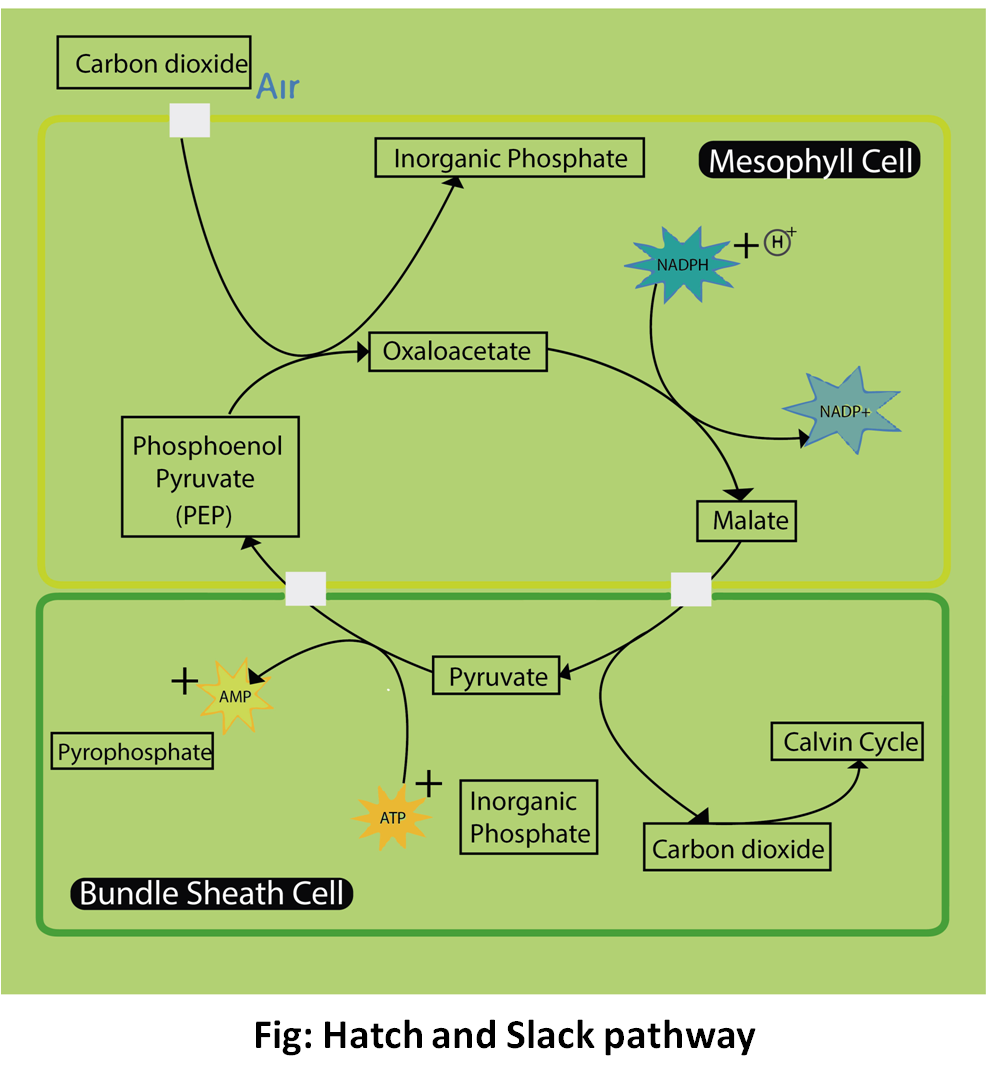
Carboxylation: ${ CO }_{ 2 }$ is accepted by phosphoenolpyruvate and fixed into a four-carbon acid i.e oxaloacetate. This takes place in mesophyll cells. It is converted to malic acid
Diffusion: Transport of the fixed malic acid from mesophyll to bundle sheath cells.
Decarboxylation: ${ CO }_{ 2 }$ and pyruvate is released from malic acid by its decarboxylation. The ${ CO }_{ 2 }$ enters the C3 cycle. It is accepted by RuBisCo and the first step of ${ C }_{ 3 }$ cycle, carboxylation, begins.
Regeneration: Phosphoenolpyruvate is regenerated from the 3-Carbon pyruvate. It is again transported to the mesophyll cells to accept and fix another ${ CO }_{ 2 }$ entering the cell.
So, the correct answer is ‘(a) Mesophyll and Bundle sheath.’
Note:
-RuBisCo has the dual capacity to react with both ${ CO }_{ 2 }$ and${ O }_{ 2 }$. At high temperature, the concentration of ${ CO }_{ 2 }$ decreases and the specificity factor of RuBisCo also decreases. And the plants start undergoing photorespiration where RuBisCo reacts with ${ O }_{ 2 }$ to release ${ CO }_{ 2 }$.
-${ C }_{ 4 }$ plants have evolved to escape photorespiration by concentrating ${ CO }_{ 2 }$ in bundle sheath cells which is the site of carboxylation for ${ C }_{ 3 }$ cycle. This is done to keep the concentration high enough in bundle sheath for RuBisCo to bind ${ CO }_{ 2 }$ rather than ${ O }_{ 2 }$.
Complete answer:
${ C }_{ 4 }$ cycle is an alternate process of carbon fixation that has been evolved to minimize photorespiration and increase the efficiency of carbon fixation from whatever level of carbon dioxide is available in the immediate environment. This is named so due to the four-carbon acid ‘oxaloacetate’ being the first stable product.
In the ${ C }_{ 4 }$ cycle, compartmentalization occurs in the form of Kranz anatomy. In kranz anatomy, the mesophyll cells are concentrically arranged around bundle sheath cells. Bundle sheath cells, in turn, surround vascular bundles in a wreath-like manner in one to several layers. Both mesophyll and bundle sheath cells are connected via plasmodesmata or cytoplasmic bridges. All the reactions of ${ C }_{ 4 }$ pathway take place in mesophyll and bundle sheath while ${ C }_{ 3 }$ cycle occurs in bundle sheath cells. Examples of ${ C }_{ 4 }$ plants are Maize, sugarcane, Amaranthus, etc.
This cycle occurs through three basic steps which are as follows:
Carboxylation: ${ CO }_{ 2 }$ is accepted by phosphoenolpyruvate and fixed into a four-carbon acid i.e oxaloacetate. This takes place in mesophyll cells. It is converted to malic acid
Diffusion: Transport of the fixed malic acid from mesophyll to bundle sheath cells.
Decarboxylation: ${ CO }_{ 2 }$ and pyruvate is released from malic acid by its decarboxylation. The ${ CO }_{ 2 }$ enters the C3 cycle. It is accepted by RuBisCo and the first step of ${ C }_{ 3 }$ cycle, carboxylation, begins.
Regeneration: Phosphoenolpyruvate is regenerated from the 3-Carbon pyruvate. It is again transported to the mesophyll cells to accept and fix another ${ CO }_{ 2 }$ entering the cell.
So, the correct answer is ‘(a) Mesophyll and Bundle sheath.’
Note:
-RuBisCo has the dual capacity to react with both ${ CO }_{ 2 }$ and${ O }_{ 2 }$. At high temperature, the concentration of ${ CO }_{ 2 }$ decreases and the specificity factor of RuBisCo also decreases. And the plants start undergoing photorespiration where RuBisCo reacts with ${ O }_{ 2 }$ to release ${ CO }_{ 2 }$.
-${ C }_{ 4 }$ plants have evolved to escape photorespiration by concentrating ${ CO }_{ 2 }$ in bundle sheath cells which is the site of carboxylation for ${ C }_{ 3 }$ cycle. This is done to keep the concentration high enough in bundle sheath for RuBisCo to bind ${ CO }_{ 2 }$ rather than ${ O }_{ 2 }$.
Recently Updated Pages
Master Class 11 Social Science: Engaging Questions & Answers for Success

Master Class 11 English: Engaging Questions & Answers for Success
Master Class 11 Accountancy: Engaging Questions & Answers for Success
Master Class 11 Physics: Engaging Questions & Answers for Success
Master Class 11 Computer Science: Engaging Questions & Answers for Success
Master Class 11 Business Studies: Engaging Questions & Answers for Success
Trending doubts
Find the value of the expression given below sin 30circ class 11 maths CBSE
One Metric ton is equal to kg A 10000 B 1000 C 100 class 11 physics CBSE
Draw a diagram of nephron and explain its structur class 11 biology CBSE
10 examples of friction in our daily life
Proton was discovered by A Thomson B Rutherford C Chadwick class 11 chemistry CBSE
The teeth used for biting and cutting food are called class 11 biology CBSE