




The end of the spinal cord resembles a
A. Horsetail
B. Butterfly
C. H shape
D. Both B and C
Answer
 Verified
618.6k+ views
Hint:Medulla oblongata comes out from the foramen magnum and continues in the neural canal of the vertebral column, called the spinal cord. It extends from the base of the skull to the lumbar vertebra. The group of the spinal nerve at the terminal end \[({L_1})\] of the spinal cord form a tail-like structure called cauda equina or the horsetail.
Complete answer:
Medulla oblongata comes out from the foramen magnum and continues in the neural canal of the vertebral column, called the spinal cord. It extends from the base of the skull to the lumbar vertebra. Its upper part is wide while the lower part is known as conus-medullaris. The group of the spinal nerve at the terminal end \[({L_1})\] of the spinal cord form a tail-like structure called cauda equina or the horsetail.
The spinal cord is also covered by dura mater, arachnoid, and pia mater. A narrow space is found between vertebrae and dura mater known as epidural space. On the dorsolateral and ventrolateral surface of the spinal cord, the gray matter(butterfly-like) projects outside and forms the one pair dorsal and ventral horn.
The dorsal and ventral horn continues in a tube-like (bundle of nerve fibers) structure known as the dorsal root and the ventral root. Sensory neurons are found in the dorsal root ganglia which are pseudo unipolar and near to intervertebral foramen. Multipolar neurons are found in the ventral root.
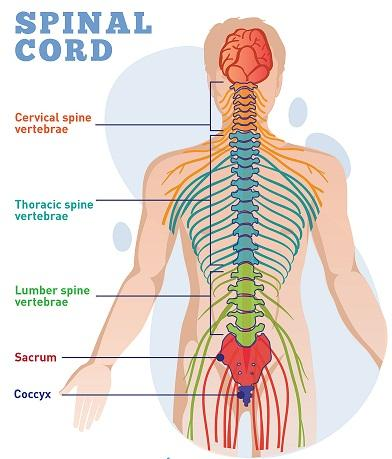
Therefore, the correct answer is option A. Horsetail.
Note:
Functions of the spinal cord:
- It acts as a bridge between the brain and the organs of the body.
- It also provides a relay path for the impulses coming from the brain.
- The spinal cord regulates and conducts the majority of the reflex action.
Complete answer:
Medulla oblongata comes out from the foramen magnum and continues in the neural canal of the vertebral column, called the spinal cord. It extends from the base of the skull to the lumbar vertebra. Its upper part is wide while the lower part is known as conus-medullaris. The group of the spinal nerve at the terminal end \[({L_1})\] of the spinal cord form a tail-like structure called cauda equina or the horsetail.
The spinal cord is also covered by dura mater, arachnoid, and pia mater. A narrow space is found between vertebrae and dura mater known as epidural space. On the dorsolateral and ventrolateral surface of the spinal cord, the gray matter(butterfly-like) projects outside and forms the one pair dorsal and ventral horn.
The dorsal and ventral horn continues in a tube-like (bundle of nerve fibers) structure known as the dorsal root and the ventral root. Sensory neurons are found in the dorsal root ganglia which are pseudo unipolar and near to intervertebral foramen. Multipolar neurons are found in the ventral root.
Therefore, the correct answer is option A. Horsetail.
Note:
Functions of the spinal cord:
- It acts as a bridge between the brain and the organs of the body.
- It also provides a relay path for the impulses coming from the brain.
- The spinal cord regulates and conducts the majority of the reflex action.
Recently Updated Pages
Basicity of sulphurous acid and sulphuric acid are

Master Class 11 English: Engaging Questions & Answers for Success
Master Class 11 Physics: Engaging Questions & Answers for Success
Master Class 11 Computer Science: Engaging Questions & Answers for Success
Master Class 11 Chemistry: Engaging Questions & Answers for Success
Master Class 11 Social Science: Engaging Questions & Answers for Success
Trending doubts
Difference Between Prokaryotic Cells and Eukaryotic Cells
Two of the body parts which do not appear in MRI are class 11 biology CBSE
One Metric ton is equal to kg A 10000 B 1000 C 100 class 11 physics CBSE
10 examples of friction in our daily life
Draw a diagram of nephron and explain its structur class 11 biology CBSE
What will happen if the mucus is not secreted by the class 11 biology CBSE