




The empirical formula for chlorophyll a is
A. ${C_{35}}{H_{72}}{O_5}{N_4}Mg$
B. ${C_{65}}{H_{70}}{O_6}{N_4}Mg$
C. ${C_{55}}{H_{72}}{O_5}{N_4}Mg$
D. ${C_{45}}{H_{70}}{O_6}{N_4}Mg$
Answer
 Verified
599.1k+ views
Hint: Chlorophyll is a green coloured pigment found in the leaves which helps in the photosynthesis. Chlorophyll a and b are the two types of chlorophyll. The structure has a porphyrin ring joined to a phytol ring.
Complete answer:
Photosynthesis is the process in which light energy is transformed into chemical energy. Chlorophyll is the essential pigment which helps in the photosynthesis. It is present in green plants, cyanobacteria etc.
It achieves the energy from sunlight and by this energy carbon dioxide is converted to carbohydrates.
Chlorophyll is enclosed in the thylakoid membrane of chloroplast. Chlorophyll is the derivative of porphyrin with magnesium at the core.
In 1817 Joseph Bienaime and Caventou identified chlorophyll. Formula of chlorophyll is ${C_{55}}{H_{72}}{O_6}{N_4}Mg$.
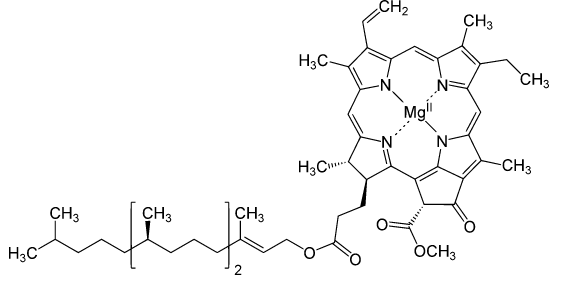
Chlorophyll is vital for photosynthesis and absorbs sunlight and transfers it to other parts of the photosystem. Chlorophylls are of numerous types such as chlorophyll a,b, c and d.
But the most widely distributed form of chlorophyll in plants is chlorophyll due to which plants majorly show green colouration.
Chlorophyll a is insoluble in water and is the primary pigment for the process of photosynthesis. All organisms that perform photosynthesis contain essential chlorophyll a. Chlorophyll a is a specific form which is generally used in oxygenic photosynthesis.
Hence, the correct answer is option (C).
Note: The colours of the leaves is not due to a single pigment but due to four pigments chlorophyll a which gives blue green colour, chlorophyll b which gives yellow green colour, xanthophylls which gave yellow colour and carotenoids which gave yellow to yellow orange colour.
Complete answer:
Photosynthesis is the process in which light energy is transformed into chemical energy. Chlorophyll is the essential pigment which helps in the photosynthesis. It is present in green plants, cyanobacteria etc.
It achieves the energy from sunlight and by this energy carbon dioxide is converted to carbohydrates.
Chlorophyll is enclosed in the thylakoid membrane of chloroplast. Chlorophyll is the derivative of porphyrin with magnesium at the core.
In 1817 Joseph Bienaime and Caventou identified chlorophyll. Formula of chlorophyll is ${C_{55}}{H_{72}}{O_6}{N_4}Mg$.
Chlorophyll is vital for photosynthesis and absorbs sunlight and transfers it to other parts of the photosystem. Chlorophylls are of numerous types such as chlorophyll a,b, c and d.
But the most widely distributed form of chlorophyll in plants is chlorophyll due to which plants majorly show green colouration.
Chlorophyll a is insoluble in water and is the primary pigment for the process of photosynthesis. All organisms that perform photosynthesis contain essential chlorophyll a. Chlorophyll a is a specific form which is generally used in oxygenic photosynthesis.
Hence, the correct answer is option (C).
Note: The colours of the leaves is not due to a single pigment but due to four pigments chlorophyll a which gives blue green colour, chlorophyll b which gives yellow green colour, xanthophylls which gave yellow colour and carotenoids which gave yellow to yellow orange colour.
Recently Updated Pages
Master Class 11 Social Science: Engaging Questions & Answers for Success

Master Class 11 English: Engaging Questions & Answers for Success
Master Class 11 Maths: Engaging Questions & Answers for Success
Master Class 11 Chemistry: Engaging Questions & Answers for Success
Master Class 11 Biology: Engaging Questions & Answers for Success
Class 11 Question and Answer - Your Ultimate Solutions Guide
Trending doubts
One Metric ton is equal to kg A 10000 B 1000 C 100 class 11 physics CBSE
Difference Between Prokaryotic Cells and Eukaryotic Cells
Find the value of the expression given below sin 30circ class 11 maths CBSE
1 ton equals to A 100 kg B 1000 kg C 10 kg D 10000 class 11 physics CBSE
Two of the body parts which do not appear in MRI are class 11 biology CBSE
Draw a diagram of nephron and explain its structur class 11 biology CBSE