




The elements in the fifth row of Pascal triangle is
A) 1, 5, 10, 10, 5, 1
B) 1, 6, 15, 20, 15, 6, 1
C) 1, 4, 6, 4, 1
D) 1, 7, 21, 35, 35, 21, 7, 1
Answer
 Verified
653.7k+ views
Hint: Pascal's triangle determines the coefficients which arise in the binomial expansions.
Pascal’s triangle is the triangular array meaning the arrangement of the binomial coefficient. It is named after the French mathematician Blaise Pascal.
Complete step-by-step answer:
Conventionally the rows of Pascal’s are enumerated starting with the row $n=0$ at the top of the zeroth row. Entries are numbered from the left hand side in each and every row with $k=0$ and generally staggered relative to the numbers in the adjacent rows.
Construction of the triangle –
In top most, zeroth row, there is the unique non-zero number i.e. number one.
Each subsequent entry of the row is constructed by adding the number above and to the left with the number above and to the right, treating blank entries as $0$ (zero)
For example, the initial number in the first row or any other row is $1\text{ (0+1)}$ (the sum of zero and one), while the numbers 1 and 3 in the third row are added to construct the number 4 in the fourth row.
In the Pascal triangle, each entry of the row is the value of the binomial coefficient. So, the simple solution is to construct all row elements up to nth row and add them.
But the approach probably will have O($n^3$) time complexity.
Conversely, it can be optimized up to O($n^2$) time complexity.
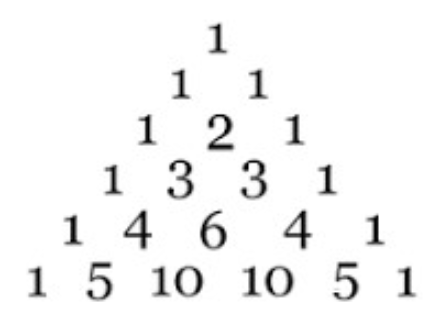
The elements in the fifth row of the Pascal triangle are 1,4,6,4,1.
Note: The sum of the entries in the $n^{th}$ row of Pascal's triangle is the $n^{th}$ power of 2. This is equivalent to the statement that the number of subsets or the cardinality of the power set of an n-element set is that the number of subsets is the sum of the number of combinations of each of the possible lengths, which ranges from zero through to the n.
Pascal’s triangle is the triangular array meaning the arrangement of the binomial coefficient. It is named after the French mathematician Blaise Pascal.
Complete step-by-step answer:
Conventionally the rows of Pascal’s are enumerated starting with the row $n=0$ at the top of the zeroth row. Entries are numbered from the left hand side in each and every row with $k=0$ and generally staggered relative to the numbers in the adjacent rows.
Construction of the triangle –
In top most, zeroth row, there is the unique non-zero number i.e. number one.
Each subsequent entry of the row is constructed by adding the number above and to the left with the number above and to the right, treating blank entries as $0$ (zero)
For example, the initial number in the first row or any other row is $1\text{ (0+1)}$ (the sum of zero and one), while the numbers 1 and 3 in the third row are added to construct the number 4 in the fourth row.
In the Pascal triangle, each entry of the row is the value of the binomial coefficient. So, the simple solution is to construct all row elements up to nth row and add them.
But the approach probably will have O($n^3$) time complexity.
Conversely, it can be optimized up to O($n^2$) time complexity.
The elements in the fifth row of the Pascal triangle are 1,4,6,4,1.
Note: The sum of the entries in the $n^{th}$ row of Pascal's triangle is the $n^{th}$ power of 2. This is equivalent to the statement that the number of subsets or the cardinality of the power set of an n-element set is that the number of subsets is the sum of the number of combinations of each of the possible lengths, which ranges from zero through to the n.
Recently Updated Pages
Differentiate between voluntary action and reflex class 10 biology CBSE

The uses of bleaching powder are A It is used bleaching class 10 chemistry CBSE
Fill in the blanks with abstract nouns of the words class 10 english CBSE
How many threedigit numbers are there class 10 maths CBSE
What is a reflex arc class 10 biology CBSE
Construct a square whose diagonal is 6cm Measure the class 10 maths CBSE
Trending doubts
Explain the Treaty of Vienna of 1815 class 10 social science CBSE
The slogan Jai Hind was given by A Lal Bahadur Shastri class 10 social science CBSE
10 examples of evaporation in daily life with explanations
What is the full form of POSCO class 10 social science CBSE
Identify the feminine form of noun nephew a shenephew class 10 english CBSE
Make a sketch of the human nerve cell What function class 10 biology CBSE