




The electrons present in the outermost shell of an atom are known as:
(A) Protons
(B) Neutrons
(C) Octet
(D) Valence electrons
Answer
 Verified
630.6k+ views
Hint: An atom consists of three basic particles which are protons, electrons, and neutrons. The atom is the smallest particle in which protons and neutrons are present in the center and electrons revolve around it. Electrons revolve around the nucleus in certain definite paths called orbits or shells.
Complete answer:
The structure of an atom is as shown below:
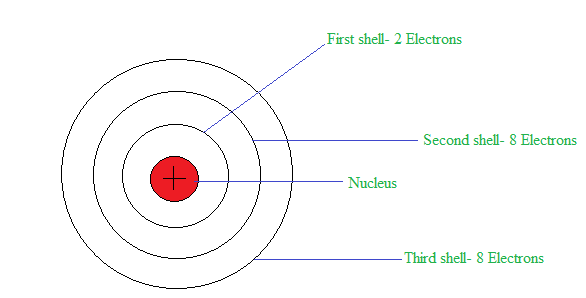
As stated in the Bohr’s model of an atom, electrons travel in a definite circular orbit also known as shells. In addition to this, the last orbit is known as the outermost shell. If the outermost shell is completely filled with electrons then it is a noble gas.
If the outermost shell is partially filled with electrons then it becomes a valence shell. The electrons present in the valence shell are known as valence electrons.
The valence electrons which are present in the outermost shell participate in the compound formation. An atom achieves stability either by donating valence electrons or by accepting extra electrons from another atom. This is done in order to gain the stable configuration or basically to complete the octet.
Thus, the electrons present in the outermost shell of an atom are known as valence electrons.
So, the correct choice is (D).
Note: The atoms don’t achieve stability only by donating or accepting the valence electrons. Sometimes stability is achieved from various types of bonds by sharing the electrons. A chemical bond is basically the force of attraction between any two atoms in a molecule required to maintain stability. These various types of bonds are covalent bond, triple bond, hydrogen bonding, ionic bond, polar covalent bond, metallic bond, etc. In a group there are the same number of electrons in the outermost shell.
Complete answer:
The structure of an atom is as shown below:
As stated in the Bohr’s model of an atom, electrons travel in a definite circular orbit also known as shells. In addition to this, the last orbit is known as the outermost shell. If the outermost shell is completely filled with electrons then it is a noble gas.
If the outermost shell is partially filled with electrons then it becomes a valence shell. The electrons present in the valence shell are known as valence electrons.
The valence electrons which are present in the outermost shell participate in the compound formation. An atom achieves stability either by donating valence electrons or by accepting extra electrons from another atom. This is done in order to gain the stable configuration or basically to complete the octet.
Thus, the electrons present in the outermost shell of an atom are known as valence electrons.
So, the correct choice is (D).
Note: The atoms don’t achieve stability only by donating or accepting the valence electrons. Sometimes stability is achieved from various types of bonds by sharing the electrons. A chemical bond is basically the force of attraction between any two atoms in a molecule required to maintain stability. These various types of bonds are covalent bond, triple bond, hydrogen bonding, ionic bond, polar covalent bond, metallic bond, etc. In a group there are the same number of electrons in the outermost shell.
Recently Updated Pages
If x a + bt + ct2 where x is in meters and t is in class 11 physics CBSE

A car covers the first half distance between two places class 11 physics CBSE
The resultant of two vectors overrightarrow P and overrightarrow class 11 physics CBSE
Find the value of cos 135 class 11 maths CBSE
A mass M is held in place by an applied force F and class 11 physics CBSE
A solution of glucose in water is labelled as 10 dfracwv class 11 chemistry CBSE
Trending doubts
One Metric ton is equal to kg A 10000 B 1000 C 100 class 11 physics CBSE
Find the value of the expression given below sin 30circ class 11 maths CBSE
What do you mean by retardation What is its SI uni class 11 physics CBSE
Draw a diagram of nephron and explain its structur class 11 biology CBSE
10 examples of friction in our daily life
Difference between physical and chemical change class 11 chemistry CBSE