




The electromagnetic waves propagate in the vector parallel to –
\[\begin{align}
& A)\ \overrightarrow{E} \\
& B)\text{ }\overrightarrow{B} \\
& C)\text{ }\overrightarrow{E}\times \overrightarrow{B} \\
& D)\text{ }\overrightarrow{B}\times \overrightarrow{E} \\
\end{align}\]
Answer
 Verified
598.5k+ views
Hint: Electromagnetic waves are produced by the regeneration of the time dependent electric field and magnetic field. The electromagnetic waves are the result of wave propagation produced by the varying electric and magnetic fields, so are all related to each other.
Complete answer:
The electromagnetic waves are a special category of waves, which is different from the other mechanical waves. The mechanical waves involve the oscillation of matter in horizontal or vertical axis, whereas the electromagnetic waves involve the oscillation or an acceleration of charged particles.
The idea that electromagnetic waves can be developed from oscillating electric fields was introduced by James Maxwell. The theory gave a fair chance that both the electric and magnetic fields are inter-convertible. It was later proved by J.C. Bose and H.R. Hertz. Both of them successfully produced electromagnetic waves using a time-varying electric field.
Let us consider the electric and magnetic fields involved in the production of electromagnetic waves.
\[\begin{align}
& \overrightarrow{E}={{E}_{0}}\sin (kz-\omega t)\widehat{i} \\
& \overrightarrow{B}={{B}_{0}}\sin (kz-\omega t)\widehat{j} \\
\end{align}\]
This equation denotes that the electric field is along the x-axis and the magnetic field is along the y-axis, with the wave propagation along the z-axis.
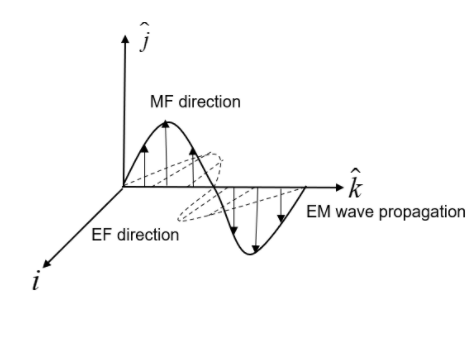
The electromagnetic wave is perpendicular to both the fields, this means that the cross-product of electric and magnetic fields is involved. The propagation of the wave is along the positive z-axis, i.e., \[\text{along }\widehat{k}\].
The direction of electromagnetic wave is along
\[\overrightarrow{E}\times \overrightarrow{B}\]
as,
\[\widehat{k}=\widehat{i}\times \widehat{j}\]
The correct answer is option C.
Note:
- The oscillating or accelerating charged particle produces a time-varying electric field which produces a time-varying magnetic field, this continues throughout the wave propagation and thus electromagnetic waves sustain for long distances as they don’t involve much particle interactions.
- The direction of propagation is dependent on the direction of both electric field and magnetic field.
Complete answer:
The electromagnetic waves are a special category of waves, which is different from the other mechanical waves. The mechanical waves involve the oscillation of matter in horizontal or vertical axis, whereas the electromagnetic waves involve the oscillation or an acceleration of charged particles.
The idea that electromagnetic waves can be developed from oscillating electric fields was introduced by James Maxwell. The theory gave a fair chance that both the electric and magnetic fields are inter-convertible. It was later proved by J.C. Bose and H.R. Hertz. Both of them successfully produced electromagnetic waves using a time-varying electric field.
Let us consider the electric and magnetic fields involved in the production of electromagnetic waves.
\[\begin{align}
& \overrightarrow{E}={{E}_{0}}\sin (kz-\omega t)\widehat{i} \\
& \overrightarrow{B}={{B}_{0}}\sin (kz-\omega t)\widehat{j} \\
\end{align}\]
This equation denotes that the electric field is along the x-axis and the magnetic field is along the y-axis, with the wave propagation along the z-axis.
The electromagnetic wave is perpendicular to both the fields, this means that the cross-product of electric and magnetic fields is involved. The propagation of the wave is along the positive z-axis, i.e., \[\text{along }\widehat{k}\].
The direction of electromagnetic wave is along
\[\overrightarrow{E}\times \overrightarrow{B}\]
as,
\[\widehat{k}=\widehat{i}\times \widehat{j}\]
The correct answer is option C.
Note:
- The oscillating or accelerating charged particle produces a time-varying electric field which produces a time-varying magnetic field, this continues throughout the wave propagation and thus electromagnetic waves sustain for long distances as they don’t involve much particle interactions.
- The direction of propagation is dependent on the direction of both electric field and magnetic field.
Recently Updated Pages
Master Class 11 Social Science: Engaging Questions & Answers for Success

Master Class 11 Physics: Engaging Questions & Answers for Success
Master Class 11 Maths: Engaging Questions & Answers for Success
Master Class 11 Economics: Engaging Questions & Answers for Success
Master Class 11 Computer Science: Engaging Questions & Answers for Success
Master Class 11 Chemistry: Engaging Questions & Answers for Success
Trending doubts
One Metric ton is equal to kg A 10000 B 1000 C 100 class 11 physics CBSE
There are 720 permutations of the digits 1 2 3 4 5 class 11 maths CBSE
1 Quintal is equal to a 110 kg b 10 kg c 100kg d 1000 class 11 physics CBSE
State and prove Bernoullis theorem class 11 physics CBSE
Difference Between Prokaryotic Cells and Eukaryotic Cells
Which among the following are examples of coming together class 11 social science CBSE