




The effective resistance of a circuit containing resistances in a parallel connection is:
${\text{A}}{\text{.}}$ equal to the sum of individual resistances
${\text{B}}{\text{.}}$ smaller than any of the individual resistances
${\text{C}}{\text{.}} $ greater than any of the individual resistances
${\text{D}}{\text{.}}$ sometimes greater and sometimes smaller than the individual resistances
Answer
 Verified
674.1k+ views
Hint: To determine the effective resistance we consider a circuit with resistors in parallel connection having each individual resistance of some variable and then we find the effective resistance of the circuit using the definition of a parallel connection.
Formula Used:
Effective resistance - $\dfrac{1}{{{{\text{R}}_{\text{t}}}}} = \dfrac{1}{{{{\text{R}}_1}}} + \dfrac{1}{{{{\text{R}}_2}}} + \dfrac{1}{{{{\text{R}}_3}}}$
Complete Step-by-Step solution:
A parallel connection is when all the components are connected across each other’s leads. Every component is connected in an individual path, all the individual paths have no more than two sets of electrically common points no matter how many ever components the circuit has.
The current that flows in each path of a parallel connected circuit is not necessarily the same but the sum of currents flowing across each path is equal to the total current that flows from the source.
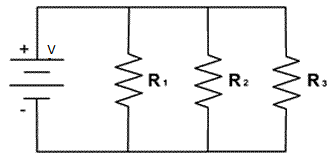
Let us consider a circuit with three different resistances connected in parallel as shown in the figure:
The total resistance of a parallel connection is given by the formula –
$\dfrac{1}{{{{\text{R}}_{\text{t}}}}} = \dfrac{1}{{{{\text{R}}_1}}} + \dfrac{1}{{{{\text{R}}_2}}} + \dfrac{1}{{{{\text{R}}_3}}}$, where ${{\text{R}}_{\text{t}}}$is the effective resistance of the circuit and ${{\text{R}}_1},{{\text{R}}_2}{\text{ and }}{{\text{R}}_3}$ are the individual resistances in the circuit.
Now let us take some random values of ${{\text{R}}_1},{{\text{R}}_2}{\text{ and }}{{\text{R}}_3}$and find the effective resistance to compare it with the individual resistances and find the answer.
Let, ${{\text{R}}_1}$= 2Ω, ${{\text{R}}_2}$= 3Ω and ${{\text{R}}_3}$= 4Ω
Now the effective resistance ${{\text{R}}_{\text{t}}}$is:
$
\Rightarrow \dfrac{1}{{{{\text{R}}_{\text{t}}}}} = \dfrac{1}{{{{\text{R}}_1}}} + \dfrac{1}{{{{\text{R}}_2}}} + \dfrac{1}{{{{\text{R}}_3}}} \\
\Rightarrow \dfrac{1}{{{{\text{R}}_{\text{t}}}}} = \dfrac{1}{2} + \dfrac{1}{3} + \dfrac{1}{4} \\
\Rightarrow \dfrac{1}{{{{\text{R}}_{\text{t}}}}} = \dfrac{{6 + 4 + 3}}{{12}} \\
\Rightarrow \dfrac{1}{{{{\text{R}}_{\text{t}}}}} = \dfrac{{13}}{{12}} \\
\Rightarrow {{\text{R}}_{\text{t}}} = \dfrac{{12}}{{13}} \\
$
On comparing with individual resistances we get, ${{\text{R}}_{\text{t}}} < {{\text{R}}_1},{\text{ }}{{\text{R}}_{\text{t}}} < {{\text{R}}_2}{\text{ and }}{{\text{R}}_{\text{t}}} < {{\text{R}}_3}$. The effective resistance is always less than any of the individual resistances.
Hence Option B is the correct answer.
Note – In order to answer this type of question the key is to know the formula of effective resistance in a parallel connection.
In a parallel connection even if one of the paths broke and is dysfunctional, current keeps flowing in all the remaining paths keeping them functional. This is one of the main reasons circuits are connected in parallel in daily life usage because several components can be independent of each other.
Parallel circuits are used in so many daily life examples like wiring lights in a building/house, use a charger to a mobile or plug anything to a supply etc.
Formula Used:
Effective resistance - $\dfrac{1}{{{{\text{R}}_{\text{t}}}}} = \dfrac{1}{{{{\text{R}}_1}}} + \dfrac{1}{{{{\text{R}}_2}}} + \dfrac{1}{{{{\text{R}}_3}}}$
Complete Step-by-Step solution:
A parallel connection is when all the components are connected across each other’s leads. Every component is connected in an individual path, all the individual paths have no more than two sets of electrically common points no matter how many ever components the circuit has.
The current that flows in each path of a parallel connected circuit is not necessarily the same but the sum of currents flowing across each path is equal to the total current that flows from the source.
Let us consider a circuit with three different resistances connected in parallel as shown in the figure:
The total resistance of a parallel connection is given by the formula –
$\dfrac{1}{{{{\text{R}}_{\text{t}}}}} = \dfrac{1}{{{{\text{R}}_1}}} + \dfrac{1}{{{{\text{R}}_2}}} + \dfrac{1}{{{{\text{R}}_3}}}$, where ${{\text{R}}_{\text{t}}}$is the effective resistance of the circuit and ${{\text{R}}_1},{{\text{R}}_2}{\text{ and }}{{\text{R}}_3}$ are the individual resistances in the circuit.
Now let us take some random values of ${{\text{R}}_1},{{\text{R}}_2}{\text{ and }}{{\text{R}}_3}$and find the effective resistance to compare it with the individual resistances and find the answer.
Let, ${{\text{R}}_1}$= 2Ω, ${{\text{R}}_2}$= 3Ω and ${{\text{R}}_3}$= 4Ω
Now the effective resistance ${{\text{R}}_{\text{t}}}$is:
$
\Rightarrow \dfrac{1}{{{{\text{R}}_{\text{t}}}}} = \dfrac{1}{{{{\text{R}}_1}}} + \dfrac{1}{{{{\text{R}}_2}}} + \dfrac{1}{{{{\text{R}}_3}}} \\
\Rightarrow \dfrac{1}{{{{\text{R}}_{\text{t}}}}} = \dfrac{1}{2} + \dfrac{1}{3} + \dfrac{1}{4} \\
\Rightarrow \dfrac{1}{{{{\text{R}}_{\text{t}}}}} = \dfrac{{6 + 4 + 3}}{{12}} \\
\Rightarrow \dfrac{1}{{{{\text{R}}_{\text{t}}}}} = \dfrac{{13}}{{12}} \\
\Rightarrow {{\text{R}}_{\text{t}}} = \dfrac{{12}}{{13}} \\
$
On comparing with individual resistances we get, ${{\text{R}}_{\text{t}}} < {{\text{R}}_1},{\text{ }}{{\text{R}}_{\text{t}}} < {{\text{R}}_2}{\text{ and }}{{\text{R}}_{\text{t}}} < {{\text{R}}_3}$. The effective resistance is always less than any of the individual resistances.
Hence Option B is the correct answer.
Note – In order to answer this type of question the key is to know the formula of effective resistance in a parallel connection.
In a parallel connection even if one of the paths broke and is dysfunctional, current keeps flowing in all the remaining paths keeping them functional. This is one of the main reasons circuits are connected in parallel in daily life usage because several components can be independent of each other.
Parallel circuits are used in so many daily life examples like wiring lights in a building/house, use a charger to a mobile or plug anything to a supply etc.
Recently Updated Pages
Write any three differences between metals and nonmetals class 10 social science CBSE

Amit standing on a horizontal plane finds a bird flying class 10 maths CBSE
Two circles of radii 5 cm and 3 cm intersect at two class 10 maths CBSE
Solve the following i John and Jivanti together have class 10 maths CBSE
What is the relation between orthocenter circumcentre class 10 maths CBSE
Two plane mirrors are inclined at 70circ A ray incident class 10 physics CBSE
Trending doubts
Explain the Treaty of Vienna of 1815 class 10 social science CBSE
1 GB equals how many MB?
10 examples of evaporation in daily life with explanations
What is the full form of POSCO class 10 social science CBSE
Which is the hottest planet in the Solar system A Earth class 10 social science CBSE
Name any four life processes in living things class 10 biology CBSE