




The edges of the cuboid are 4cm, 5cm and 10cm. What will be the surface area of a cuboid?
\[\begin{align}
& A.210c{{m}^{2}} \\
& B.200c{{m}^{2}} \\
& C.220c{{m}^{2}} \\
& D.\text{None of these} \\
\end{align}\]
Answer
 Verified
600.6k+ views
Hint: In this question, we are given measurements of edges of the cuboid and we have to find its surface area. Since the general shape is given, we will find the total surface area of the cuboid. For this, we will use the formula of total surface area of cuboid which is given as: $\text{Total surface area of cuboid}=2\left( lb+bh+hl \right)$ where, l is length of the cuboid, b is the breadth of cuboid and h is the height of cuboid.
Complete step by step answer:
Here, we are given measurements of the edges of the cuboid as 4cm, 5cm and 10cm. Let us suppose that, length of the cuboid is 10cm, breadth of cuboid is 4cm and height of cuboid is 5cm. So, l = 10cm, b = 4cm and h = 5cm. Diagram of cuboid is given as:
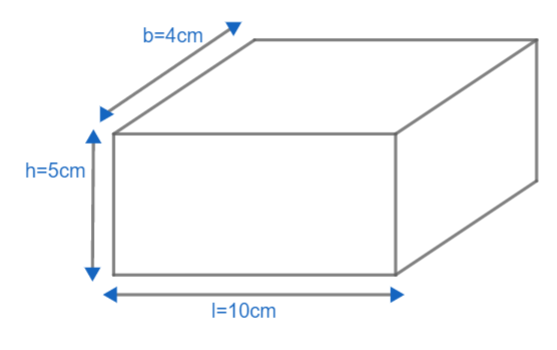
Now we need to find the surface area of the cuboid. Since the general shape is given, we will find the total surface area of the cuboid.
As we know, the total surface area of the cuboid is given by $2\left( lb+bh+hl \right)$ where, l is the length of the cuboid, b is the breadth of the cuboid and h is the height of the cuboid. So, the total surface area of the given cuboid becomes equal to $2\left( 10\times 4+4\times 5+5\times 10 \right)$.
Simplifying it, we get:
\[\begin{align}
& \text{Total surface area of cuboid}=\left( 2\left( 40+20+50 \right) \right)c{{m}^{2}} \\
& \Rightarrow \left( 2\left( 110 \right) \right)c{{m}^{2}} \\
& \Rightarrow 220c{{m}^{2}} \\
\end{align}\]
Hence, the surface area of the given cuboid is $220c{{m}^{2}}$.
We have used $c{{m}^{2}}$ for area because measurements were given in cm.
So, the correct answer is “Option C”.
Note: Students should know how the formula for finding surface area arrives. Since cuboid has six faces and faces are represented by rectangles. So we need to find the area of six rectangles. Opposite faces have equal area so there are 3 pairs of the rectangle. Area of one pair of rectangles will be $2\left( \text{Length}\times \text{breadth} \right)\left( 2lb \right)$. Area of the second pair of rectangles will be $2\left( \text{Length}\times \text{height} \right)\left( 2lh \right)$. Area of the third pair of rectangles will be $2\left( \text{breadth}\times \text{height} \right)\left( 2bh \right)$. So the total surface area will be $\left( 2lb+2bh+2hl \right)\Rightarrow 2\left( lb+bh+hl \right)$. Students should always use units while calculating measurements. Square units should be used for area and cubic units for volume.
Complete step by step answer:
Here, we are given measurements of the edges of the cuboid as 4cm, 5cm and 10cm. Let us suppose that, length of the cuboid is 10cm, breadth of cuboid is 4cm and height of cuboid is 5cm. So, l = 10cm, b = 4cm and h = 5cm. Diagram of cuboid is given as:
Now we need to find the surface area of the cuboid. Since the general shape is given, we will find the total surface area of the cuboid.
As we know, the total surface area of the cuboid is given by $2\left( lb+bh+hl \right)$ where, l is the length of the cuboid, b is the breadth of the cuboid and h is the height of the cuboid. So, the total surface area of the given cuboid becomes equal to $2\left( 10\times 4+4\times 5+5\times 10 \right)$.
Simplifying it, we get:
\[\begin{align}
& \text{Total surface area of cuboid}=\left( 2\left( 40+20+50 \right) \right)c{{m}^{2}} \\
& \Rightarrow \left( 2\left( 110 \right) \right)c{{m}^{2}} \\
& \Rightarrow 220c{{m}^{2}} \\
\end{align}\]
Hence, the surface area of the given cuboid is $220c{{m}^{2}}$.
We have used $c{{m}^{2}}$ for area because measurements were given in cm.
So, the correct answer is “Option C”.
Note: Students should know how the formula for finding surface area arrives. Since cuboid has six faces and faces are represented by rectangles. So we need to find the area of six rectangles. Opposite faces have equal area so there are 3 pairs of the rectangle. Area of one pair of rectangles will be $2\left( \text{Length}\times \text{breadth} \right)\left( 2lb \right)$. Area of the second pair of rectangles will be $2\left( \text{Length}\times \text{height} \right)\left( 2lh \right)$. Area of the third pair of rectangles will be $2\left( \text{breadth}\times \text{height} \right)\left( 2bh \right)$. So the total surface area will be $\left( 2lb+2bh+2hl \right)\Rightarrow 2\left( lb+bh+hl \right)$. Students should always use units while calculating measurements. Square units should be used for area and cubic units for volume.
Recently Updated Pages
Master Class 12 Business Studies: Engaging Questions & Answers for Success

Master Class 12 Biology: Engaging Questions & Answers for Success
Master Class 12 Chemistry: Engaging Questions & Answers for Success
Class 12 Question and Answer - Your Ultimate Solutions Guide
Master Class 11 Social Science: Engaging Questions & Answers for Success
Master Class 11 English: Engaging Questions & Answers for Success
Trending doubts
Explain the Treaty of Vienna of 1815 class 10 social science CBSE
Which Indian city is known as the "City of Victory"?
Which instrument is used to measure the Blood Pressure?
Who Won 36 Oscar Awards? Record Holder Revealed
What is the median of the first 10 natural numbers class 10 maths CBSE
Why is it 530 pm in india when it is 1200 afternoon class 10 social science CBSE