




The eclipse occurs when the Earth, sun and moon form –
A) An isosceles triangle
B) A straight line
C) Any random position
D) A right-angled triangle
Answer
 Verified
608.1k+ views
Hint: We need to explain what an eclipse is and the reasons for an eclipse to find the solution for this problem. The type of eclipse also determines the position of different celestial bodies in the space with respect to earth. We can easily find the solution for this.
Complete answer:
The eclipse is a natural phenomenon occurring by the specific positions of the earth, sun and moon in the space with respect to each other. It occurs periodically as the speed of revolution of the earth and the moon are almost constant throughout ages.
The eclipse is the phenomenon in which one of the two – the sun or the moon is blocked from view from the earth. The two types of eclipse are the solar eclipse and the lunar eclipse.
The solar eclipse is the phenomenon in which the sunlight is blocked by the moon to reach the earth. For that to be possible, the moon should be in between the path of light from sun to earth. As the light travels in straight through space, the sun, moon and the earth fall in the same line during the solar eclipse as shown below.
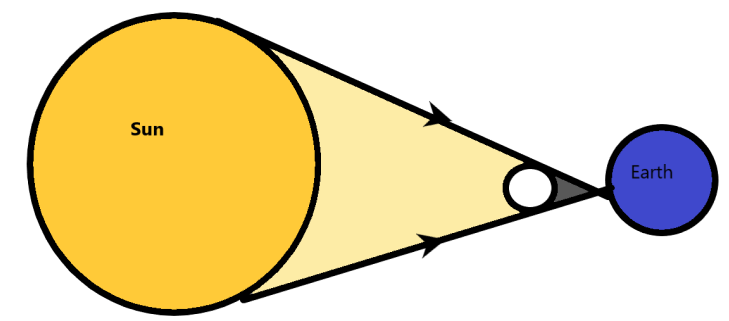
The lunar eclipse occurs when the earth blocks the sunlight from falling on the moon. This results in a dark moon even on a full moon day. In this case, the earth comes between the sun and the moon, all the three forming a straight line as shown below.
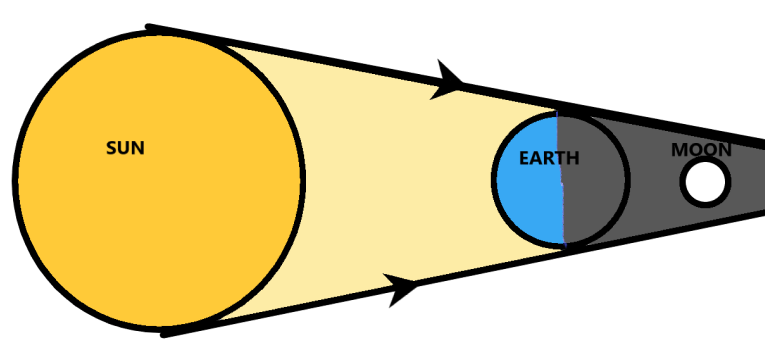
The eclipse occurs when the sun, earth and the moon form a straight line.
The correct answer is option B.
Note:
The solar eclipses and lunar eclipses are meant to take place many times in a year. But the probability of a proper alignment and that too from the side of earth in which we live coincides very rarely, so they are considered rare or special natural phenomena.
Complete answer:
The eclipse is a natural phenomenon occurring by the specific positions of the earth, sun and moon in the space with respect to each other. It occurs periodically as the speed of revolution of the earth and the moon are almost constant throughout ages.
The eclipse is the phenomenon in which one of the two – the sun or the moon is blocked from view from the earth. The two types of eclipse are the solar eclipse and the lunar eclipse.
The solar eclipse is the phenomenon in which the sunlight is blocked by the moon to reach the earth. For that to be possible, the moon should be in between the path of light from sun to earth. As the light travels in straight through space, the sun, moon and the earth fall in the same line during the solar eclipse as shown below.
The lunar eclipse occurs when the earth blocks the sunlight from falling on the moon. This results in a dark moon even on a full moon day. In this case, the earth comes between the sun and the moon, all the three forming a straight line as shown below.
The eclipse occurs when the sun, earth and the moon form a straight line.
The correct answer is option B.
Note:
The solar eclipses and lunar eclipses are meant to take place many times in a year. But the probability of a proper alignment and that too from the side of earth in which we live coincides very rarely, so they are considered rare or special natural phenomena.
Recently Updated Pages
Master Class 12 Economics: Engaging Questions & Answers for Success

Master Class 12 English: Engaging Questions & Answers for Success
Master Class 12 Social Science: Engaging Questions & Answers for Success
Master Class 12 Maths: Engaging Questions & Answers for Success
Master Class 12 Physics: Engaging Questions & Answers for Success
Master Class 11 Social Science: Engaging Questions & Answers for Success
Trending doubts
One Metric ton is equal to kg A 10000 B 1000 C 100 class 11 physics CBSE
Difference Between Prokaryotic Cells and Eukaryotic Cells
Find the value of the expression given below sin 30circ class 11 maths CBSE
Two of the body parts which do not appear in MRI are class 11 biology CBSE
Draw a diagram of nephron and explain its structur class 11 biology CBSE
10 examples of friction in our daily life