




The distance-time graph of a body is a straight line inclined to the time axis. The body is in
A. Uniform motion
B. Uniformly accelerated motion
C. Uniformly retarded motion
D. Rest position
Answer
 Verified
607.5k+ views
Hint: For the body in the uniform motion, the acceleration of the body should be zero. Use the formula for average velocity to express the velocity of the body. The slope of the distance-time graph represents the average velocity of the body.
Complete step by step solution:
We have given that the distance-time graph of a body is inclined to the time axis. Therefore, we can draw the distance-time graph as shown in the figure below.
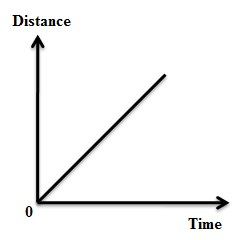
From the above graph, the slope of the line is,
\[\dfrac{{{x_2} - {x_1}}}{{{t_2} - {t_1}}} = \dfrac{{\Delta x}}{{\Delta t}}\]
From the above graph, we can say that the slope is constant since the line is a straight line passing through the origin.
We know that the body is said to be in the uniform motion, if the acceleration of the body is zero.
We have, the average velocity of the body is,
\[{v_{avg}} = \dfrac{{{x_2} - {x_1}}}{{{t_2} - {t_1}}}\]
Here, \[{x_2}\] is the final position,\[{x_1}\] is the initial position of the body and t represents time.
We have seen that the term on the right hand side is the slope of the line and it is constant, therefore, the velocity of the body is also constant. Since the velocity is constant, the body has zero acceleration. Therefore, we can say that the body has uniform motion.
So, the correct answer is option (A).
The acceleration of the body shown in the above distance-time graph is zero. Therefore, the body cannot have uniformly accelerated motion. Thus, the option (B) is incorrect.
The acceleration of the body shown in the above distance-time graph is zero. Therefore, the body cannot have uniformly retarded motion. Thus, the option (C) is incorrect.
We know that for a body in rest position, the distance-time graph does not incline to the time axis rather than overlap on the time axis. Therefore, the option (D) is incorrect.
So, the correct answer is “Option A”.
Note:
In the formula for average velocity, \[{t_2} - {t_1}\] is not the difference in the time but it is the total elapsed time. If you have given the velocity-time graph, then for uniform motion of the body, the graph will be parallel to the time axis.
Complete step by step solution:
We have given that the distance-time graph of a body is inclined to the time axis. Therefore, we can draw the distance-time graph as shown in the figure below.
From the above graph, the slope of the line is,
\[\dfrac{{{x_2} - {x_1}}}{{{t_2} - {t_1}}} = \dfrac{{\Delta x}}{{\Delta t}}\]
From the above graph, we can say that the slope is constant since the line is a straight line passing through the origin.
We know that the body is said to be in the uniform motion, if the acceleration of the body is zero.
We have, the average velocity of the body is,
\[{v_{avg}} = \dfrac{{{x_2} - {x_1}}}{{{t_2} - {t_1}}}\]
Here, \[{x_2}\] is the final position,\[{x_1}\] is the initial position of the body and t represents time.
We have seen that the term on the right hand side is the slope of the line and it is constant, therefore, the velocity of the body is also constant. Since the velocity is constant, the body has zero acceleration. Therefore, we can say that the body has uniform motion.
So, the correct answer is option (A).
The acceleration of the body shown in the above distance-time graph is zero. Therefore, the body cannot have uniformly accelerated motion. Thus, the option (B) is incorrect.
The acceleration of the body shown in the above distance-time graph is zero. Therefore, the body cannot have uniformly retarded motion. Thus, the option (C) is incorrect.
We know that for a body in rest position, the distance-time graph does not incline to the time axis rather than overlap on the time axis. Therefore, the option (D) is incorrect.
So, the correct answer is “Option A”.
Note:
In the formula for average velocity, \[{t_2} - {t_1}\] is not the difference in the time but it is the total elapsed time. If you have given the velocity-time graph, then for uniform motion of the body, the graph will be parallel to the time axis.
Recently Updated Pages
Master Class 12 Economics: Engaging Questions & Answers for Success

Master Class 12 English: Engaging Questions & Answers for Success
Master Class 12 Social Science: Engaging Questions & Answers for Success
Master Class 12 Maths: Engaging Questions & Answers for Success
Master Class 12 Physics: Engaging Questions & Answers for Success
Master Class 11 Social Science: Engaging Questions & Answers for Success
Trending doubts
One Metric ton is equal to kg A 10000 B 1000 C 100 class 11 physics CBSE
Difference Between Prokaryotic Cells and Eukaryotic Cells
Two of the body parts which do not appear in MRI are class 11 biology CBSE
1 ton equals to A 100 kg B 1000 kg C 10 kg D 10000 class 11 physics CBSE
Draw a diagram of nephron and explain its structur class 11 biology CBSE
10 examples of friction in our daily life