




The diploid (2n) number of chromosome for humans is
A. 22
B. 23
C. 44
D. 46
Answer
 Verified
596.1k+ views
Hint: Chromosome is the dense nuclear material that has the power of self-duplication and is found in the living cell. It contains the hereditary unit of genes, which carry all biological information important for an organism.
Complete step-by-step answer:
The chromosomes are the dense that is found in the cell especially within the nucleus, which can be detected using karyotyping. It is an intranuclear, fibrous or rod-shaped and made up of DNA and protein. In each species, there are a definite number of chromosome while the sex chromosome varies in male and female of same species. The somatic cell of sexually reproducing organisms has two sets of chromosomes and they are known as diploid (2n) while in reproductive cells only one set of the chromosome is found and it is known as haploid (n).
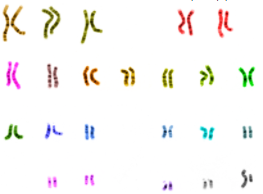
The significance of the chromosomes is that it carries all the genetic information from the parents to the offspring. As it is a nuclear material, it can control all the biological and physiological activity of a cell and organisms. The synthesis of RNA is also done by the chromosome and it plays an important role in the determination of the sex. In humans, there are 46 numbers of chromosomes present, the 23 sets of chromosomes come from the father and the other 23 sets of chromosomes come from the mother.
So, the correct answer is option D, 46.
Note: The size of chromosomes changes in different organisms. In the metaphase stage, the small chromosome is found in fungus and bird is about 0.25 micrometre while the large chromosome is found in Trillium plant which is 30 micrometres long. The chromosome may be very giant and it is known as a giant chromosome which is found in the salivary gland of the dipteran larva.
Complete step-by-step answer:
The chromosomes are the dense that is found in the cell especially within the nucleus, which can be detected using karyotyping. It is an intranuclear, fibrous or rod-shaped and made up of DNA and protein. In each species, there are a definite number of chromosome while the sex chromosome varies in male and female of same species. The somatic cell of sexually reproducing organisms has two sets of chromosomes and they are known as diploid (2n) while in reproductive cells only one set of the chromosome is found and it is known as haploid (n).
The significance of the chromosomes is that it carries all the genetic information from the parents to the offspring. As it is a nuclear material, it can control all the biological and physiological activity of a cell and organisms. The synthesis of RNA is also done by the chromosome and it plays an important role in the determination of the sex. In humans, there are 46 numbers of chromosomes present, the 23 sets of chromosomes come from the father and the other 23 sets of chromosomes come from the mother.
So, the correct answer is option D, 46.
Note: The size of chromosomes changes in different organisms. In the metaphase stage, the small chromosome is found in fungus and bird is about 0.25 micrometre while the large chromosome is found in Trillium plant which is 30 micrometres long. The chromosome may be very giant and it is known as a giant chromosome which is found in the salivary gland of the dipteran larva.
Recently Updated Pages
Master Class 11 Social Science: Engaging Questions & Answers for Success

Master Class 11 Physics: Engaging Questions & Answers for Success
Master Class 11 Maths: Engaging Questions & Answers for Success
Master Class 11 Economics: Engaging Questions & Answers for Success
Master Class 11 Computer Science: Engaging Questions & Answers for Success
Master Class 11 Chemistry: Engaging Questions & Answers for Success
Trending doubts
One Metric ton is equal to kg A 10000 B 1000 C 100 class 11 physics CBSE
There are 720 permutations of the digits 1 2 3 4 5 class 11 maths CBSE
1 Quintal is equal to a 110 kg b 10 kg c 100kg d 1000 class 11 physics CBSE
State and prove Bernoullis theorem class 11 physics CBSE
Difference Between Prokaryotic Cells and Eukaryotic Cells
Which among the following are examples of coming together class 11 social science CBSE