




The difference between the radii of the largest and the smallest circles which have their centers on the circumference of the circles \[{x^2} + {y^2} + {\rm{2}}x + {\rm{4}}y - {\rm{4}} = {\rm{0}}\] and pass through the points $\left( {a,b} \right)$ lying outside the circle is
(A). 3
(B). 6
(C). 5
(D). None of these
Answer
 Verified
636k+ views
Hint: Consider point \[\left( {{\rm{a}},{\rm{b}}} \right)\] as P and Q be the nearest point on the circumference of the circle to point P. Then the farthest will be just opposite to point Q, let’s say R so the distance between them will be the difference between radii of largest and smallest circle.
Complete step-by-step solution -
In the question we are asked to find out the difference between the radii of the largest and the smallest circles which have their centers on the circumference of the circle ${x^2} + {y^2} + {\rm{2}}x + {\rm{4}}y - {\rm{4}} = {\rm{0}}$ and also passes through the point \[\left( {{\rm{a}},{\rm{ b}}} \right)\] lying outside the given circle.
The equation of the given circle is ${x^2} + {y^2} + {\rm{2}}x + {\rm{4}}y - {\rm{4}} = {\rm{0}}$
We will first write it in form of ${\left( {x - {x_1}} \right)^2} + {\left( {y - {y_1}} \right)^2}{\rm{ = }}{{\rm{r}}^2}$ where center is \[\left( {{{\rm{x}}_{\rm{1}}},{\rm{ }}{{\rm{y}}_{\rm{1}}}} \right)\]and radius is r.
So we can rewrite the equation of circle as,
\[{x^2} + {\rm{2}}x + 1 + {y^2} + {\rm{4}}y + 4 - 1 - 4 - 4 = {\rm{0}}\]
Or, \[{\left( {x + 1} \right)^2} + {\left( {y + 2} \right)^2} = 9 = {3^2}\]
So the center of the circle is \[\left( { - {\rm{1}}, - {\rm{2}}} \right)\] and radius is 3.
So let’s say that the point \[\left( {{\rm{a}},{\rm{b}}} \right)\]as P. We will represent it as,
Here we assumed R be the farthest point from the given point P and Q be the nearest point from the point P. In the figure P is placed in \[{{\rm{1}}^{{\rm{st}}}}\] quadrant which is not necessary.
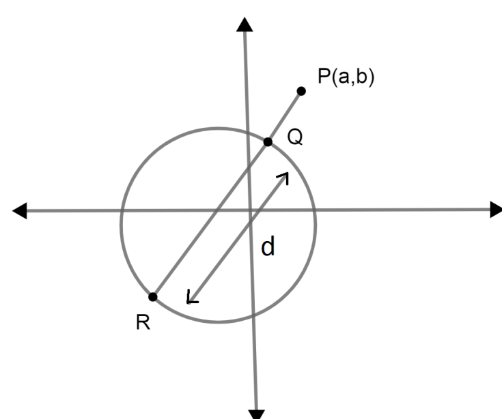
Here d is the distance between Q and R and also the diameter of the circle.
If Q is the nearest point from P then according to that R will be the farthest as R and Q will farthest only when they are extremities of the diameter of the circle.
So, Q R forms as the diameter of the circle.
Then the smallest circle will be formed by taking Q as center which should be passing through \[{\rm{P}}\left( {{\rm{a}},{\rm{ b}}} \right)\] and the largest circle will be formed by taking R as center which should be passing through P.
So the distance between their radii will be the difference between \[{\rm{PR}}-{\rm{PQ}}\]=$\text{QR}$ or QR means the diameter of the circle. As the radius of the circle is 3cm then its diameter will be \[{\rm{2}} \times {\rm{3cm}}\] or 6cm.
So the correct option is ‘B’.
Note: If two points are considered on the circumference of a circle then the max distance between them will be obtained when they are at the extremes of the diameter.
Complete step-by-step solution -
In the question we are asked to find out the difference between the radii of the largest and the smallest circles which have their centers on the circumference of the circle ${x^2} + {y^2} + {\rm{2}}x + {\rm{4}}y - {\rm{4}} = {\rm{0}}$ and also passes through the point \[\left( {{\rm{a}},{\rm{ b}}} \right)\] lying outside the given circle.
The equation of the given circle is ${x^2} + {y^2} + {\rm{2}}x + {\rm{4}}y - {\rm{4}} = {\rm{0}}$
We will first write it in form of ${\left( {x - {x_1}} \right)^2} + {\left( {y - {y_1}} \right)^2}{\rm{ = }}{{\rm{r}}^2}$ where center is \[\left( {{{\rm{x}}_{\rm{1}}},{\rm{ }}{{\rm{y}}_{\rm{1}}}} \right)\]and radius is r.
So we can rewrite the equation of circle as,
\[{x^2} + {\rm{2}}x + 1 + {y^2} + {\rm{4}}y + 4 - 1 - 4 - 4 = {\rm{0}}\]
Or, \[{\left( {x + 1} \right)^2} + {\left( {y + 2} \right)^2} = 9 = {3^2}\]
So the center of the circle is \[\left( { - {\rm{1}}, - {\rm{2}}} \right)\] and radius is 3.
So let’s say that the point \[\left( {{\rm{a}},{\rm{b}}} \right)\]as P. We will represent it as,
Here we assumed R be the farthest point from the given point P and Q be the nearest point from the point P. In the figure P is placed in \[{{\rm{1}}^{{\rm{st}}}}\] quadrant which is not necessary.
Here d is the distance between Q and R and also the diameter of the circle.
If Q is the nearest point from P then according to that R will be the farthest as R and Q will farthest only when they are extremities of the diameter of the circle.
So, Q R forms as the diameter of the circle.
Then the smallest circle will be formed by taking Q as center which should be passing through \[{\rm{P}}\left( {{\rm{a}},{\rm{ b}}} \right)\] and the largest circle will be formed by taking R as center which should be passing through P.
So the distance between their radii will be the difference between \[{\rm{PR}}-{\rm{PQ}}\]=$\text{QR}$ or QR means the diameter of the circle. As the radius of the circle is 3cm then its diameter will be \[{\rm{2}} \times {\rm{3cm}}\] or 6cm.
So the correct option is ‘B’.
Note: If two points are considered on the circumference of a circle then the max distance between them will be obtained when they are at the extremes of the diameter.
Recently Updated Pages
Master Class 12 Economics: Engaging Questions & Answers for Success

Master Class 12 English: Engaging Questions & Answers for Success
Master Class 12 Social Science: Engaging Questions & Answers for Success
Master Class 12 Maths: Engaging Questions & Answers for Success
Master Class 12 Physics: Engaging Questions & Answers for Success
Master Class 10 English: Engaging Questions & Answers for Success
Trending doubts
Explain the Treaty of Vienna of 1815 class 10 social science CBSE
Why is it 530 pm in india when it is 1200 afternoon class 10 social science CBSE
What is the full form of POSCO class 10 social science CBSE
Define Potential, Developed, Stock and Reserved resources
The speaker of the Lok Sabha is elected by the APresident class 10 social science CBSE
Complete the sentence with the most appropriate word class 10 english CBSE