




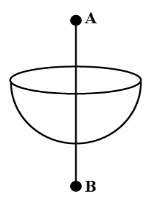
The diagram shows a uniformly charged hemisphere of radius $R$. It has volume charge density $ρ$. If the electric field at a point $2R$ distance above its center is $E$ then what is the electric field at the point which is $2R$ below its center?
A. $\dfrac{{\rho R}}{{6{\varepsilon _o}}} + E$
B. $\dfrac{{\rho R}}{{12{\varepsilon _o}}} - E$
C. $ - \dfrac{{\rho R}}{{6{\varepsilon _o}}} + E$
D. $\dfrac{{\rho R}}{{24{\varepsilon _o}}} + E$
Answer
 Verified
524.7k+ views
Hint: The electric force per unit charge is known as the electric field. The force that the field will apply on a positive test charge is assumed to be in the same direction as the field's direction. A positive charge's electric field is radially outward, and a negative charge's field is radially inward.
Complete step by step answer:
Permittivity is a proportionality constant that connects the electric field in a substance to its electric displacement. It describes the tendency of an insulating material's atomic charge to deform in the presence of an electric field. Gauss' law can be used to calculate the electric field of a sphere with uniform charge density and cumulative charge $Q$. The electric field has the same magnitude at any point of a Gaussian surface in the shape of a sphere with radius $r > R$ and is directed outward.
$E = \dfrac{Q}{{4\pi {\varepsilon _0}{r^2}}}$
Let's finish the sphere. The electric field produced by the lower part at A is equal to the electric field generated by the upper part at B=E. (given) At B, the electric field due to the lower part equals the electric field due to the entire sphere minus the electric field due to the upper part.
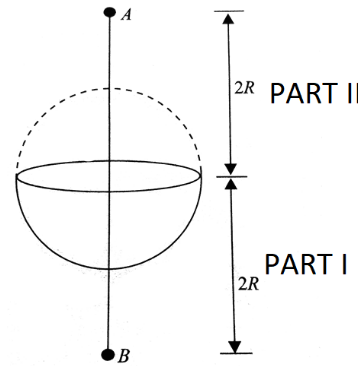
${\text{ Net field due to part }}I{\text{ and }}II{\text{ at }}A = \dfrac{{NQ}}{{{{(2R)}^2}}}$
$\Rightarrow {{\text{ Net field due to part }}I{\text{ and }}II{\text{ at }}A= \dfrac{{{\text{kQ}}}}{{{{(2{\text{R}})}^2}}} - {\text{E}}} \\
\Rightarrow {{\text{ Net field due to part }}I{\text{ and }}II{\text{ at }}A = \dfrac{1}{{4\pi {\varepsilon _0}}}\dfrac{{\rho \left( {4/3\pi {{\text{R}}^3}} \right)}}{{4{{\text{R}}^2}}} - {\text{E}}} \\
\therefore {{\text{ Net field due to part }}I{\text{ and }}II{\text{ at }}A = \dfrac{{\rho {\text{R}}}}{{12{\varepsilon _0}}} - {\text{E}}} \\ $
Hence option B is correct.
Note: The energy contained in an electric field is linked to the electric permittivity. Since it concerns the amount of charge that must be levied on a capacitor to obtain a certain net electric field, it is used in the capacitance phrase. It takes more charge to obtain a given net electric field in the presence of a polarizable medium, and the effect of the medium is often expressed in terms of relative permittivity.
Complete step by step answer:
Permittivity is a proportionality constant that connects the electric field in a substance to its electric displacement. It describes the tendency of an insulating material's atomic charge to deform in the presence of an electric field. Gauss' law can be used to calculate the electric field of a sphere with uniform charge density and cumulative charge $Q$. The electric field has the same magnitude at any point of a Gaussian surface in the shape of a sphere with radius $r > R$ and is directed outward.
$E = \dfrac{Q}{{4\pi {\varepsilon _0}{r^2}}}$
Let's finish the sphere. The electric field produced by the lower part at A is equal to the electric field generated by the upper part at B=E. (given) At B, the electric field due to the lower part equals the electric field due to the entire sphere minus the electric field due to the upper part.
${\text{ Net field due to part }}I{\text{ and }}II{\text{ at }}A = \dfrac{{NQ}}{{{{(2R)}^2}}}$
$\Rightarrow {{\text{ Net field due to part }}I{\text{ and }}II{\text{ at }}A= \dfrac{{{\text{kQ}}}}{{{{(2{\text{R}})}^2}}} - {\text{E}}} \\
\Rightarrow {{\text{ Net field due to part }}I{\text{ and }}II{\text{ at }}A = \dfrac{1}{{4\pi {\varepsilon _0}}}\dfrac{{\rho \left( {4/3\pi {{\text{R}}^3}} \right)}}{{4{{\text{R}}^2}}} - {\text{E}}} \\
\therefore {{\text{ Net field due to part }}I{\text{ and }}II{\text{ at }}A = \dfrac{{\rho {\text{R}}}}{{12{\varepsilon _0}}} - {\text{E}}} \\ $
Hence option B is correct.
Note: The energy contained in an electric field is linked to the electric permittivity. Since it concerns the amount of charge that must be levied on a capacitor to obtain a certain net electric field, it is used in the capacitance phrase. It takes more charge to obtain a given net electric field in the presence of a polarizable medium, and the effect of the medium is often expressed in terms of relative permittivity.
Recently Updated Pages
Basicity of sulphurous acid and sulphuric acid are

Master Class 12 English: Engaging Questions & Answers for Success
Master Class 12 Social Science: Engaging Questions & Answers for Success
Master Class 12 Maths: Engaging Questions & Answers for Success
Master Class 12 Economics: Engaging Questions & Answers for Success
Master Class 12 Physics: Engaging Questions & Answers for Success
Trending doubts
Which are the Top 10 Largest Countries of the World?
Draw a labelled sketch of the human eye class 12 physics CBSE
Draw ray diagrams each showing i myopic eye and ii class 12 physics CBSE
Give 10 examples of unisexual and bisexual flowers
Give simple chemical tests to distinguish between the class 12 chemistry CBSE
Define Vant Hoff factor How is it related to the degree class 12 chemistry CBSE