




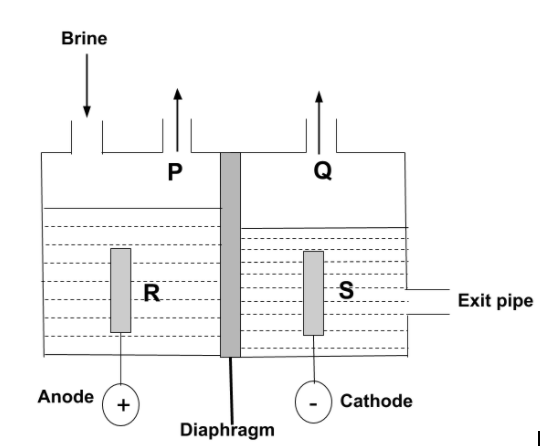
The diagram shows a diaphragm cell used for the electrolysis of brine. Brine is concentrated aqueous sodium chloride. A solution of sodium chlorate (I) which is commonly used as bleach, can be made by mixing which of the two substances?
A.P and R
B.P and S
C.Q and R
D.Q and S
Answer
 Verified
626.1k+ views
Hint:The chemical formula for sodium chlorate is $NaCl{O_3}$ which can be formed by the reaction between chloride and sodium hydroxide. Brine is a high concentration solution of sodium chloride salt in the water.
Complete step by step answer:
-The high concentration solution of salt sodium chloride $NaCl$ in water, ${H_2}O$ is called Brine. Lower levels of concentration can be called by other names: saline water, freshwater and brackish water.
-Sodium chlorate is the white crystalline powder which is readily soluble in water and is the inorganic compound with the molecular formula, $NaCl{O_3}$ .
-Now, according to the question, the electrolysis of brine is carried out. So, we have to find which substances are used for the formation of sodium chlorate, $NaCl{O_3}$. In this electrolysis, the diaphragm cell process is used in which there are two compartments separated by permeable diaphragm which is generally made of asbestos fibers. Brine is introduced into the anode and flows into the cathode compartment.
-The chloride ion is negatively charged, so it can get attracted towards positively charged anode. So, P can be $C{l_2}$ , whereas sodium ions and hydrogen ions from the water are positively charged so, they get attracted towards negative cathode, then, the dilute solution of sodium hydroxide is produced at cathode, so, S can be $NaOH$. Hence, the reaction is –
$6NaOH + 3C{l_2}\xrightarrow[{}]{}NaC{l_3} + 5NaCl + 3{H_2}O$
-Therefore, the sodium chlorate solution can be made by mixing P and S.
Hence, the correct option is (B).
Note:
When the electrolysis of aqueous $NaCl$ is carried out we have to take water into equation. Water can be oxidized and reduced both and it competes with the dissolved $N{a^ + }$ and $C{l^ - }$ ions. This produces hydrogen instead of producing sodium.
Complete step by step answer:
-The high concentration solution of salt sodium chloride $NaCl$ in water, ${H_2}O$ is called Brine. Lower levels of concentration can be called by other names: saline water, freshwater and brackish water.
-Sodium chlorate is the white crystalline powder which is readily soluble in water and is the inorganic compound with the molecular formula, $NaCl{O_3}$ .
-Now, according to the question, the electrolysis of brine is carried out. So, we have to find which substances are used for the formation of sodium chlorate, $NaCl{O_3}$. In this electrolysis, the diaphragm cell process is used in which there are two compartments separated by permeable diaphragm which is generally made of asbestos fibers. Brine is introduced into the anode and flows into the cathode compartment.
-The chloride ion is negatively charged, so it can get attracted towards positively charged anode. So, P can be $C{l_2}$ , whereas sodium ions and hydrogen ions from the water are positively charged so, they get attracted towards negative cathode, then, the dilute solution of sodium hydroxide is produced at cathode, so, S can be $NaOH$. Hence, the reaction is –
$6NaOH + 3C{l_2}\xrightarrow[{}]{}NaC{l_3} + 5NaCl + 3{H_2}O$
-Therefore, the sodium chlorate solution can be made by mixing P and S.
Hence, the correct option is (B).
Note:
When the electrolysis of aqueous $NaCl$ is carried out we have to take water into equation. Water can be oxidized and reduced both and it competes with the dissolved $N{a^ + }$ and $C{l^ - }$ ions. This produces hydrogen instead of producing sodium.
Recently Updated Pages
Basicity of sulphurous acid and sulphuric acid are

Master Class 11 English: Engaging Questions & Answers for Success
Master Class 11 Physics: Engaging Questions & Answers for Success
Master Class 11 Computer Science: Engaging Questions & Answers for Success
Master Class 11 Chemistry: Engaging Questions & Answers for Success
Master Class 11 Social Science: Engaging Questions & Answers for Success
Trending doubts
Difference Between Prokaryotic Cells and Eukaryotic Cells
Two of the body parts which do not appear in MRI are class 11 biology CBSE
One Metric ton is equal to kg A 10000 B 1000 C 100 class 11 physics CBSE
10 examples of friction in our daily life
Draw a diagram of nephron and explain its structur class 11 biology CBSE
What will happen if the mucus is not secreted by the class 11 biology CBSE