




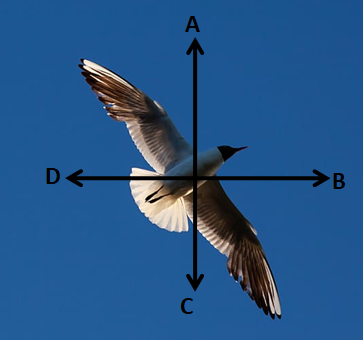
The diagram shows a bird in flight. The bird is flying in the horizontal direction to the right. In which direction does the air resistance act on the bird?
Answer
 Verified
481.8k+ views
Hint: Air resistance always tries to resist the motion of the bird. Just like friction which acts in a direction opposite to the direction of motion, air resistance on the flying body works. The birds overcome the constraints by flapping their wings.
Complete step by step answer:
In the question. It is given that the bird is flying horizontally towards the right.
The air resistance works like the frictional force. We know that frictional force always tries to stop the motion of an object. It acts towards the opposite direction of that of the object.
Similarly, the air resistance acts in a direction opposite to its direction of motion to slow down or to stop the motion of a bird. Therefore we can say the air resistance will work horizontally towards the left to continue its nature to be opposite to the direction of motion of the bird.
The answer has been illustrated by the diagram below.
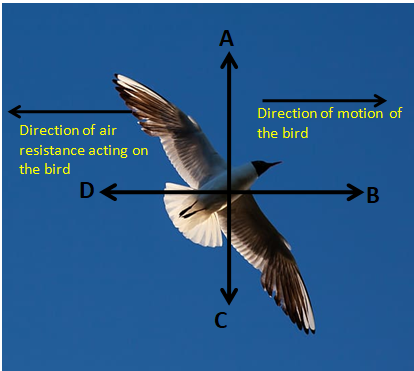
The arrow in the blue color shows the direction in which the bird is flying and the arrow in red color shows the direction of air resistance.
The direction of the air resistance is toward (D).
Note:
Lift opposes gravity. But it must have occurred strong enough to combat weight. The wing-flapping works here by forcing air to glide over the interlocking barbules of a feather. Birds can decrease the value of lift generated by reshaping their wings downward, called a negative dihedral.
Complete step by step answer:
In the question. It is given that the bird is flying horizontally towards the right.
The air resistance works like the frictional force. We know that frictional force always tries to stop the motion of an object. It acts towards the opposite direction of that of the object.
Similarly, the air resistance acts in a direction opposite to its direction of motion to slow down or to stop the motion of a bird. Therefore we can say the air resistance will work horizontally towards the left to continue its nature to be opposite to the direction of motion of the bird.
The answer has been illustrated by the diagram below.
The arrow in the blue color shows the direction in which the bird is flying and the arrow in red color shows the direction of air resistance.
The direction of the air resistance is toward (D).
Note:
Lift opposes gravity. But it must have occurred strong enough to combat weight. The wing-flapping works here by forcing air to glide over the interlocking barbules of a feather. Birds can decrease the value of lift generated by reshaping their wings downward, called a negative dihedral.
Recently Updated Pages
Understanding the Sun's Density: Exploring the Mass Density of a Hot Plasma - FAQs and Data Analysis

The magnetic field in a plane electromagnetic wave class 11 physics CBSE
The branch of science which deals with nature and natural class 10 physics CBSE
Where is the Centre for Environmental Education Located?
How is Abiogenesis Theory Disproved Experimentally?
Which country won UEFA Euro 2020 tournament (played in 2021)?
Trending doubts
One Metric ton is equal to kg A 10000 B 1000 C 100 class 11 physics CBSE
What are the examples of C3 and C4 plants class 11 biology CBSE
What is charge mass and charge to mass ratio of an class 11 chemistry CBSE
State and prove Bernoullis theorem class 11 physics CBSE
Difference Between Prokaryotic Cells and Eukaryotic Cells
1 ton equals to A 100 kg B 1000 kg C 10 kg D 10000 class 11 physics CBSE