




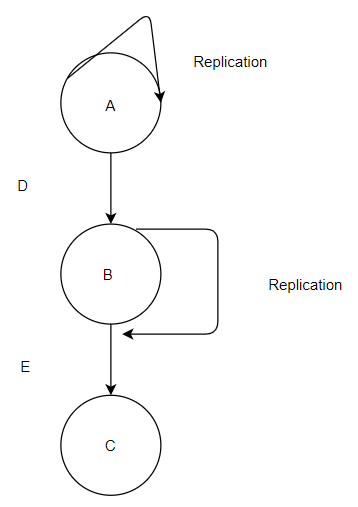
The diagram represents the ‘central dogma’ of molecular biology. Choose the correct combination of labeling.
(A) A- protein, B- RNA, C-DNA, D- translation, E- transcription
(B) A- RNA, B- DNA, C- protein, D- transcription, E- translation
(C) A- transcription, B- translation, C- protein, D- DNA, E- RNA
(D) A-DNA, B-RNA, C-protein, D- translation, E- translation
(E) A-DNA, B-RNA, C-protein, D- transcription, E- translation
Answer
 Verified
602.7k+ views
Hint: Central dogma clearly explains the hereditary information flow in the biological system. All the cells follow this central dogma for the flow of the genetic information in the body. It mainly takes place in the three processes as replication, transcription and translation.
Complete Answer:
- Central dogma refers to the way of the stream of hereditary material. This central dogma was proposed by the Crick.
- It consists of the three significant cycles, the first cycle deals with the duplicating of parental DNA to frame a daughter DNA particles with indistinguishable nucleotide successions called as replication. The second process in the central dogma is the transcription.
- Transcription is the process in which the hereditary data encoded in DNA are replicated absolutely into RNA.
- The last advanced process is the interpretation or the translation, whereby the hereditary data encoded in mRNA is converted back into a polypeptide/protein with a specific grouping of amino acids. enzyme. Hence the central dogma involves the following process as A- DNA, B-RNA, C-protein, D- transcription, E- translation.
Thus the option (E) is correct.
Note: The transcription is the process in which the DNA is converted into mRNA and it takes place with the help of RNA polymerase enzyme. The exceptions in the central dogma are reverse transcription and the prion disease. Due to these exceptions the central dogma changes.
Complete Answer:
- Central dogma refers to the way of the stream of hereditary material. This central dogma was proposed by the Crick.
- It consists of the three significant cycles, the first cycle deals with the duplicating of parental DNA to frame a daughter DNA particles with indistinguishable nucleotide successions called as replication. The second process in the central dogma is the transcription.
- Transcription is the process in which the hereditary data encoded in DNA are replicated absolutely into RNA.
- The last advanced process is the interpretation or the translation, whereby the hereditary data encoded in mRNA is converted back into a polypeptide/protein with a specific grouping of amino acids. enzyme. Hence the central dogma involves the following process as A- DNA, B-RNA, C-protein, D- transcription, E- translation.
Thus the option (E) is correct.
Note: The transcription is the process in which the DNA is converted into mRNA and it takes place with the help of RNA polymerase enzyme. The exceptions in the central dogma are reverse transcription and the prion disease. Due to these exceptions the central dogma changes.
Recently Updated Pages
Master Class 12 Business Studies: Engaging Questions & Answers for Success

Master Class 12 Chemistry: Engaging Questions & Answers for Success
Master Class 12 Biology: Engaging Questions & Answers for Success
Class 12 Question and Answer - Your Ultimate Solutions Guide
Master Class 11 Social Science: Engaging Questions & Answers for Success
Master Class 11 Chemistry: Engaging Questions & Answers for Success
Trending doubts
Which are the Top 10 Largest Countries of the World?
Draw a labelled sketch of the human eye class 12 physics CBSE
Name the crygenes that control cotton bollworm and class 12 biology CBSE
Differentiate between homogeneous and heterogeneous class 12 chemistry CBSE
Ribosomal RNA is actively synthesised in A Nucleoplasm class 12 biology CBSE
How many molecules of ATP and NADPH are required information class 12 biology CBSE