




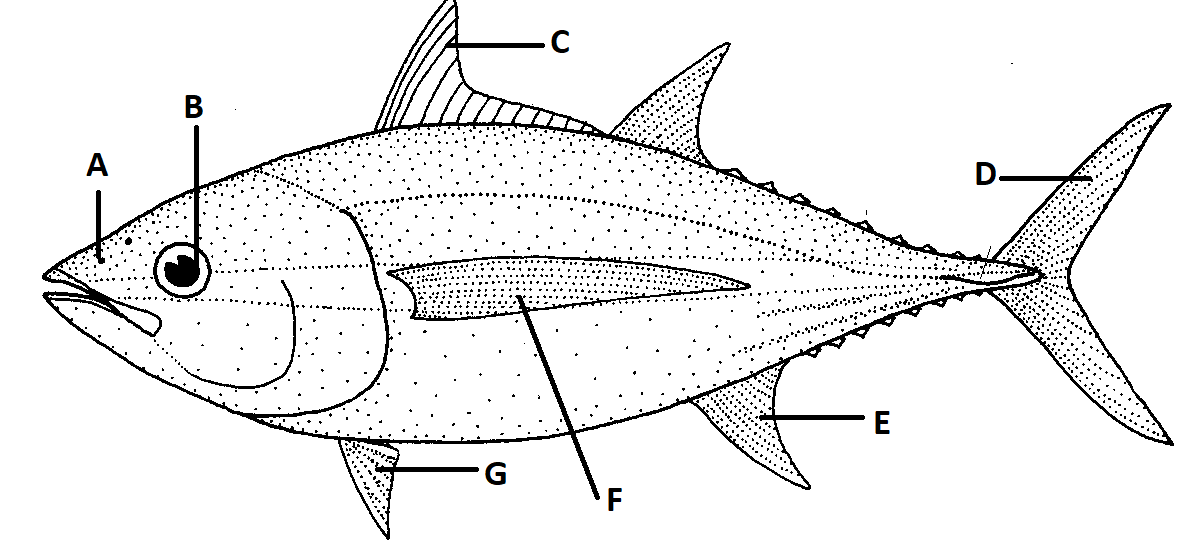
The diagram of Labeo rohita is given below. Identify the parts labelled as A. B. C. D. E. F. G respectively.
A. A- Stimulus. B - Receptor nerve. C - Sensory nerve. D - Motor. E - Effector nerve. F - Pectoral fin. G - Pelvic fin
B. A - Nostril. B - Eye. C - Anal fin. D - Caudal fin. E - Dorsal fin. F - Pectoral fin. G - Pelvic fin
C. A- Nostril. B - Eye. C - Dorsal fin. D- Caudal fin. E - Anal fin. F - Pelvic fin. G - Pectoral fin
D. A - Nostril. B - Eye. C - Dorsal fin. D - Caudal fin. E - Pectoral fin. F - Anal fin. G - Pelvic fin
Answer
 Verified
522.9k+ views
Hint: The carp-like roho labeo can be found in rivers throughout South Asia. It's a huge omnivore with a lot of uses in aquaculture. The rohu can be found in rivers all over northern, central, and eastern India.
Complete answer:
-The operculum is the cover that protects the fish's mouth, nose, and gills.
-The fish's nose is A, and the fish's eye is B.
-Fins consist of stiff rays or scales that are coated in skin. It aids the fish in swimming. Fins such as dorsal, caudal, and lateral fins are seen on the fish. The dorsal fin is the side fin of a fish that offers stability while swimming. The caudal fin, also known as the tail fin, is the main propulsive fin and is located near the back of the animal. This fin aids in shifting swimming directions.
-The dorsal fin is C, and the caudal fin is D.
-Fins are often used as foils to provide lift or push, or to steer or stabilise motion while travelling in water, air, or other fluids. Fins can also be utilised to improve surface areas for heat transmission or as decorative elements. Fins evolved as a mechanism of propulsion for fish.
-Another form of fin that helps with swimming stability is the anal fin. The anal fin is denoted by the letter E.
-The anal fin is present on the ventral side of fish, usually at the base of the anus, but not always. The anal fin, like the dorsal fin, serves to support the fish and prevent it from rolling around in the water.
-The pectoral fins aid in propulsion and movement from side to side. The letter G stands for pectoral fin.
As a result, option C is the proper response.
Note: Rohita labeo Rohu, also known as Carpo fish, contains a significant amount of protein. Omega 3 fatty acids, as well as vitamins A, B, and C, are abundant. At least once a week, you should eat Rohu.
Complete answer:
-The operculum is the cover that protects the fish's mouth, nose, and gills.
-The fish's nose is A, and the fish's eye is B.
-Fins consist of stiff rays or scales that are coated in skin. It aids the fish in swimming. Fins such as dorsal, caudal, and lateral fins are seen on the fish. The dorsal fin is the side fin of a fish that offers stability while swimming. The caudal fin, also known as the tail fin, is the main propulsive fin and is located near the back of the animal. This fin aids in shifting swimming directions.
-The dorsal fin is C, and the caudal fin is D.
-Fins are often used as foils to provide lift or push, or to steer or stabilise motion while travelling in water, air, or other fluids. Fins can also be utilised to improve surface areas for heat transmission or as decorative elements. Fins evolved as a mechanism of propulsion for fish.
-Another form of fin that helps with swimming stability is the anal fin. The anal fin is denoted by the letter E.
-The anal fin is present on the ventral side of fish, usually at the base of the anus, but not always. The anal fin, like the dorsal fin, serves to support the fish and prevent it from rolling around in the water.
-The pectoral fins aid in propulsion and movement from side to side. The letter G stands for pectoral fin.
As a result, option C is the proper response.
Note: Rohita labeo Rohu, also known as Carpo fish, contains a significant amount of protein. Omega 3 fatty acids, as well as vitamins A, B, and C, are abundant. At least once a week, you should eat Rohu.
Recently Updated Pages
Master Class 11 Social Science: Engaging Questions & Answers for Success

Master Class 11 Physics: Engaging Questions & Answers for Success
Master Class 11 Maths: Engaging Questions & Answers for Success
Master Class 11 Economics: Engaging Questions & Answers for Success
Master Class 11 Computer Science: Engaging Questions & Answers for Success
Master Class 11 Chemistry: Engaging Questions & Answers for Success
Trending doubts
One Metric ton is equal to kg A 10000 B 1000 C 100 class 11 physics CBSE
There are 720 permutations of the digits 1 2 3 4 5 class 11 maths CBSE
1 Quintal is equal to a 110 kg b 10 kg c 100kg d 1000 class 11 physics CBSE
State and prove Bernoullis theorem class 11 physics CBSE
Difference Between Prokaryotic Cells and Eukaryotic Cells
Which among the following are examples of coming together class 11 social science CBSE