




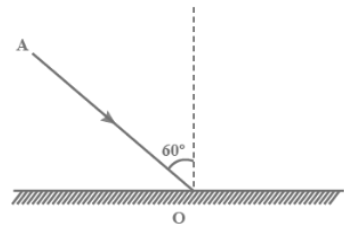
The diagram in fig. shows an incident ray AO and the normal ON on a plane mirror.Draw the reflected ray. State the law you use to draw the direction of the reflected ray.
Answer
 Verified
533.7k+ views
Hint: At an interface between two separate media, reflection is the change in direction of a wavefront such that it returns to the medium from which it came. Light, tone, and water waves are all examples of reflection.
Complete answer:
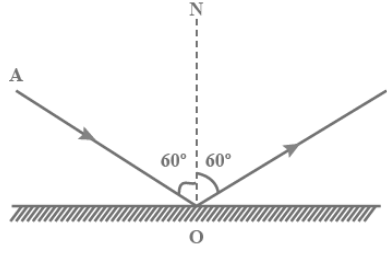
The angle of the reflected ray is equal to the angle of the incident ray as reflected from a smooth surface with respect to the natural surface, which is a line perpendicular to the surface at the point of contact, according to the law of reflection. At the point of touch of the incident ray, the reflected ray is always in the plane defined by the incident ray and the normal to the surface.
The law of reflection can be used to explain the images created by planes and curved mirrors. The law of reflection states that when light rays strike a smooth surface, the angle of reflection equals the angle of incidence, and that the incident ray, reflected ray, and normal to the surface are all in the same plane. Reflection of light is the process of light rays colliding with a surface and being reflected back.
This form of reflection is generated by plane mirrors with a smooth surface. The picture is transparent and easily recognisable in this situation. Plane mirror images are still simulated, which means they can't be collected on a computer. The law of light reflection is used to determine the path of the reflecting beam. The angle of incidence equals the angle of reflection, according to this theorem.
$\angle {\mathbf{i}} = \angle {\mathbf{r}}$
Note: Unlike mirrors, most natural surfaces are rugged on the scale of light wavelengths, and as a result, parallel incident light rays are mirrored irregularly or diffusely in several different directions. As a result, diffuse illumination aids in object recognition and is responsible for the ability to see most illuminated surfaces from any angle.
Complete answer:
The angle of the reflected ray is equal to the angle of the incident ray as reflected from a smooth surface with respect to the natural surface, which is a line perpendicular to the surface at the point of contact, according to the law of reflection. At the point of touch of the incident ray, the reflected ray is always in the plane defined by the incident ray and the normal to the surface.
The law of reflection can be used to explain the images created by planes and curved mirrors. The law of reflection states that when light rays strike a smooth surface, the angle of reflection equals the angle of incidence, and that the incident ray, reflected ray, and normal to the surface are all in the same plane. Reflection of light is the process of light rays colliding with a surface and being reflected back.
This form of reflection is generated by plane mirrors with a smooth surface. The picture is transparent and easily recognisable in this situation. Plane mirror images are still simulated, which means they can't be collected on a computer. The law of light reflection is used to determine the path of the reflecting beam. The angle of incidence equals the angle of reflection, according to this theorem.
$\angle {\mathbf{i}} = \angle {\mathbf{r}}$
Note: Unlike mirrors, most natural surfaces are rugged on the scale of light wavelengths, and as a result, parallel incident light rays are mirrored irregularly or diffusely in several different directions. As a result, diffuse illumination aids in object recognition and is responsible for the ability to see most illuminated surfaces from any angle.
Recently Updated Pages
Master Class 11 Social Science: Engaging Questions & Answers for Success

Master Class 11 Physics: Engaging Questions & Answers for Success
Master Class 11 Maths: Engaging Questions & Answers for Success
Master Class 11 Economics: Engaging Questions & Answers for Success
Master Class 11 Computer Science: Engaging Questions & Answers for Success
Master Class 11 Chemistry: Engaging Questions & Answers for Success
Trending doubts
One Metric ton is equal to kg A 10000 B 1000 C 100 class 11 physics CBSE
There are 720 permutations of the digits 1 2 3 4 5 class 11 maths CBSE
1 Quintal is equal to a 110 kg b 10 kg c 100kg d 1000 class 11 physics CBSE
State and prove Bernoullis theorem class 11 physics CBSE
Difference Between Prokaryotic Cells and Eukaryotic Cells
Which among the following are examples of coming together class 11 social science CBSE