




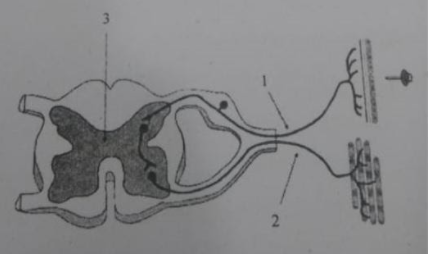
The diagram given shows the internal structure of a spinal cord depicting a phenomenon. Study the diagram and answer the question.
Name the phenomenon that is depicted in the diagram. Define the phenomenon.
Answer
 Verified
621k+ views
Hint:Reflex action is an automated reaction to a stimulus, which isn't always under our control. For example, sneezing, blinking of eyes, coughing, etc.
Complete answer:
The given diagram depicts the phenomenon of reflex action. It is an involuntary and instantaneous motion in response to a stimulus. This phenomenon takes place with the assist of reflex arc. It acts on an impulse earlier than that impulse reaches the brain. It includes a sensory nerve and a motor nerve with a synapse between. The stimulus stimulates the ache receptors of the skin, which provoke an impulse in a sensory neuron. These travel to the spinal cord, in which it passes, by using a synapse, to a connecting neuron referred to as the relay neuron located withinside the spinal cord.The relay neuron, in turn, makes a synapse with one or greater motor neurons that transmit the impulse to the muscle groups to provoke a reaction.Reflexes do now no longer require the involvement of the brain.
Additional information
A reflex is an involuntary motor reaction to a sensory stimulus. Reflexes carry out many roles for our important frightened system. They shield us from danger, they assist us flow our body, they assist us see, etc.
Note: Reflex action is an involuntary and almost on the spot motion in reaction to a stimulus. It is a conduct wherein a stimulus conjures up a reaction without regarding the brain.
Complete answer:
The given diagram depicts the phenomenon of reflex action. It is an involuntary and instantaneous motion in response to a stimulus. This phenomenon takes place with the assist of reflex arc. It acts on an impulse earlier than that impulse reaches the brain. It includes a sensory nerve and a motor nerve with a synapse between. The stimulus stimulates the ache receptors of the skin, which provoke an impulse in a sensory neuron. These travel to the spinal cord, in which it passes, by using a synapse, to a connecting neuron referred to as the relay neuron located withinside the spinal cord.The relay neuron, in turn, makes a synapse with one or greater motor neurons that transmit the impulse to the muscle groups to provoke a reaction.Reflexes do now no longer require the involvement of the brain.
Additional information
A reflex is an involuntary motor reaction to a sensory stimulus. Reflexes carry out many roles for our important frightened system. They shield us from danger, they assist us flow our body, they assist us see, etc.
Note: Reflex action is an involuntary and almost on the spot motion in reaction to a stimulus. It is a conduct wherein a stimulus conjures up a reaction without regarding the brain.
Recently Updated Pages
Master Class 12 Economics: Engaging Questions & Answers for Success

Master Class 12 English: Engaging Questions & Answers for Success
Master Class 12 Social Science: Engaging Questions & Answers for Success
Master Class 12 Maths: Engaging Questions & Answers for Success
Master Class 12 Physics: Engaging Questions & Answers for Success
Master Class 11 Social Science: Engaging Questions & Answers for Success
Trending doubts
One Metric ton is equal to kg A 10000 B 1000 C 100 class 11 physics CBSE
Difference Between Prokaryotic Cells and Eukaryotic Cells
Two of the body parts which do not appear in MRI are class 11 biology CBSE
1 ton equals to A 100 kg B 1000 kg C 10 kg D 10000 class 11 physics CBSE
Draw a diagram of nephron and explain its structur class 11 biology CBSE
10 examples of friction in our daily life