




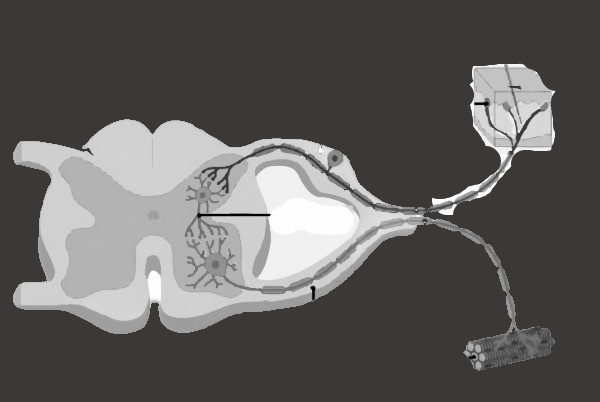
The diagram given below shows the internal structure of the spinal cord, depicting a phenomenon. Study the diagram and answer the questions. Name the phenomena which are depicted in the diagram. Define the phenomena.
Answer
 Verified
634.5k+ views
Hint: Whenever an organism comes in contact with something unusual, it’s body suddenly shows some reaction against that stimulus to protect the organism from any danger or sudden change in the surrounding conditions.
Complete step by step answer:
The phenomenon which is depicted in the diagram is a reflex action.
Definition: Reflex action is a sudden and instant movement in response to the stimulus. A true reflex is achieved by the reflex arc. It is involuntary i.e we do not have any control over them.
The reflex action mechanism starts when the receptor detects any sudden change or stimulus. The stimulus is noticed by the sensory organ. The sensory nerve of the sensory organ sends signals to the relay neuron. Further, the relay neuron will send a signal to the motor neuron. Now the motor neuron will send a signal to the last i.e effector and this causes sudden movement of the body part or cell.

There are two types of reflex arcs. First is the autonomic reflex arc, which is affecting inner organs, and Second is the somatic reflex arc, which is affecting muscles.
Examples: When we suddenly move out in the sun, our eye pupil contracts as that time light acts as a stimulus.
Similarly, when we get unknowingly pricked with a needle, we move our body part against the needle.
So, the correct answer is ‘reflex action’.
Note: It is very important to note that signals do not travel up to the brain. This is the reason why it is a very quick and sudden response to the stimulus. Signals are only carried up to sensory neurons that are present in the spinal column.
Complete step by step answer:
The phenomenon which is depicted in the diagram is a reflex action.
Definition: Reflex action is a sudden and instant movement in response to the stimulus. A true reflex is achieved by the reflex arc. It is involuntary i.e we do not have any control over them.
The reflex action mechanism starts when the receptor detects any sudden change or stimulus. The stimulus is noticed by the sensory organ. The sensory nerve of the sensory organ sends signals to the relay neuron. Further, the relay neuron will send a signal to the motor neuron. Now the motor neuron will send a signal to the last i.e effector and this causes sudden movement of the body part or cell.
There are two types of reflex arcs. First is the autonomic reflex arc, which is affecting inner organs, and Second is the somatic reflex arc, which is affecting muscles.
Examples: When we suddenly move out in the sun, our eye pupil contracts as that time light acts as a stimulus.
Similarly, when we get unknowingly pricked with a needle, we move our body part against the needle.
So, the correct answer is ‘reflex action’.
Note: It is very important to note that signals do not travel up to the brain. This is the reason why it is a very quick and sudden response to the stimulus. Signals are only carried up to sensory neurons that are present in the spinal column.
Recently Updated Pages
Basicity of sulphurous acid and sulphuric acid are

Master Class 11 English: Engaging Questions & Answers for Success
Master Class 11 Physics: Engaging Questions & Answers for Success
Master Class 11 Computer Science: Engaging Questions & Answers for Success
Master Class 11 Chemistry: Engaging Questions & Answers for Success
Master Class 11 Social Science: Engaging Questions & Answers for Success
Trending doubts
Difference Between Prokaryotic Cells and Eukaryotic Cells
Two of the body parts which do not appear in MRI are class 11 biology CBSE
One Metric ton is equal to kg A 10000 B 1000 C 100 class 11 physics CBSE
10 examples of friction in our daily life
Draw a diagram of nephron and explain its structur class 11 biology CBSE
What will happen if the mucus is not secreted by the class 11 biology CBSE