



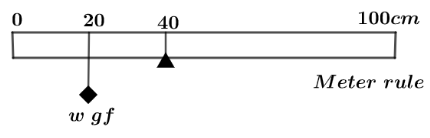
The diagram alongside shows a uniform meter rule of weight \[100\,gf\] being balanced on a knife edge placed at the $40\,cm$ mark, by suspending a weight $w$ at the mark $20\,cm$ ,find:
(a) The value of $w$.
(b) The resultant moment and its direction if the weight $w$ is moved to the mark $30\,cm$.
(c) The position of another weight of $50\,gf$ to balance the rule.
Answer
 Verified
580.2k+ views
Hint: In order to solve this question, we will use the concept of principle of moments. Which states that in equilibrium state of forces the clockwise moment about a point is always equal to its anticlockwise moment. Moment is the product of force and perpendicular stable distance point of suspension.
Complete step by step answer:
(a) Let us first find the clockwise moment about weight $w$
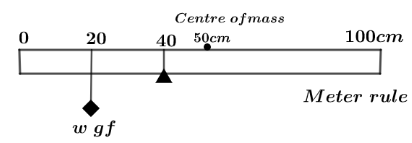
Is given by, $100 \times {d_1}$ where $100$ is the mass of the ruler and ${d_1} = (50 - 40) = 10cm$ which is the distance from centre of mass to the balancing point knife edge.
Clockwise moment $ = 100 \times 10 \to (i)$
Now, an anticlockwise moment is given as, $w \times {d_2}$ where ${d_2}$ is the distance between weight and knife edge point.
Anticlockwise moment $ = w \times 20 \to (ii)$
Comparing both equations $(i)and(ii)$ we get,
$w = \dfrac{{1000}}{{20}}g$
$\therefore w = 50\,g$
Hence, the unknown weight is $w = 50\,g$.
(b) If weight is now moved to the point $30\,cm$ then, the meter ruler will try to bend in clockwise direction. So calculating the moment about the mark $30\,cm$ is given by $w \times d$ where $w = 50\,g$ and $d$ is the distance between knife edge and weight.
$d = 40 - 30 = 10cm$
Moment $ = 50 \times 10$
Moment $ = 500\,gcm$ in anticlockwise direction.
(c) Let the position of new weight $50\,gf$ is at a distance of $x$ cm from left and this weight must be placed after the knife edge so to produce an anticlockwise moment hence balancing the ruler.
Since, we have anticlockwise Moment $ = 500gcm \to (i)$ in Clockwise direction.
And, calculating clockwise moment as:
$1000 + 50(x - 40) \to (ii)$
Equating both equations $(i)and(ii)$ we get,
$1500 = 50x$
$\therefore x = 30\,cm$
Hence, the new weight $50\,gf$ must be placed at a point of $30\,cm$ from the left.
Note:Principle of moment is based upon the concept that a weight tends to produce an anticlockwise moment about its equilibrium point this makes system unstable and hence if it’s placed in such a point where its clockwise moment will just equals to the anticlockwise moment, system will remain in equilibrium as long as the positions of weights don’t changes.
Complete step by step answer:
(a) Let us first find the clockwise moment about weight $w$
Is given by, $100 \times {d_1}$ where $100$ is the mass of the ruler and ${d_1} = (50 - 40) = 10cm$ which is the distance from centre of mass to the balancing point knife edge.
Clockwise moment $ = 100 \times 10 \to (i)$
Now, an anticlockwise moment is given as, $w \times {d_2}$ where ${d_2}$ is the distance between weight and knife edge point.
Anticlockwise moment $ = w \times 20 \to (ii)$
Comparing both equations $(i)and(ii)$ we get,
$w = \dfrac{{1000}}{{20}}g$
$\therefore w = 50\,g$
Hence, the unknown weight is $w = 50\,g$.
(b) If weight is now moved to the point $30\,cm$ then, the meter ruler will try to bend in clockwise direction. So calculating the moment about the mark $30\,cm$ is given by $w \times d$ where $w = 50\,g$ and $d$ is the distance between knife edge and weight.
$d = 40 - 30 = 10cm$
Moment $ = 50 \times 10$
Moment $ = 500\,gcm$ in anticlockwise direction.
(c) Let the position of new weight $50\,gf$ is at a distance of $x$ cm from left and this weight must be placed after the knife edge so to produce an anticlockwise moment hence balancing the ruler.
Since, we have anticlockwise Moment $ = 500gcm \to (i)$ in Clockwise direction.
And, calculating clockwise moment as:
$1000 + 50(x - 40) \to (ii)$
Equating both equations $(i)and(ii)$ we get,
$1500 = 50x$
$\therefore x = 30\,cm$
Hence, the new weight $50\,gf$ must be placed at a point of $30\,cm$ from the left.
Note:Principle of moment is based upon the concept that a weight tends to produce an anticlockwise moment about its equilibrium point this makes system unstable and hence if it’s placed in such a point where its clockwise moment will just equals to the anticlockwise moment, system will remain in equilibrium as long as the positions of weights don’t changes.
Recently Updated Pages
Master Class 11 Social Science: Engaging Questions & Answers for Success

Master Class 11 English: Engaging Questions & Answers for Success
Master Class 11 Accountancy: Engaging Questions & Answers for Success
Master Class 11 Physics: Engaging Questions & Answers for Success
Master Class 11 Computer Science: Engaging Questions & Answers for Success
Master Class 11 Business Studies: Engaging Questions & Answers for Success
Trending doubts
Find the value of the expression given below sin 30circ class 11 maths CBSE
One Metric ton is equal to kg A 10000 B 1000 C 100 class 11 physics CBSE
Draw a diagram of nephron and explain its structur class 11 biology CBSE
10 examples of friction in our daily life
Proton was discovered by A Thomson B Rutherford C Chadwick class 11 chemistry CBSE
The teeth used for biting and cutting food are called class 11 biology CBSE