




The diagonals of a rectangle are unequal in length.
(a) True
(b) False
Answer
 Verified
619.8k+ views
Hint: For solving this problem use the congruence of triangles. We consider a rectangle ‘ABCD’.
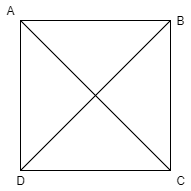
Here, we consider two triangles which have two diagonals in each triangle and prove that those two triangles are congruent to each other so that the diagonals are equal.
Complete step by step answer:
Let us consider a rectangle ‘ABCD’ as shown below
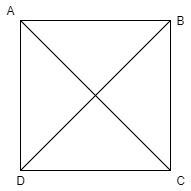
Now, let us assume the two triangles \[\Delta ADC\] and \[\Delta BCD\].
Here we can write three equations
(i)\[DC=CD\]
(ii)\[\angle ADC=\angle BCD={{90}^{0}}\], angles in a rectangle are equal to \[{{90}^{0}}\].
(iii)\[\angle DAC=\angle CBD\]
We know that if two angles and one side of two triangles are equal then we can say that from A.A.S congruence those two triangles are equal.
So, from A.A.S congruence we can write \[\Delta ADC\] and \[\Delta BCD\] are congruent to each other.
We know that if two triangles are congruent then all the corresponding sides and angles are equal.
So, from the definition of congruence we can say that
\[\Rightarrow AC=BD\]
Hence, we can say that the diagonals of a rectangle are equal.
But we are given that the diagonals of the rectangle are unequal in length. So, the given statement is wrong.
So, the correct answer is “Option b”.
Note: This question is explained in another way.
Considering all the types of quadrilaterals there are only two quadrilaterals which have equal lengths of diagonals, they are squares and rectangles.
Since, all four angles in squares and rectangles are equal to \[{{90}^{0}}\] the diagonals will always be equal and cut at midpoints in right angles. This is the definition of squares and rectangles.
So, the given statement is wrong which leaves option (b) as the correct answer.
Here, we consider two triangles which have two diagonals in each triangle and prove that those two triangles are congruent to each other so that the diagonals are equal.
Complete step by step answer:
Let us consider a rectangle ‘ABCD’ as shown below
Now, let us assume the two triangles \[\Delta ADC\] and \[\Delta BCD\].
Here we can write three equations
(i)\[DC=CD\]
(ii)\[\angle ADC=\angle BCD={{90}^{0}}\], angles in a rectangle are equal to \[{{90}^{0}}\].
(iii)\[\angle DAC=\angle CBD\]
We know that if two angles and one side of two triangles are equal then we can say that from A.A.S congruence those two triangles are equal.
So, from A.A.S congruence we can write \[\Delta ADC\] and \[\Delta BCD\] are congruent to each other.
We know that if two triangles are congruent then all the corresponding sides and angles are equal.
So, from the definition of congruence we can say that
\[\Rightarrow AC=BD\]
Hence, we can say that the diagonals of a rectangle are equal.
But we are given that the diagonals of the rectangle are unequal in length. So, the given statement is wrong.
So, the correct answer is “Option b”.
Note: This question is explained in another way.
Considering all the types of quadrilaterals there are only two quadrilaterals which have equal lengths of diagonals, they are squares and rectangles.
Since, all four angles in squares and rectangles are equal to \[{{90}^{0}}\] the diagonals will always be equal and cut at midpoints in right angles. This is the definition of squares and rectangles.
So, the given statement is wrong which leaves option (b) as the correct answer.
Recently Updated Pages
Master Class 11 English: Engaging Questions & Answers for Success

Master Class 11 Social Science: Engaging Questions & Answers for Success
Master Class 11 Maths: Engaging Questions & Answers for Success
Master Class 11 Biology: Engaging Questions & Answers for Success
Master Class 11 Physics: Engaging Questions & Answers for Success
Master Class 11 Chemistry: Engaging Questions & Answers for Success
Trending doubts
Explain the Treaty of Vienna of 1815 class 10 social science CBSE
What is the Total Duration of Football Match?
First Cotton Mill of India
In which year voting age was reduced from 21 to 18?
10 examples of evaporation in daily life with explanations
What planets have no moons Which one has only one moon class 10 physics CBSE