




The diagonals of a quadrilateral ABCD intersect each other at the point O such that $\dfrac{{AO}}{{BO}} = \dfrac{{CO}}{{DO}}$. Show that ABCD is a trapezium.
Answer
 Verified
628.2k+ views
Hint: In this particular question first draw the pictorial representation of the given problem it will give us a clear picture of what we have to find out then make a construction in the figure, draw a line OE parallel to AB such that it cuts the line BC at point E, so use these concepts to reach the solution of the question.
Complete step-by-step answer:
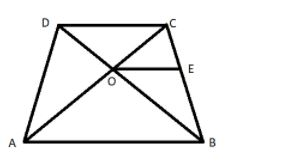
Given data:
The diagonals of a quadrilateral ABCD intersect each other at the point O, such that,
$\dfrac{{AO}}{{BO}} = \dfrac{{CO}}{{DO}}$
$ \Rightarrow \dfrac{{CO}}{{AO}} = \dfrac{{DO}}{{BO}}$....... (1).
Now we have to prove that ABCD is a trapezium.
As we know that in a trapezium any two opposite sides are parallel, the rest of the two opposite sides are not parallel to each other.
If we prove that AB parallel to CD i.e. AB||CD then ABCD is trapezium.
Proof –
So for this draw a line OE parallel to AB such that it cuts the line BC at point E, as shown in the figure.
So, OE||AB.................... (2)
Now in triangle ABC, according to basic proportionality theorem we have,
$ \Rightarrow \dfrac{{CO}}{{AO}} = \dfrac{{CE}}{{BE}}$.................... (3), (this is only possible if and only if OE||AB)
Now from equation (1) and (3) we have,
$ \Rightarrow \dfrac{{CO}}{{AO}} = \dfrac{{DO}}{{BO}} = \dfrac{{CE}}{{BE}}$
$ \Rightarrow \dfrac{{DO}}{{BO}} = \dfrac{{CE}}{{BE}}$
Hence by converse of basic proportionality theorem the above relation is only possible if and only if OE||DC............... (4)
So from equation (2) and (4)
AB||OE||DC
Hence ABCD is trapezium.
Hence Proved.
Note: Whenever we face such types of questions the key concept we have to remember is that in a triangle if we draw a line parallel to the base of the triangle and cuts the other two sides of the triangle then according to the basic proportionality theorem the ratio of the respective sides of upper half and the lower half are equal.
Complete step-by-step answer:
Given data:
The diagonals of a quadrilateral ABCD intersect each other at the point O, such that,
$\dfrac{{AO}}{{BO}} = \dfrac{{CO}}{{DO}}$
$ \Rightarrow \dfrac{{CO}}{{AO}} = \dfrac{{DO}}{{BO}}$....... (1).
Now we have to prove that ABCD is a trapezium.
As we know that in a trapezium any two opposite sides are parallel, the rest of the two opposite sides are not parallel to each other.
If we prove that AB parallel to CD i.e. AB||CD then ABCD is trapezium.
Proof –
So for this draw a line OE parallel to AB such that it cuts the line BC at point E, as shown in the figure.
So, OE||AB.................... (2)
Now in triangle ABC, according to basic proportionality theorem we have,
$ \Rightarrow \dfrac{{CO}}{{AO}} = \dfrac{{CE}}{{BE}}$.................... (3), (this is only possible if and only if OE||AB)
Now from equation (1) and (3) we have,
$ \Rightarrow \dfrac{{CO}}{{AO}} = \dfrac{{DO}}{{BO}} = \dfrac{{CE}}{{BE}}$
$ \Rightarrow \dfrac{{DO}}{{BO}} = \dfrac{{CE}}{{BE}}$
Hence by converse of basic proportionality theorem the above relation is only possible if and only if OE||DC............... (4)
So from equation (2) and (4)
AB||OE||DC
Hence ABCD is trapezium.
Hence Proved.
Note: Whenever we face such types of questions the key concept we have to remember is that in a triangle if we draw a line parallel to the base of the triangle and cuts the other two sides of the triangle then according to the basic proportionality theorem the ratio of the respective sides of upper half and the lower half are equal.
Recently Updated Pages
Master Class 12 Economics: Engaging Questions & Answers for Success

Master Class 12 English: Engaging Questions & Answers for Success
Master Class 12 Social Science: Engaging Questions & Answers for Success
Master Class 12 Maths: Engaging Questions & Answers for Success
Master Class 12 Physics: Engaging Questions & Answers for Success
Master Class 10 English: Engaging Questions & Answers for Success
Trending doubts
Explain the Treaty of Vienna of 1815 class 10 social science CBSE
Why is it 530 pm in india when it is 1200 afternoon class 10 social science CBSE
What is the full form of POSCO class 10 social science CBSE
Define Potential, Developed, Stock and Reserved resources
The speaker of the Lok Sabha is elected by the APresident class 10 social science CBSE
Complete the sentence with the most appropriate word class 10 english CBSE