




The diagonals of a quadrilateral ABCD are perpendicular. Show that the quadrilateral, formed by joining the mid-points of its sides, is a rectangle.
Answer
 Verified
613.8k+ views
Hint: First, we will use the mid point theorem where the line segment in a triangle joining the midpoint of two sides of the triangle is said to be parallel to its third side and is also half of the length of the third side. Apply this theorem, and then use the given conditions to find the required value.
Complete step-by-step answer:
It is given that ABCD is a quadrilateral and its diagonals are perpendicular with each other.
We will now plot the mid points of the sides of the quadrilateral ABCD with PQRS and join them.
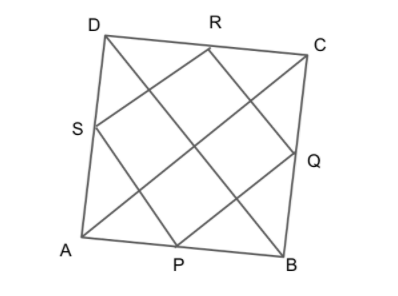
First, we will take the triangle \[\Delta {\text{ABC}}\] where P and Q are mid points of AB and BC.
We know that in the mid point theorem, the line segment in some triangle ABC joining the midpoint of two sides of the triangle is said to be parallel to its third side and is also half of the length of the third side.
So using the mid point theorem we know that the length AC and PQ are perpendicular with each other.
\[\therefore {\text{PQ||AC and PQ = }}\dfrac{1}{2}{\text{AC ......}}\left( 1 \right)\]
We will now take the triangle \[\Delta {\text{ACD}}\] where R and S are mid points of CD and AD.
So using the mid point theorem we know that the length SR and AC are perpendicular with each other.
\[\therefore {\text{SR||AC and SR = }}\dfrac{1}{2}{\text{AC ......}}\left( 2 \right)\]
From equation \[\left( 1 \right)\] and equation \[\left( 2 \right)\], we get
\[{\text{PQ||SR}}\] and \[{\text{PQ = SR}}\]
Thus, PQRS is a rectangle.
Note: In this question, students should know that opposite sides of the rectangle are equal and parallel. Students must crack the point of using the mid point theorem, the line segment in a triangle joining the midpoint of two sides of the triangle is said to be parallel to its third side and is also half of the length of the third side. If we are able to crack this point, then the proof is very simple.
Complete step-by-step answer:
It is given that ABCD is a quadrilateral and its diagonals are perpendicular with each other.
We will now plot the mid points of the sides of the quadrilateral ABCD with PQRS and join them.
First, we will take the triangle \[\Delta {\text{ABC}}\] where P and Q are mid points of AB and BC.
We know that in the mid point theorem, the line segment in some triangle ABC joining the midpoint of two sides of the triangle is said to be parallel to its third side and is also half of the length of the third side.
So using the mid point theorem we know that the length AC and PQ are perpendicular with each other.
\[\therefore {\text{PQ||AC and PQ = }}\dfrac{1}{2}{\text{AC ......}}\left( 1 \right)\]
We will now take the triangle \[\Delta {\text{ACD}}\] where R and S are mid points of CD and AD.
So using the mid point theorem we know that the length SR and AC are perpendicular with each other.
\[\therefore {\text{SR||AC and SR = }}\dfrac{1}{2}{\text{AC ......}}\left( 2 \right)\]
From equation \[\left( 1 \right)\] and equation \[\left( 2 \right)\], we get
\[{\text{PQ||SR}}\] and \[{\text{PQ = SR}}\]
Thus, PQRS is a rectangle.
Note: In this question, students should know that opposite sides of the rectangle are equal and parallel. Students must crack the point of using the mid point theorem, the line segment in a triangle joining the midpoint of two sides of the triangle is said to be parallel to its third side and is also half of the length of the third side. If we are able to crack this point, then the proof is very simple.

Recently Updated Pages
Master Class 12 Business Studies: Engaging Questions & Answers for Success

Master Class 12 Biology: Engaging Questions & Answers for Success
Master Class 12 Chemistry: Engaging Questions & Answers for Success
Class 12 Question and Answer - Your Ultimate Solutions Guide
Master Class 11 Social Science: Engaging Questions & Answers for Success
Master Class 11 English: Engaging Questions & Answers for Success
Trending doubts
Full Form of IASDMIPSIFSIRSPOLICE class 7 social science CBSE
List of coprime numbers from 1 to 100 class 7 maths CBSE
How many thousands make a crore class 7 maths CBSE
Differentiate between map and globe class 7 social science CBSE
AIM To prepare stained temporary mount of onion peel class 7 biology CBSE
The plural of Chief is Chieves A True B False class 7 english CBSE