




The development of Funaria gametophyte always initiated from:
(a) Antheridium
(b) Protonema
(c) Archegonia
(d) Capsule
Answer
 Verified
628.5k+ views
Hint: The spores liberated germinate into a creeping, green, branched, chlorophyll and frequently filamentous stage which marked the development of gametophyte in Funaria.
Complete answer:
The predominant stage of the life cycle of a Funaria is the gametophyte which consists of protonema and leafy stages. It is commonly found in the life cycle of Hornworts and Liverworts.
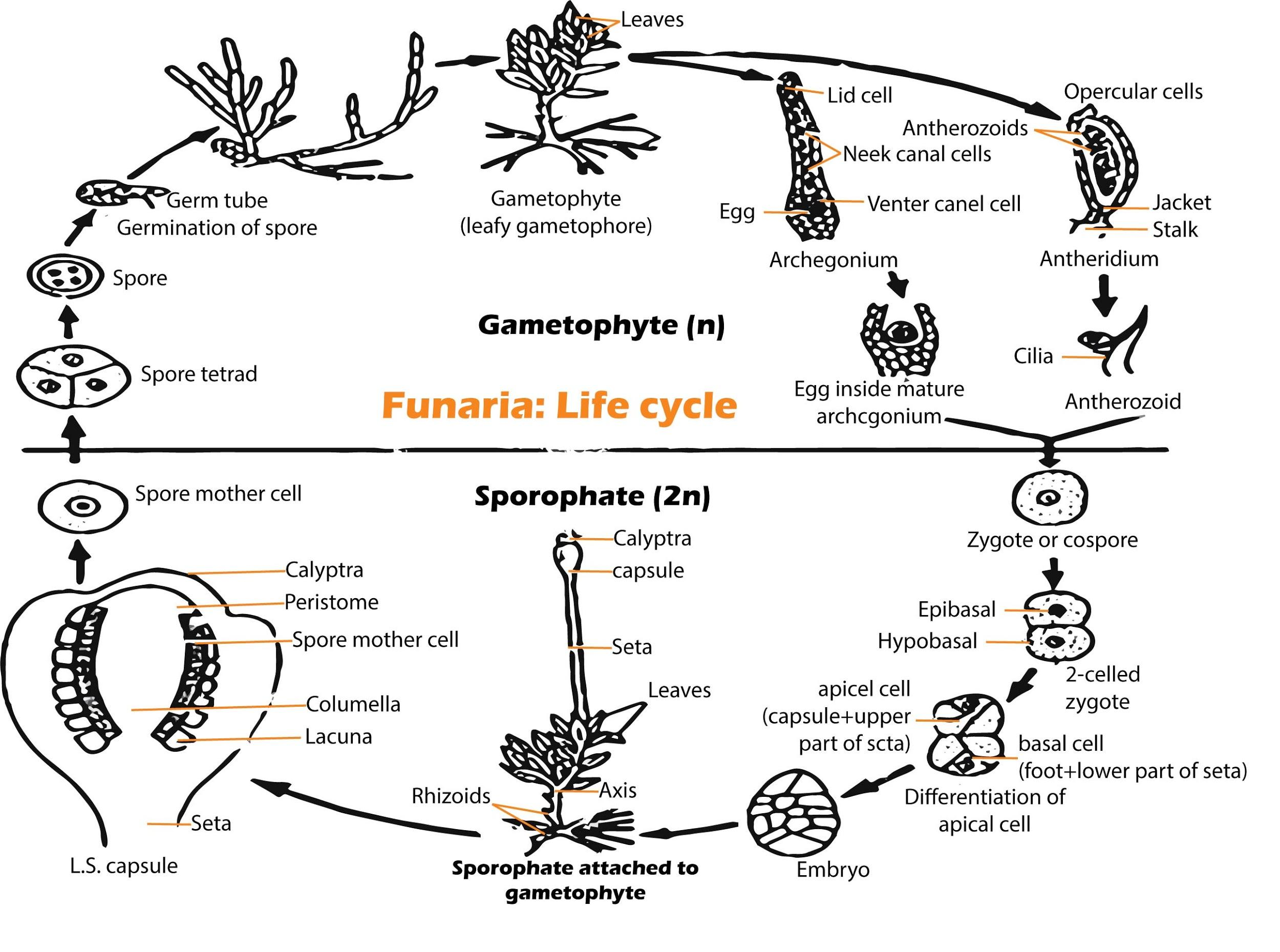
Additional Information: - The plant body is a leafy gametophyte which has multicellular and branched rhizoids.
- They contain upright, slender, axis bearing, spirally arranged leaves. This stage bears the sex organ. - In sexual reproduction, the sex organs antheridia and archegonia are produced at the apex of the leafy shoot.
- The sex organs are present on the same plant but different branches.
- Each antheridium produces several biflagellate antherozoids. Each archegonium produces a fertile egg. - The fusion of gametes with the help of water leads to the formation of zygote. The zygote develops into a sporophyte which is differentiated into foot, seta and capsule. - The capsule encloses two spore sacs where spores are formed through meiosis. - The spore on liberation germinates into a creeping green branched and frequently filamentous stage called protonema (juvenile phase) .
- In the case of mosses, protonema consists of two types of cell chromonemata and caulonema.
So, the correct answer is, ‘Protonema.’
Note: Vegetative reproduction also occurs in Funaria. Fragmentation and budding occur in secondary protonema. In secondary protonema, a lateral bud is produced which develops into a leafy stage. Funaria is an amphibious plant and sexual reproduction takes place through the water. They show alternation of generation i.e. gametophyte alternates with sporophytes.
Complete answer:
The predominant stage of the life cycle of a Funaria is the gametophyte which consists of protonema and leafy stages. It is commonly found in the life cycle of Hornworts and Liverworts.
Additional Information: - The plant body is a leafy gametophyte which has multicellular and branched rhizoids.
- They contain upright, slender, axis bearing, spirally arranged leaves. This stage bears the sex organ. - In sexual reproduction, the sex organs antheridia and archegonia are produced at the apex of the leafy shoot.
- The sex organs are present on the same plant but different branches.
- Each antheridium produces several biflagellate antherozoids. Each archegonium produces a fertile egg. - The fusion of gametes with the help of water leads to the formation of zygote. The zygote develops into a sporophyte which is differentiated into foot, seta and capsule. - The capsule encloses two spore sacs where spores are formed through meiosis. - The spore on liberation germinates into a creeping green branched and frequently filamentous stage called protonema (juvenile phase) .
- In the case of mosses, protonema consists of two types of cell chromonemata and caulonema.
So, the correct answer is, ‘Protonema.’
Note: Vegetative reproduction also occurs in Funaria. Fragmentation and budding occur in secondary protonema. In secondary protonema, a lateral bud is produced which develops into a leafy stage. Funaria is an amphibious plant and sexual reproduction takes place through the water. They show alternation of generation i.e. gametophyte alternates with sporophytes.
Recently Updated Pages
Master Class 11 English: Engaging Questions & Answers for Success

Master Class 11 Social Science: Engaging Questions & Answers for Success
Master Class 11 Maths: Engaging Questions & Answers for Success
Master Class 11 Biology: Engaging Questions & Answers for Success
Master Class 11 Physics: Engaging Questions & Answers for Success
Master Class 11 Chemistry: Engaging Questions & Answers for Success
Trending doubts
One Metric ton is equal to kg A 10000 B 1000 C 100 class 11 physics CBSE
Difference Between Prokaryotic Cells and Eukaryotic Cells
1 ton equals to A 100 kg B 1000 kg C 10 kg D 10000 class 11 physics CBSE
Find the value of the expression given below sin 30circ class 11 maths CBSE
Two of the body parts which do not appear in MRI are class 11 biology CBSE
Draw a diagram of a plant cell and label at least eight class 11 biology CBSE