




The correct order of boiling point is:
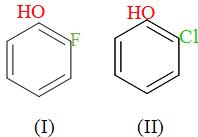
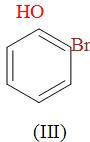
(a) I > II > III
(b) III > II > I
(c) II > I > III
(d) I > III > II
Answer
 Verified
645.6k+ views
Hint: Boiling point in the o-substituted phenols is due to the intramolecular H-bonding and boiling point always increases with increase in the molecular weight of the substances and vice-versa. Now, identify the order of the boiling point.
Complete step by step answer:
By the term boiling point, we simply mean the temperature at which the particular substances begin to boil and get converted into its vapor phase.
The boiling point depends on the intermolecular (the bonding between the two molecules) and intramolecular (the bonding within the molecule) hydrogen bonding. Stronger the intramolecular bonding, greater is the boiling point and vice- versa. It is so because due to the H-bonding they hold a large no of the water molecules and require large energy to break such bonds.
Now, we have been given o-fluoro-phenol, o-chloro-phenol and o-bromo-phenol i.e. belongs to the category of the phenols and their boiling point is determined on the basis of H-bonding.
In the above, we can see that all the substituents occupy the ortho -positions and in case of phenols, there is intramolecular H-bonding when the substituents are present at the ortho-positions. The substituents attached are the halogen atoms i.e. the fluorine, chlorine and bromine. Since, we know that all them i.e. o-fluoro-phenol, o-chloro-phenol and o-bromo-phenol will have intramolecular H-bonding so there we can identify that who’s is having the higher boiling points through their molecular weights. It is so because the boiling point increases with the increase in the atomic weight.
So, among o-fluoro-phenol, o-chloro-phenol and o-bromo-phenol, o-bromo-phenol has the highest boiling point and the o-fluoro-phenol has the lowest boiling point and o-chloro-phenol has the boiling point in between them because Br has the highest molecular weight thereafter followed by Cl and then the F.
So, the order of the boiling point is:
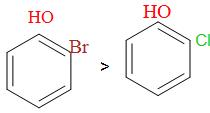
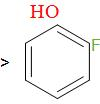
i.e. (III) > (II) > (I)
So, the correct answer is “Option B”.
Note: In ortho substituted phenols, due to close proximity of the phenol and the substituents, they form the intra =-molecular H-bonding and undergoes chelation and thus, therefore exist as discrete molecules (i.e. exist as separate molecules).
Complete step by step answer:
By the term boiling point, we simply mean the temperature at which the particular substances begin to boil and get converted into its vapor phase.
The boiling point depends on the intermolecular (the bonding between the two molecules) and intramolecular (the bonding within the molecule) hydrogen bonding. Stronger the intramolecular bonding, greater is the boiling point and vice- versa. It is so because due to the H-bonding they hold a large no of the water molecules and require large energy to break such bonds.
Now, we have been given o-fluoro-phenol, o-chloro-phenol and o-bromo-phenol i.e. belongs to the category of the phenols and their boiling point is determined on the basis of H-bonding.
In the above, we can see that all the substituents occupy the ortho -positions and in case of phenols, there is intramolecular H-bonding when the substituents are present at the ortho-positions. The substituents attached are the halogen atoms i.e. the fluorine, chlorine and bromine. Since, we know that all them i.e. o-fluoro-phenol, o-chloro-phenol and o-bromo-phenol will have intramolecular H-bonding so there we can identify that who’s is having the higher boiling points through their molecular weights. It is so because the boiling point increases with the increase in the atomic weight.
So, among o-fluoro-phenol, o-chloro-phenol and o-bromo-phenol, o-bromo-phenol has the highest boiling point and the o-fluoro-phenol has the lowest boiling point and o-chloro-phenol has the boiling point in between them because Br has the highest molecular weight thereafter followed by Cl and then the F.
So, the order of the boiling point is:
i.e. (III) > (II) > (I)
So, the correct answer is “Option B”.
Note: In ortho substituted phenols, due to close proximity of the phenol and the substituents, they form the intra =-molecular H-bonding and undergoes chelation and thus, therefore exist as discrete molecules (i.e. exist as separate molecules).
Recently Updated Pages
Which of the following graphs shows the variation of class 12 physics CBSE

Draw a labelled diagram of the human male reproductive class 12 biology CBSE
Describe the experiment to compare the emf of two cells class 12 physics CBSE
What is standard hydrogen electrode
What is conventional current and electric current class 12 physics CBSE
2Bromopentane is treated with an alcoholic KOH solution class 12 chemistry CBSE
Trending doubts
Draw a labelled sketch of the human eye class 12 physics CBSE
Which are the Top 10 Largest Countries of the World?
Differentiate between homogeneous and heterogeneous class 12 chemistry CBSE
Draw ray diagrams each showing i myopic eye and ii class 12 physics CBSE
Which is the correct genotypic ratio of mendel dihybrid class 12 biology CBSE
What is the Full Form of PVC, PET, HDPE, LDPE, PP and PS ?