




The correct expression for Ampere’s law is:
A. $\int {B.dl = \sum i } $
B. $\int {B.dl = \dfrac{1}{{\sum i }}} $
C. $\int {B.dl = {\mu _0}\sum i } $
D. $\int {B.dl = \dfrac{{\sum i }}{{{\mu _0}}}} $
Answer
 Verified
612.9k+ views
Hint: Early experimentations by scientists such as Maxwell and Oersted show that whenever there is an electric current, there is another invisible force acting on the metallic objects called magnetism. However, it was not until Jean Biot and Felix Savart in 1820, that this theory was confirmed. And alternatively, this was also confirmed by Ampere’s circuital law.
Complete step-by-step answer:
Biot Savart’s law gives us an insight about the term magnetic field that arises due to presence of electric current.
Consider a line element in a conductor $dl$ through which current is flowing and an arbitrary point P at a distance of r from the conductor
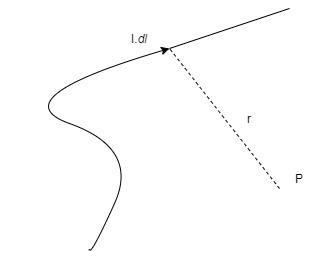
It states that, the magnetic field due to the line element $dl$is given by –
$dB \propto \dfrac{{I.dl}}{{{r^3}}}$
By removing the proportionality symbol, we have –
$dB = \dfrac{{{\mu _0}}}{{4\pi }}\dfrac{{I.dl}}{{{r^3}}}$ where ${\mu _0}$ is called the absolute permeability.
Another alternative for this law is the Ampere’s circuital law. The Ampere’s circuital law could be applied to surfaces with a boundary
Consider the surface with the boundary as shown.
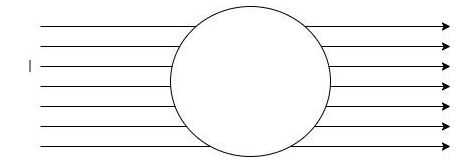
$I$ is the current flowing. Let $dl$ be the line element of the boundary.
By summing the line integrals infinistemally, we obtain a term known as line integral. So, the magnetic field associated with each line element $dl$ is summed up to form the line integral.
The Ampere’s circuital law states that this line integral of the magnetic field B over the entire boundary is equal to ${\mu _0}$ times the current flowing through it.
$\oint {B.dl = {\mu _0}} I$
Here, if $i$ is considered to be current through each line element, the total current will be equal to the summation of the current. Hence –
$\oint {B.dl = {\mu _0}} \sum i $
Hence, the correct option is Option C.
Note: Applying Biot-Savart’s Law and Ampere’s Circuital law over a boundary will result in the same expression for the magnetic field. The Ampere’s law is, however, very significant in electromagnetic radiation, wherein, a scientist by name James Maxwell, generalised this Ampere’s law equation to include in the list of his 4 fundamental Maxwell equations of classical electromagnetism.
Complete step-by-step answer:
Biot Savart’s law gives us an insight about the term magnetic field that arises due to presence of electric current.
Consider a line element in a conductor $dl$ through which current is flowing and an arbitrary point P at a distance of r from the conductor
It states that, the magnetic field due to the line element $dl$is given by –
$dB \propto \dfrac{{I.dl}}{{{r^3}}}$
By removing the proportionality symbol, we have –
$dB = \dfrac{{{\mu _0}}}{{4\pi }}\dfrac{{I.dl}}{{{r^3}}}$ where ${\mu _0}$ is called the absolute permeability.
Another alternative for this law is the Ampere’s circuital law. The Ampere’s circuital law could be applied to surfaces with a boundary
Consider the surface with the boundary as shown.
$I$ is the current flowing. Let $dl$ be the line element of the boundary.
By summing the line integrals infinistemally, we obtain a term known as line integral. So, the magnetic field associated with each line element $dl$ is summed up to form the line integral.
The Ampere’s circuital law states that this line integral of the magnetic field B over the entire boundary is equal to ${\mu _0}$ times the current flowing through it.
$\oint {B.dl = {\mu _0}} I$
Here, if $i$ is considered to be current through each line element, the total current will be equal to the summation of the current. Hence –
$\oint {B.dl = {\mu _0}} \sum i $
Hence, the correct option is Option C.
Note: Applying Biot-Savart’s Law and Ampere’s Circuital law over a boundary will result in the same expression for the magnetic field. The Ampere’s law is, however, very significant in electromagnetic radiation, wherein, a scientist by name James Maxwell, generalised this Ampere’s law equation to include in the list of his 4 fundamental Maxwell equations of classical electromagnetism.
Recently Updated Pages
Master Class 12 Economics: Engaging Questions & Answers for Success

Master Class 12 English: Engaging Questions & Answers for Success
Master Class 12 Social Science: Engaging Questions & Answers for Success
Master Class 12 Maths: Engaging Questions & Answers for Success
Master Class 12 Physics: Engaging Questions & Answers for Success
Master Class 9 General Knowledge: Engaging Questions & Answers for Success
Trending doubts
One Metric ton is equal to kg A 10000 B 1000 C 100 class 11 physics CBSE
Difference Between Prokaryotic Cells and Eukaryotic Cells
Two of the body parts which do not appear in MRI are class 11 biology CBSE
1 ton equals to A 100 kg B 1000 kg C 10 kg D 10000 class 11 physics CBSE
Draw a diagram of nephron and explain its structur class 11 biology CBSE
10 examples of friction in our daily life