




The correct Biot-Savart law in vector form is?
\[
A.{\text{ }}d\vec B = \dfrac{{{\mu _0}}}{{4\pi }}\dfrac{{I\left( {d\vec l \times \vec r} \right)}}{{{r^2}}} \\
B.{\text{ }}d\vec B = \dfrac{{{\mu _0}}}{{4\pi }}\dfrac{{I\left( {d\vec l \times \vec r} \right)}}{{{r^3}}} \\
C.{\text{ }}d\vec B = \dfrac{{{\mu _0}}}{{4\pi }}\dfrac{{Id\vec l}}{{{r^2}}} \\
D.{\text{ }}d\vec B = \dfrac{{{\mu _0}}}{{4\pi }}\dfrac{{Id\vec l}}{{{r^3}}} \\
\]
Answer
 Verified
625.8k+ views
- Hint: In order to deal with this question first we will understand the Biot-Savart law, then we will proceed further by considering the Biot-Savart law formula and by changing it in vector form we will get the answer.
Formula used- $d\vec B = \dfrac{{{\mu _0}}}{{4\pi }}\dfrac{{Idl\sin \theta }}{{{r^2}}}\hat r,\hat r = \dfrac{{\vec r}}{r}$
Complete step-by-step answer:
Biot-Savart’s law: The law of Biot-Savart is an equation that gives the magnetic field generated as a result of an individual carrying a fragment. This section is taken as the individual entity known as the vector quantity.
Figure:
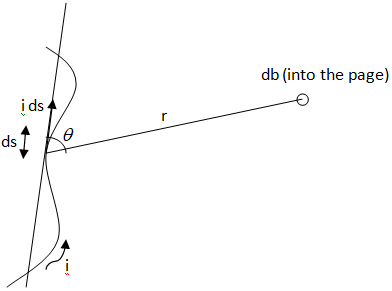
Biot-Savart’s law formula: Consider a current carrying wire $I$ in a specific direction as shown in the above figure. Take a small element of the wire of length $dl$ . The direction of this element is along that of the current so that it forms a vector $Id\vec l$ .
One can apply the Law of Biot-Savart to know the magnetic field produced at a point due to this small element. Let the position vector of the point in question drawn from the current element be r and the angle between the two be $\theta $. Then,
$d\vec B = \dfrac{{{\mu _0}}}{{4\pi }}\dfrac{{Idl\sin \theta }}{{{r^2}}}\hat r$
Where
${\mu _0}$ is the permeability of free space and is equal to $4\pi \times {10^{ - 7}}Tm{A^{ - 1}}$ .
So the Biot Savart's Law formula is
Now we know:
$\hat r = \dfrac{{\vec r}}{r}$
Using this and the cross product we obtain from two vectors;
$
\because d\vec B = \dfrac{{{\mu _0}}}{{4\pi }}\dfrac{{Idl\sin \theta }}{{{r^2}}}\hat r \\
\Rightarrow d\vec B = \dfrac{{{\mu _0}}}{{4\pi }}\dfrac{{Id\vec l\sin \theta }}{{{r^2}}}\dfrac{{\vec r}}{r} \\
\Rightarrow d\vec B = \dfrac{{{\mu _0}}}{{4\pi }}\dfrac{{I\left( {d\vec l.\vec r\sin \theta } \right)}}{{{r^2} \times r}} \\
\Rightarrow d\vec B = \dfrac{{{\mu _0}}}{{4\pi }}\dfrac{{I\left( {d\vec l \times \vec r} \right)}}{{{r^3}}}{\text{ }}\left[ {\because \vec a \times \vec b = ab\sin \theta } \right] \\
$
Hence, the correct Biot-Savart law in vector form is $d\vec B = \dfrac{{{\mu _0}}}{{4\pi }}\dfrac{{I\left( {d\vec l \times \vec r} \right)}}{{{r^3}}}$
Hence the correct answer is option B.
Note: The Biot – Savart Law is an equation that describes the magnetic field produced by a constant electric current. It relates magnetic fields to electric current magnitude, direction, length, and proximity. Also at the atomic or molecular stage we can use the Biot – Savart rule to measure magnetic responses. It is also used for measuring the velocity caused by the vortex lines in aerodynamic theory.
Formula used- $d\vec B = \dfrac{{{\mu _0}}}{{4\pi }}\dfrac{{Idl\sin \theta }}{{{r^2}}}\hat r,\hat r = \dfrac{{\vec r}}{r}$
Complete step-by-step answer:
Biot-Savart’s law: The law of Biot-Savart is an equation that gives the magnetic field generated as a result of an individual carrying a fragment. This section is taken as the individual entity known as the vector quantity.
Figure:
Biot-Savart’s law formula: Consider a current carrying wire $I$ in a specific direction as shown in the above figure. Take a small element of the wire of length $dl$ . The direction of this element is along that of the current so that it forms a vector $Id\vec l$ .
One can apply the Law of Biot-Savart to know the magnetic field produced at a point due to this small element. Let the position vector of the point in question drawn from the current element be r and the angle between the two be $\theta $. Then,
$d\vec B = \dfrac{{{\mu _0}}}{{4\pi }}\dfrac{{Idl\sin \theta }}{{{r^2}}}\hat r$
Where
${\mu _0}$ is the permeability of free space and is equal to $4\pi \times {10^{ - 7}}Tm{A^{ - 1}}$ .
So the Biot Savart's Law formula is
Now we know:
$\hat r = \dfrac{{\vec r}}{r}$
Using this and the cross product we obtain from two vectors;
$
\because d\vec B = \dfrac{{{\mu _0}}}{{4\pi }}\dfrac{{Idl\sin \theta }}{{{r^2}}}\hat r \\
\Rightarrow d\vec B = \dfrac{{{\mu _0}}}{{4\pi }}\dfrac{{Id\vec l\sin \theta }}{{{r^2}}}\dfrac{{\vec r}}{r} \\
\Rightarrow d\vec B = \dfrac{{{\mu _0}}}{{4\pi }}\dfrac{{I\left( {d\vec l.\vec r\sin \theta } \right)}}{{{r^2} \times r}} \\
\Rightarrow d\vec B = \dfrac{{{\mu _0}}}{{4\pi }}\dfrac{{I\left( {d\vec l \times \vec r} \right)}}{{{r^3}}}{\text{ }}\left[ {\because \vec a \times \vec b = ab\sin \theta } \right] \\
$
Hence, the correct Biot-Savart law in vector form is $d\vec B = \dfrac{{{\mu _0}}}{{4\pi }}\dfrac{{I\left( {d\vec l \times \vec r} \right)}}{{{r^3}}}$
Hence the correct answer is option B.
Note: The Biot – Savart Law is an equation that describes the magnetic field produced by a constant electric current. It relates magnetic fields to electric current magnitude, direction, length, and proximity. Also at the atomic or molecular stage we can use the Biot – Savart rule to measure magnetic responses. It is also used for measuring the velocity caused by the vortex lines in aerodynamic theory.
Recently Updated Pages
Master Class 12 Business Studies: Engaging Questions & Answers for Success

Master Class 12 Chemistry: Engaging Questions & Answers for Success
Master Class 12 Biology: Engaging Questions & Answers for Success
Class 12 Question and Answer - Your Ultimate Solutions Guide
Master Class 9 General Knowledge: Engaging Questions & Answers for Success
Master Class 9 Maths: Engaging Questions & Answers for Success
Trending doubts
Which are the Top 10 Largest Countries of the World?
Draw a labelled sketch of the human eye class 12 physics CBSE
Differentiate between homogeneous and heterogeneous class 12 chemistry CBSE
Sulphuric acid is known as the king of acids State class 12 chemistry CBSE
Why is the cell called the structural and functional class 12 biology CBSE
A dentist uses a small mirror that gives a magnification class 12 physics CBSE