




The core of any transformer is laminated so as to:
(A) reduce the energy loss due to eddy currents
(B) make it light weight
(C) make it robust and strong
(D) increase the secondary voltage
Answer
 Verified
598.5k+ views
Hint
A transformer is a passive electrical device that transfers electrical energy from one electrical circuit to another, or multiple circuits. A varying current in any one coil of the transformer produces a varying magnetic flux in the transformer's core, which induces a varying electromotive force across any other coils wound around the same core.
Complete step by step answer
Electrical energy can be transferred between separate coils without a metallic (conductive) connection between the two circuits. Faraday's law of induction, discovered in 1831, describes the induced voltage effect in any coil due to a changing magnetic flux encircled by the coil.
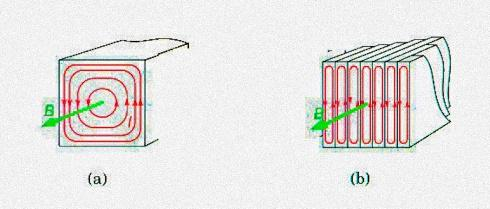
Eddy currents are the loops of electrical current induced within conductors by a changing magnetic field in the conductor, due to Faraday's law of induction. Figure (a) shows eddy currents within solid iron transformer cores. Making the core out of thin laminations (figure b) parallel to the magnetic field with insulation between them reduces the eddy currents and thus also reduces the energy loss due to eddy currents.
Option (A) is correct.
Note
Transformers are usually used for increasing low AC voltages at high current (a step-up transformer) or decreasing high AC voltages at low current (a step-down transformer) in electric power applications, and for coupling the stages of signal processing circuits. Transformers can also be used for isolation, where the voltage in equals the voltage out, with separate coils not electrically bonded to one another.
A transformer is a passive electrical device that transfers electrical energy from one electrical circuit to another, or multiple circuits. A varying current in any one coil of the transformer produces a varying magnetic flux in the transformer's core, which induces a varying electromotive force across any other coils wound around the same core.
Complete step by step answer
Electrical energy can be transferred between separate coils without a metallic (conductive) connection between the two circuits. Faraday's law of induction, discovered in 1831, describes the induced voltage effect in any coil due to a changing magnetic flux encircled by the coil.
Eddy currents are the loops of electrical current induced within conductors by a changing magnetic field in the conductor, due to Faraday's law of induction. Figure (a) shows eddy currents within solid iron transformer cores. Making the core out of thin laminations (figure b) parallel to the magnetic field with insulation between them reduces the eddy currents and thus also reduces the energy loss due to eddy currents.
Option (A) is correct.
Note
Transformers are usually used for increasing low AC voltages at high current (a step-up transformer) or decreasing high AC voltages at low current (a step-down transformer) in electric power applications, and for coupling the stages of signal processing circuits. Transformers can also be used for isolation, where the voltage in equals the voltage out, with separate coils not electrically bonded to one another.
Recently Updated Pages
Master Class 12 Social Science: Engaging Questions & Answers for Success

Master Class 12 Physics: Engaging Questions & Answers for Success
Master Class 12 Maths: Engaging Questions & Answers for Success
Master Class 12 Economics: Engaging Questions & Answers for Success
Master Class 12 Chemistry: Engaging Questions & Answers for Success
Master Class 12 Business Studies: Engaging Questions & Answers for Success
Trending doubts
Which of the following is the cheapest mode of transport class 12 social science CBSE
What are the major means of transport Explain each class 12 social science CBSE
Planting of trees on unused farmland road and rail class 12 biology CBSE
The lifespan of a parrot is a 15 years b 20 years c class 12 biology CBSE
Potato spindle tuber disease is caused by A Prions class 12 biology CBSE
Rearing honey bees is called as A Horticulture B Apiary class 12 biology CBSE