




The compound(s) that exhibit(s) geometrical isomerism is (are):
A. $[Pt(en)C{{l}_{2}}]$
B. $[Pt{{(en)}_{2}}]C{{l}_{2}}$
C. $[Pt{{(en)}_{2}}C{{l}_{2}}]C{{l}_{2}}$
D. $[Pt{{(N{{H}_{3}})}_{2}}]C{{l}_{2}}$
Answer
 Verified
591.6k+ views
Hint: Geometrical isomerism is going to exhibit a compound which has different ligands around the central metal atom. If all the ligands are the same around the central metal atom then the molecule should not show any geometrical isomerism.
Complete answer:
- Coming to the given question we have to find which molecules in the options show geometrical isomerism.
- Coming to option A, $[Pt(en)C{{l}_{2}}]$ , it does not show any geometrical isomerism due to the less number of ligands attached to the central metal atom. So, option A is wrong.
- Coming to option B, $[Pt{{(en)}_{2}}]C{{l}_{2}}$ , it is also does not show any geometrical isomerism because the chlorine atoms are present in the outer sphere complex, they should present in inner sphere complex to show geometrical isomerism. So, option B is also wrong.
- Coming to option C, $[Pt{{(en)}_{2}}C{{l}_{2}}]C{{l}_{2}}$ . The possible structures by this compound are as follows.
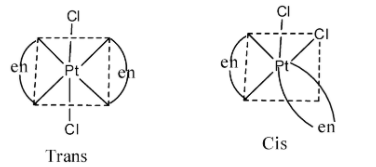
- So, option C shows geometrical isomerism.
-Coming to option D, $[Pt{{(N{{H}_{3}})}_{2}}]C{{l}_{2}}$ . The possible structures by this compound are as follows.
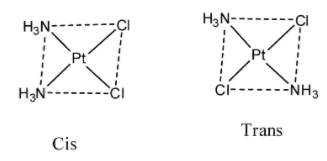
- So, the compound D also shows geometrical isomerism.
Therefore options C and D shows geometrical isomerism among the given options.
Note:
In case of coordination complexes the cis and trans forms can be identified by the presence of ligands around the central metal atom. If same ligands are adjacent in the structure of the complex then the structure is called cis and same ligands are opposite in the structure of the complex then the structure is called trans.
Complete answer:
- Coming to the given question we have to find which molecules in the options show geometrical isomerism.
- Coming to option A, $[Pt(en)C{{l}_{2}}]$ , it does not show any geometrical isomerism due to the less number of ligands attached to the central metal atom. So, option A is wrong.
- Coming to option B, $[Pt{{(en)}_{2}}]C{{l}_{2}}$ , it is also does not show any geometrical isomerism because the chlorine atoms are present in the outer sphere complex, they should present in inner sphere complex to show geometrical isomerism. So, option B is also wrong.
- Coming to option C, $[Pt{{(en)}_{2}}C{{l}_{2}}]C{{l}_{2}}$ . The possible structures by this compound are as follows.
- So, option C shows geometrical isomerism.
-Coming to option D, $[Pt{{(N{{H}_{3}})}_{2}}]C{{l}_{2}}$ . The possible structures by this compound are as follows.
- So, the compound D also shows geometrical isomerism.
Therefore options C and D shows geometrical isomerism among the given options.
Note:
In case of coordination complexes the cis and trans forms can be identified by the presence of ligands around the central metal atom. If same ligands are adjacent in the structure of the complex then the structure is called cis and same ligands are opposite in the structure of the complex then the structure is called trans.
Recently Updated Pages
Basicity of sulphurous acid and sulphuric acid are

Master Class 11 Business Studies: Engaging Questions & Answers for Success
Master Class 11 Computer Science: Engaging Questions & Answers for Success
Master Class 11 Economics: Engaging Questions & Answers for Success
Master Class 11 Social Science: Engaging Questions & Answers for Success
Master Class 11 English: Engaging Questions & Answers for Success
Trending doubts
One Metric ton is equal to kg A 10000 B 1000 C 100 class 11 physics CBSE
The largest wind power cluster is located in the state class 11 social science CBSE
Explain zero factorial class 11 maths CBSE
State and prove Bernoullis theorem class 11 physics CBSE
What steps did the French revolutionaries take to create class 11 social science CBSE
Which among the following are examples of coming together class 11 social science CBSE