




The compounds 1-butyne and 2-butyne can be distinguished by using:
A.Bromine water
B.${\text{KMn}}{{\text{O}}_{\text{4}}}$ solution
C.Tollen’s reagent
D.Chlorine gas
Answer
 Verified
577.8k+ views
Hint: The hydrogen atoms that are attached to the triply bonded carbon are weakly acidic in nature and hence they can form acetylides with heavy metallic salts.
Complete step by step answer:
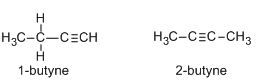
The two given alkynes are 1-butyne and 2-butyne. Their structures are shown below:
Due to the presence of two pi-bonds, alkynes can undergo a number of additional reactions in which alkynes can add two molecules of a reagent unlike alkenes which can add only one reagent molecule due to the presence of only one pi-bond.
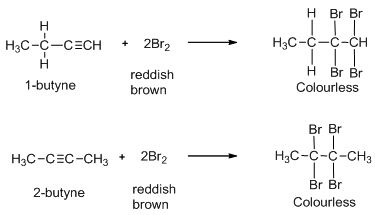
First, let us consider the reaction of both the alkynes with bromine water. Bromine water solution is a deep reddish brown colored solution. When bromine solution is added dropwise to an alkyne, the reddish brown colour disappears because the product is colourless. Thus, both 1-butyne and 2-butyne decolourise bromine water solution. Hence, bromine water tests cannot be used to distinguish between them. So, the option (A) is incorrect.
Now, let us consider the reaction of both the alkynes with ${\text{KMn}}{{\text{O}}_{\text{4}}}$ solution. Under neutral conditions, alkynes react with dilute ${\text{KMn}}{{\text{O}}_{\text{4}}}$ solution to give diketones. On the other hand, with basic ${\text{KMn}}{{\text{O}}_{\text{4}}}$ solution at high temperature, any alkyne will undergo oxidative cleavage. Thus, both 1-butyne and 2-butyne reacts with ${\text{KMn}}{{\text{O}}_{\text{4}}}$ solution and so it cannot be used to distinguish between them. So, the option (B) is incorrect.

Now, consider the reaction with Tollen’s reagent. Tollen’s reagent is a chemical reagent which consists of a solution of silver nitrate, ammonia and some sodium hydroxide. Due to the acidic nature of the hydrogen atoms attached to the triply bonded carbon, terminal alkynes react with heavy metallic salts like silver nitrate. Since 1-butyne is a terminal alkyne, it will react with Tollen’s reagent while 2-butyne will not react as it is an internal alkyne.


So, this test can be used to distinguish between them. So, the option (C) is correct.
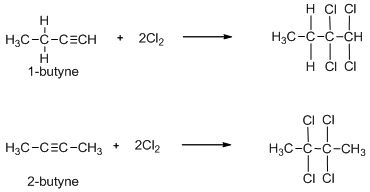
Lastly, both 1-butyne and 2-butyne will undergo an addition reaction with chlorine. So, option (D) is also incorrect.
Hence option C is correct.
Note:
Alkynes having a terminal carbon-carbon triple bond when treated with ammoniacal solution of ${\text{AgN}}{{\text{O}}_{\text{3}}}$ , forms a white precipitate of silver acetylide.
Complete step by step answer:
The two given alkynes are 1-butyne and 2-butyne. Their structures are shown below:
Due to the presence of two pi-bonds, alkynes can undergo a number of additional reactions in which alkynes can add two molecules of a reagent unlike alkenes which can add only one reagent molecule due to the presence of only one pi-bond.
First, let us consider the reaction of both the alkynes with bromine water. Bromine water solution is a deep reddish brown colored solution. When bromine solution is added dropwise to an alkyne, the reddish brown colour disappears because the product is colourless. Thus, both 1-butyne and 2-butyne decolourise bromine water solution. Hence, bromine water tests cannot be used to distinguish between them. So, the option (A) is incorrect.
Now, let us consider the reaction of both the alkynes with ${\text{KMn}}{{\text{O}}_{\text{4}}}$ solution. Under neutral conditions, alkynes react with dilute ${\text{KMn}}{{\text{O}}_{\text{4}}}$ solution to give diketones. On the other hand, with basic ${\text{KMn}}{{\text{O}}_{\text{4}}}$ solution at high temperature, any alkyne will undergo oxidative cleavage. Thus, both 1-butyne and 2-butyne reacts with ${\text{KMn}}{{\text{O}}_{\text{4}}}$ solution and so it cannot be used to distinguish between them. So, the option (B) is incorrect.
Now, consider the reaction with Tollen’s reagent. Tollen’s reagent is a chemical reagent which consists of a solution of silver nitrate, ammonia and some sodium hydroxide. Due to the acidic nature of the hydrogen atoms attached to the triply bonded carbon, terminal alkynes react with heavy metallic salts like silver nitrate. Since 1-butyne is a terminal alkyne, it will react with Tollen’s reagent while 2-butyne will not react as it is an internal alkyne.
So, this test can be used to distinguish between them. So, the option (C) is correct.
Lastly, both 1-butyne and 2-butyne will undergo an addition reaction with chlorine. So, option (D) is also incorrect.
Hence option C is correct.
Note:
Alkynes having a terminal carbon-carbon triple bond when treated with ammoniacal solution of ${\text{AgN}}{{\text{O}}_{\text{3}}}$ , forms a white precipitate of silver acetylide.
Recently Updated Pages
Lysosomes are known as suicidal bags of cell why class 11 biology CBSE

Father s age is three times the sum of the ages of-class-11-maths-CBSE
Give a comparative account of the classes of kingdom class 11 biology CBSE
The ceiling of a long hall is 25m high What is the class 11 physics CBSE
Proton was discovered by A Thomson B Rutherford C Chadwick class 11 chemistry CBSE
Name the Largest and the Smallest Cell in the Human Body ?
Trending doubts
Difference Between Prokaryotic Cells and Eukaryotic Cells
Find the value of the expression given below sin 30circ class 11 maths CBSE
One Metric ton is equal to kg A 10000 B 1000 C 100 class 11 physics CBSE
Two of the body parts which do not appear in MRI are class 11 biology CBSE
10 examples of friction in our daily life
Draw a diagram of nephron and explain its structur class 11 biology CBSE