




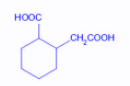
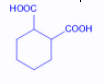
The compound that undergoes decarboxylation most readily under mild conditions is:
A.
B.

C.
D.

Answer
 Verified
602.4k+ views
Hint: To answer this question, you must recall the process and mechanism of decarboxylation. Decarboxylation of an acid is the removal of the carboxylic group of the acid in the form of carbon dioxide. $\beta $ -keto acids undergo decarboxylation reaction easily.
Complete step by step solution:
A decarboxylation reaction can be most simply termed as a reaction where there is a loss of carbon dioxide. The general decarboxylation reaction can be written as:
$RCOOH \to R - H + C{O_2}$
Simple carboxylic acids do not undergo a decarboxylation reaction easily. Whereas, carboxylic acids having a carbonyl group attached at the second carbon or the $\beta $ carbon atom, that is, $\beta $ -keto acids undergo the loss of carbon dioxide very easily. Since simple carboxylic acids are stable, they undergo decarboxylation only under harsh conditions unlike $\beta $ -keto acids which easily undergo the reaction at mild conditions as well.
Thus, we search for the beta keto acid out of the given options. The compound in option B is a $\beta $ -keto acid and thus can undergo decarboxylation reaction under mild conditions.
Hence, the correct option is B.
Note:
$\beta $ -keto acids are unstable because the ketone group present at the $\beta $ position accepts a hydrogen ion from the acidic carboxylic group forming carboxylate group and a carbocation at the $\beta $ carbon atom. A six membered cyclic transition state is formed and this anion is highly unstable. Thus, the carboxylic group shifts its electron density towards the positively charged carbon atom and leaves the compound as carbon dioxide gas. As a result, an enol is formed which tautomerizes to form a ketone.
Complete step by step solution:
A decarboxylation reaction can be most simply termed as a reaction where there is a loss of carbon dioxide. The general decarboxylation reaction can be written as:
$RCOOH \to R - H + C{O_2}$
Simple carboxylic acids do not undergo a decarboxylation reaction easily. Whereas, carboxylic acids having a carbonyl group attached at the second carbon or the $\beta $ carbon atom, that is, $\beta $ -keto acids undergo the loss of carbon dioxide very easily. Since simple carboxylic acids are stable, they undergo decarboxylation only under harsh conditions unlike $\beta $ -keto acids which easily undergo the reaction at mild conditions as well.
Thus, we search for the beta keto acid out of the given options. The compound in option B is a $\beta $ -keto acid and thus can undergo decarboxylation reaction under mild conditions.
Hence, the correct option is B.
Note:
$\beta $ -keto acids are unstable because the ketone group present at the $\beta $ position accepts a hydrogen ion from the acidic carboxylic group forming carboxylate group and a carbocation at the $\beta $ carbon atom. A six membered cyclic transition state is formed and this anion is highly unstable. Thus, the carboxylic group shifts its electron density towards the positively charged carbon atom and leaves the compound as carbon dioxide gas. As a result, an enol is formed which tautomerizes to form a ketone.
Recently Updated Pages
Master Class 12 Business Studies: Engaging Questions & Answers for Success

Master Class 12 Chemistry: Engaging Questions & Answers for Success
Master Class 12 Biology: Engaging Questions & Answers for Success
Class 12 Question and Answer - Your Ultimate Solutions Guide
Master Class 11 Social Science: Engaging Questions & Answers for Success
Master Class 11 Chemistry: Engaging Questions & Answers for Success
Trending doubts
Which are the Top 10 Largest Countries of the World?
Draw a labelled sketch of the human eye class 12 physics CBSE
Name the crygenes that control cotton bollworm and class 12 biology CBSE
Differentiate between homogeneous and heterogeneous class 12 chemistry CBSE
How many molecules of ATP and NADPH are required information class 12 biology CBSE
In a transcription unit the promoter is said to be class 12 biology CBSE