




The complex ion that will lose its crystal field stabilization energy upon oxidation of its metal to +3 state is:
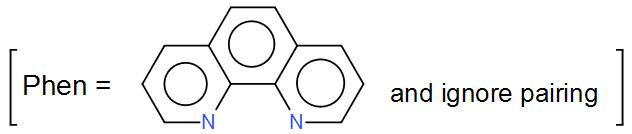
[A] ${{\left[ Fe{{\left( phen \right)}_{3}} \right]}^{2+}}$
[B] ${{\left[ Zn{{\left( phen \right)}_{3}} \right]}^{2+}}$
[C] ${{\left[ Ni{{\left( phen \right)}_{3}} \right]}^{2+}}$
[D] ${{\left[ Co{{\left( phen \right)}_{3}} \right]}^{2+}}$
Answer
 Verified
610.2k+ views
Hint:. Here we have to find out the crystal field splitting energy of the given metals in +3 and +2 state. The one where the energy will be higher in +2 state than in +3 state will definitely lose its crystal field stabilization energy.
Complete step by step answer:
To answer this question, firstly we have to know the meaning of crystal field stabilisation energy.
Under a spherical electrostatic field like in s-orbitals, the degeneracy of the orbital is maintained but under non-spherical electrostatic field or unsymmetrical field like in p, d- orbitals, splitting of orbitals occur which give rise to two non-degenerate energy levels and this is known as crystal field splitting. ${{\Delta }_{\circ }}$ is the crystal field splitting energy of a complex.
This energy depends upon certain factors. To answer this question, we have to discuss them and then compare the given complexes.
The first factor is geometry as it changes the d-orbital splitting pattern.
The next factor is the nature of the metal.
-With increase in oxidation state, the extent of metal – ligand electrostatic interaction increases leading to more splitting.
-More the d-orbital is diffused higher will be the tendency of the ligand to interact and thus the splitting will increase.
And the last factor is the nature of the ligand depending upon the spectro-chemical series.
Now let us see the given question.
Phen is a strong field ligand so will form a weak field complex. Hence, ${{t}_{2}}g$ will be filled first and then if electrons left then will move to ${{e}_{g}}$. For each electron in ${{t}_{2}}g$, ${{\Delta }_{\circ }}$ is – 0.4 and for each electron in ${{e}_{g}}$, ${{\Delta }_{\circ }}$ is + 0.6.
Firstly we have ${{\left[ Fe{{\left( phen \right)}_{3}} \right]}^{2+}}$.
\[\begin{align}
& F{{e}^{2+}}\xrightarrow{-{{e}^{-}}}F{{e}^{3+}} \\
& F{{e}^{2+}}:3{{d}^{6}}\text{(}{{\text{t}}_{2}}{{\text{g}}^{6}}\text{) }{{\Delta }_{\circ }}=6\times -0.4=-2.4 \\
& F{{e}^{3+}}:3{{d}^{5}}({{t}_{2}}{{g}^{5}})\text{ }{{\Delta }_{\circ }}=5\times -0.4=-2.0 \\
\end{align}\]
Then we have ${{\left[ Zn{{\left( phen \right)}_{3}} \right]}^{2+}}$
\[\begin{align}
& Z{{n}^{2+}}\xrightarrow{-{{e}^{-}}}Z{{n}^{3+}} \\
& Z{{n}^{2+}}:3{{d}^{10}}\text{(}{{\text{t}}_{2}}{{\text{g}}^{6}}\text{ }{{\text{e}}_{g}}^{4}\text{) }{{\Delta }_{\circ }}=6\times -0.4+4\times 0.6=0 \\
& Z{{n}^{3+}}:3{{d}^{5}}({{t}_{2}}{{g}^{6}}{{\text{e}}_{g}}^{3})\text{ }{{\Delta }_{\circ }}=6\times -0.4+3\times 0.6=-0.6 \\
\end{align}\]
Next we have ${{\left[ Ni{{\left( phen \right)}_{3}} \right]}^{2+}}$
\[\begin{align}
& N{{i}^{2+}}\xrightarrow{-{{e}^{-}}}N{{i}^{3+}} \\
& N{{i}^{2+}}:3{{d}^{8}}\text{(}{{\text{t}}_{2}}{{\text{g}}^{6}}\text{ }{{\text{e}}_{g}}^{2}\text{) }{{\Delta }_{\circ }}=6\times -0.4+2\times 0.6=-1.2 \\
& Z{{n}^{3+}}:3{{d}^{7}}({{t}_{2}}{{g}^{6}}{{\text{e}}_{g}}^{1})\text{ }{{\Delta }_{\circ }}=6\times -0.4+1\times 0.6=-1.8 \\
\end{align}\]
Lastly, we have ${{\left[ Co{{\left( phen \right)}_{3}} \right]}^{2+}}$.
\[\begin{align}
& C{{o}^{2+}}\xrightarrow{-{{e}^{-}}}C{{o}^{3+}} \\
& N{{i}^{2+}}:3{{d}^{7}}\text{(}{{\text{t}}_{2}}{{\text{g}}^{6}}\text{ }{{\text{e}}_{g}}^{1}\text{) }{{\Delta }_{\circ }}=6\times -0.4+1\times 0.6=-1.8 \\
& N{{i}^{3+}}:3{{d}^{6}}({{t}_{2}}{{g}^{6}})\text{ }{{\Delta }_{\circ }}=6\times -0.4=-2.4 \\
\end{align}\]
We can see that only in the case of ${{\left[ Fe{{\left( phen \right)}_{3}} \right]}^{2+}}$ crystal field splitting energy is decreasing.
So, the correct answer is “Option A”.
Note: In this series, ligands towards the left (iodide) are weak field ligands and ligands towards right (CO) are stronger field ligands. Strong field ligands have a higher splitting and results in higher crystal field stabilisation energy whereas weak field ligands have a lower crystal field splitting. Generally, weak field ligands are known to form high spin complexes and strong field ligands form low spin complexes.
Complete step by step answer:
To answer this question, firstly we have to know the meaning of crystal field stabilisation energy.
Under a spherical electrostatic field like in s-orbitals, the degeneracy of the orbital is maintained but under non-spherical electrostatic field or unsymmetrical field like in p, d- orbitals, splitting of orbitals occur which give rise to two non-degenerate energy levels and this is known as crystal field splitting. ${{\Delta }_{\circ }}$ is the crystal field splitting energy of a complex.
This energy depends upon certain factors. To answer this question, we have to discuss them and then compare the given complexes.
The first factor is geometry as it changes the d-orbital splitting pattern.
The next factor is the nature of the metal.
-With increase in oxidation state, the extent of metal – ligand electrostatic interaction increases leading to more splitting.
-More the d-orbital is diffused higher will be the tendency of the ligand to interact and thus the splitting will increase.
And the last factor is the nature of the ligand depending upon the spectro-chemical series.
Now let us see the given question.
Phen is a strong field ligand so will form a weak field complex. Hence, ${{t}_{2}}g$ will be filled first and then if electrons left then will move to ${{e}_{g}}$. For each electron in ${{t}_{2}}g$, ${{\Delta }_{\circ }}$ is – 0.4 and for each electron in ${{e}_{g}}$, ${{\Delta }_{\circ }}$ is + 0.6.
Firstly we have ${{\left[ Fe{{\left( phen \right)}_{3}} \right]}^{2+}}$.
\[\begin{align}
& F{{e}^{2+}}\xrightarrow{-{{e}^{-}}}F{{e}^{3+}} \\
& F{{e}^{2+}}:3{{d}^{6}}\text{(}{{\text{t}}_{2}}{{\text{g}}^{6}}\text{) }{{\Delta }_{\circ }}=6\times -0.4=-2.4 \\
& F{{e}^{3+}}:3{{d}^{5}}({{t}_{2}}{{g}^{5}})\text{ }{{\Delta }_{\circ }}=5\times -0.4=-2.0 \\
\end{align}\]
Then we have ${{\left[ Zn{{\left( phen \right)}_{3}} \right]}^{2+}}$
\[\begin{align}
& Z{{n}^{2+}}\xrightarrow{-{{e}^{-}}}Z{{n}^{3+}} \\
& Z{{n}^{2+}}:3{{d}^{10}}\text{(}{{\text{t}}_{2}}{{\text{g}}^{6}}\text{ }{{\text{e}}_{g}}^{4}\text{) }{{\Delta }_{\circ }}=6\times -0.4+4\times 0.6=0 \\
& Z{{n}^{3+}}:3{{d}^{5}}({{t}_{2}}{{g}^{6}}{{\text{e}}_{g}}^{3})\text{ }{{\Delta }_{\circ }}=6\times -0.4+3\times 0.6=-0.6 \\
\end{align}\]
Next we have ${{\left[ Ni{{\left( phen \right)}_{3}} \right]}^{2+}}$
\[\begin{align}
& N{{i}^{2+}}\xrightarrow{-{{e}^{-}}}N{{i}^{3+}} \\
& N{{i}^{2+}}:3{{d}^{8}}\text{(}{{\text{t}}_{2}}{{\text{g}}^{6}}\text{ }{{\text{e}}_{g}}^{2}\text{) }{{\Delta }_{\circ }}=6\times -0.4+2\times 0.6=-1.2 \\
& Z{{n}^{3+}}:3{{d}^{7}}({{t}_{2}}{{g}^{6}}{{\text{e}}_{g}}^{1})\text{ }{{\Delta }_{\circ }}=6\times -0.4+1\times 0.6=-1.8 \\
\end{align}\]
Lastly, we have ${{\left[ Co{{\left( phen \right)}_{3}} \right]}^{2+}}$.
\[\begin{align}
& C{{o}^{2+}}\xrightarrow{-{{e}^{-}}}C{{o}^{3+}} \\
& N{{i}^{2+}}:3{{d}^{7}}\text{(}{{\text{t}}_{2}}{{\text{g}}^{6}}\text{ }{{\text{e}}_{g}}^{1}\text{) }{{\Delta }_{\circ }}=6\times -0.4+1\times 0.6=-1.8 \\
& N{{i}^{3+}}:3{{d}^{6}}({{t}_{2}}{{g}^{6}})\text{ }{{\Delta }_{\circ }}=6\times -0.4=-2.4 \\
\end{align}\]
We can see that only in the case of ${{\left[ Fe{{\left( phen \right)}_{3}} \right]}^{2+}}$ crystal field splitting energy is decreasing.
So, the correct answer is “Option A”.
Note: In this series, ligands towards the left (iodide) are weak field ligands and ligands towards right (CO) are stronger field ligands. Strong field ligands have a higher splitting and results in higher crystal field stabilisation energy whereas weak field ligands have a lower crystal field splitting. Generally, weak field ligands are known to form high spin complexes and strong field ligands form low spin complexes.
Recently Updated Pages
Master Class 12 Economics: Engaging Questions & Answers for Success

Master Class 12 English: Engaging Questions & Answers for Success
Master Class 12 Social Science: Engaging Questions & Answers for Success
Master Class 12 Maths: Engaging Questions & Answers for Success
Master Class 12 Physics: Engaging Questions & Answers for Success
Master Class 11 Social Science: Engaging Questions & Answers for Success
Trending doubts
One Metric ton is equal to kg A 10000 B 1000 C 100 class 11 physics CBSE
Difference Between Prokaryotic Cells and Eukaryotic Cells
Two of the body parts which do not appear in MRI are class 11 biology CBSE
1 ton equals to A 100 kg B 1000 kg C 10 kg D 10000 class 11 physics CBSE
Draw a diagram of nephron and explain its structur class 11 biology CBSE
10 examples of friction in our daily life