




The colour of the \[{X_2}\] molecule of group \[17\] elements changes gradually from yellow to violet down the group. This is due to:
This question has multiple correct options
A. The physical state of \[{X_2}\] at room temperature changes from gas to solid down the group
B. Decrease in \[{\pi ^*} - {\sigma ^*}\] gap down the group
C. Decrease in HOMO – LUMO gap down the group
D. Decrease in ionization energy down the group
Answer
 Verified
634.8k+ views
Hint: As we know, Group \[17\] elements are nothing but the halogen i.e. fluorine, chlorine, bromine, iodine. Which exist in the diatomic form, and have highest electronegativity. Due to the valence shell electron is p orbital it will show colour due to jumping of electron from ground state to excited state and coming back to the ground state after releasing energy.
Complete answer:
Let us show the MOT Diagram of the group\[17\] of fluorine with HOMO – LUMO gap with \[h\nu \] as energy between them as follows;
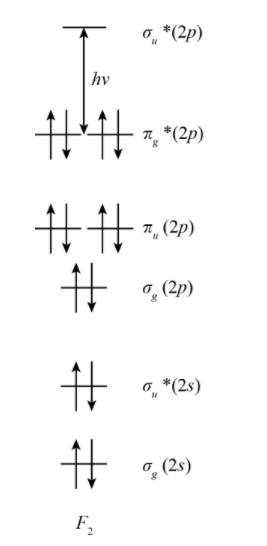
From this diagram, we can see that these gaps will decrease from top to bottom. The origin of the color of the halogens is the excitation between the highest occupied \[\pi *\] Molecular Orbital and the lowest unoccupied \[\sigma *\] Molecular Orbital. The energy gap between the HOMO and LUMO decreases according to \[{F_2}\; > {\rm{ }}C{l_2}\; > {\rm{ }}B{r_2}\; > {\rm{ }}{I_2}\].
The size of the atom will decide the amount of energy required for excitation. The force of attraction between the nucleus and the outer electrons is very large in the Fluorine which is the smallest element in the group. Hence, it will appear pale yellow as it requires a large excitation energy and absorbs violet light (high energy). Whereas, iodine will appear dark violet as it needs significantly less excitation energy and absorbs yellow light of low energy, in the same way it is possible to explain the greenish yellow color of chlorine and the reddish brown color of bromine. The halogens show a variety of colors when dissolved in different solvents can be explained by weak donor-acceptor interaction and charge-transfer bands is due to interaction with the HOMO \[\sigma _u^*\] orbital.
Hence, the correct options are (B) and (C).
Note:
Astatine (As), and Tennessine (Ts) they are not colored compound, because it cannot be explained by weak donor-acceptor interaction and charge-transfer bands is due to interaction with the HOMO \[\sigma _u^*\] orbital.
Complete answer:
Let us show the MOT Diagram of the group\[17\] of fluorine with HOMO – LUMO gap with \[h\nu \] as energy between them as follows;
From this diagram, we can see that these gaps will decrease from top to bottom. The origin of the color of the halogens is the excitation between the highest occupied \[\pi *\] Molecular Orbital and the lowest unoccupied \[\sigma *\] Molecular Orbital. The energy gap between the HOMO and LUMO decreases according to \[{F_2}\; > {\rm{ }}C{l_2}\; > {\rm{ }}B{r_2}\; > {\rm{ }}{I_2}\].
The size of the atom will decide the amount of energy required for excitation. The force of attraction between the nucleus and the outer electrons is very large in the Fluorine which is the smallest element in the group. Hence, it will appear pale yellow as it requires a large excitation energy and absorbs violet light (high energy). Whereas, iodine will appear dark violet as it needs significantly less excitation energy and absorbs yellow light of low energy, in the same way it is possible to explain the greenish yellow color of chlorine and the reddish brown color of bromine. The halogens show a variety of colors when dissolved in different solvents can be explained by weak donor-acceptor interaction and charge-transfer bands is due to interaction with the HOMO \[\sigma _u^*\] orbital.
Hence, the correct options are (B) and (C).
Note:
Astatine (As), and Tennessine (Ts) they are not colored compound, because it cannot be explained by weak donor-acceptor interaction and charge-transfer bands is due to interaction with the HOMO \[\sigma _u^*\] orbital.
Recently Updated Pages
Which will be the least stable resonating structure class 11 chemistry CBSE

How many 5 digit telephone numbers can be construc-class-11-maths-CBSE
How do you find the angle of the resultant vector class 11 physics CBSE
Draw labelled diagram of the following i Gram seed class 11 biology CBSE
1 Quintal is equal to a 110 kg b 10 kg c 100kg d 1000 class 11 physics CBSE
What is the need and importance of classification class 11 biology CBSE
Trending doubts
Find the value of the expression given below sin 30circ class 11 maths CBSE
The teeth used for biting and cutting food are called class 11 biology CBSE
Bond order ofO2 O2+ O2 and O22 is in order A O2 langle class 11 chemistry CBSE
Frogs heart when taken out of the body continues to class 11 biology CBSE
Can anyone list 10 advantages and disadvantages of friction
Draw a diagram of a plant cell and label at least eight class 11 biology CBSE