




The colour of scattered light depends ________.
A. Only on the size of the scattering particle.
B. Only on the length of travelling light.
C. Both size of scattering particles and the length of travelling light.
D. On the colour of the incident light.
Answer
 Verified
616.5k+ views
Hint: Particles show a scattering effect because of the spherical shape of particles. In regular reflection, the light reflects but does not scatter in a different direction. While in scattering, the light reflects in different directions.
Complete Step-by-step Solution
Scattering of light is a reflection of tiny spherical particles. In scattering the light reflects in all directions. Let us suppose we are having two colours of light one is red, and the other is violet. The wavelength of red is more, and violet is less. When both the waves strike with a spherical particle, then there is a chance that the wavelength of a red jump above the spherical particle and move straight. The particle will not show reflection because the size of the particle is too small compared to the wavelength. But the same particle gets struck by the blue wavelength of light, and light gets scattered. The smaller wavelength will scatter, and so the larger wavelength will jump over it.
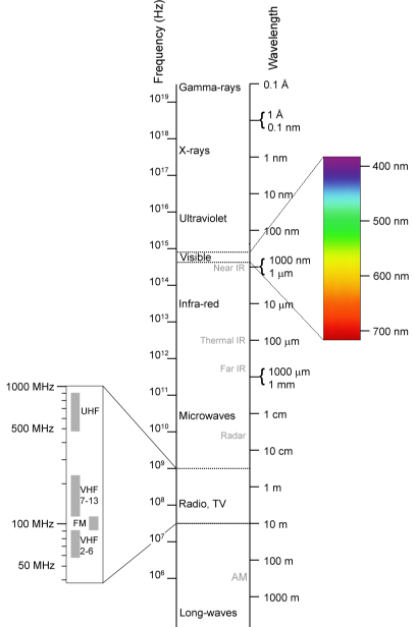
So when white light is going, which is a mixture of VIBGYOR, then the light with a smaller wavelength as compared to the size of a particle gets scattered, and the light with larger wavelength is not scattered and pass through the observer eyes and the observer see the light with larger wavelength.
So the colour of scattered light depends on the size of scattering particles.
$\therefore $ The correct option is (A).
Note:
As the larger wavelength is yellow, orange, and red, these colours of wavelength are extensive compared to the dust particle and water droplets in the atmosphere. So the particles on earth do not scatter these wavelengths of lights, and this is the reason we see sun rays as a mixture of red, yellow, and orange.
Complete Step-by-step Solution
Scattering of light is a reflection of tiny spherical particles. In scattering the light reflects in all directions. Let us suppose we are having two colours of light one is red, and the other is violet. The wavelength of red is more, and violet is less. When both the waves strike with a spherical particle, then there is a chance that the wavelength of a red jump above the spherical particle and move straight. The particle will not show reflection because the size of the particle is too small compared to the wavelength. But the same particle gets struck by the blue wavelength of light, and light gets scattered. The smaller wavelength will scatter, and so the larger wavelength will jump over it.
So when white light is going, which is a mixture of VIBGYOR, then the light with a smaller wavelength as compared to the size of a particle gets scattered, and the light with larger wavelength is not scattered and pass through the observer eyes and the observer see the light with larger wavelength.
So the colour of scattered light depends on the size of scattering particles.
$\therefore $ The correct option is (A).
Note:
As the larger wavelength is yellow, orange, and red, these colours of wavelength are extensive compared to the dust particle and water droplets in the atmosphere. So the particles on earth do not scatter these wavelengths of lights, and this is the reason we see sun rays as a mixture of red, yellow, and orange.
Recently Updated Pages
Master Class 9 General Knowledge: Engaging Questions & Answers for Success

Master Class 9 Maths: Engaging Questions & Answers for Success
Master Class 9 Science: Engaging Questions & Answers for Success
Master Class 9 English: Engaging Questions & Answers for Success
Master Class 9 Social Science: Engaging Questions & Answers for Success
Class 9 Question and Answer - Your Ultimate Solutions Guide
Trending doubts
Explain the Treaty of Vienna of 1815 class 10 social science CBSE
Who Won 36 Oscar Awards? Record Holder Revealed
What is the median of the first 10 natural numbers class 10 maths CBSE
Why is it 530 pm in india when it is 1200 afternoon class 10 social science CBSE
Make a sketch of the human nerve cell What function class 10 biology CBSE
Define Potential, Developed, Stock and Reserved resources