




The circular divisions of the shown screw gauge are\[50\] . It moves \[0.5mm\] on the main scale in one rotation. The diameter of the ball is:
$
(A)2.25mm \\
(B)2.20mm \\
(C)1.20mm \\
(D)1.25mm \\
$
Answer
 Verified
536.1k+ views
Hint: Find the formula of zero error of a screw gauge and calculate it with the given data.
Also, calculate the least count of the circular scale used in the screw gauge.
Using the least count, find the main scale reading and circular scale reading.
Note that the formula of actual measurement is based upon these two readings and the zero error of the screw gauge.
Complete step by step answer:
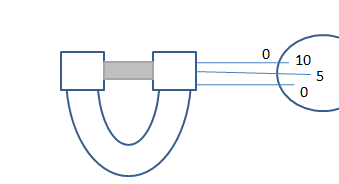
From the 1st figure, the Zero error of the screw gauge is, $Z.E = \dfrac{{5 \times 0.5}}{{50}} = 0.05mm$
Now the least count of the circular scale is, $L.C = \dfrac{{0.5}}{{50}} = 0.01mm$
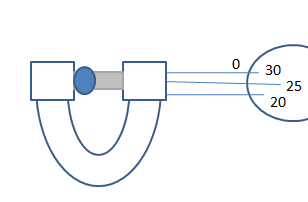
So, The circular scale reading, $C.S.R = 25 \times 0.01 = 0.25mm$
And, the main scale reading, $M.S.R = 2 \times 0.5 = 1mm$
So the diameter will be C. S.R+M.S.R-Z.E
Hence the diameter = $0.25 + 1 - 0.05 = 1.20mm$
So, the correct answer is “Option C”.
Additional information:
The micrometer screw gauge. The micrometer screw gauge is used in the measurement of even smaller dimensions than the vernier calipers. The micrometer screw gauge additionally uses an auxiliary scale (measuring hundredths of a millimeter) that is marked on a rotary thimble
Note: The screw gauge is an instrument used for mensuration precisely the diameter of a wire or the breadth of a sheet of metal. It contains a U-like that is mounted with a screwed pin that's mounted to a thimble. fact by fact to the axis of the thimble, a scale passed in millimeter linear unit is inscribed.
A screw gauge works on the principle of the screw. This screw principle helps to convert smaller distances into larger ones by the rotation of the screw. It amplifies the smaller dimensions and this converts into larger ones. Once we tend to rotate the screw, there's a linear movement of the foremost scale.
Also, calculate the least count of the circular scale used in the screw gauge.
Using the least count, find the main scale reading and circular scale reading.
Note that the formula of actual measurement is based upon these two readings and the zero error of the screw gauge.
Complete step by step answer:
From the 1st figure, the Zero error of the screw gauge is, $Z.E = \dfrac{{5 \times 0.5}}{{50}} = 0.05mm$
Now the least count of the circular scale is, $L.C = \dfrac{{0.5}}{{50}} = 0.01mm$
So, The circular scale reading, $C.S.R = 25 \times 0.01 = 0.25mm$
And, the main scale reading, $M.S.R = 2 \times 0.5 = 1mm$
So the diameter will be C. S.R+M.S.R-Z.E
Hence the diameter = $0.25 + 1 - 0.05 = 1.20mm$
So, the correct answer is “Option C”.
Additional information:
The micrometer screw gauge. The micrometer screw gauge is used in the measurement of even smaller dimensions than the vernier calipers. The micrometer screw gauge additionally uses an auxiliary scale (measuring hundredths of a millimeter) that is marked on a rotary thimble
Note: The screw gauge is an instrument used for mensuration precisely the diameter of a wire or the breadth of a sheet of metal. It contains a U-like that is mounted with a screwed pin that's mounted to a thimble. fact by fact to the axis of the thimble, a scale passed in millimeter linear unit is inscribed.
A screw gauge works on the principle of the screw. This screw principle helps to convert smaller distances into larger ones by the rotation of the screw. It amplifies the smaller dimensions and this converts into larger ones. Once we tend to rotate the screw, there's a linear movement of the foremost scale.
Recently Updated Pages
Master Class 11 Social Science: Engaging Questions & Answers for Success

Master Class 11 Physics: Engaging Questions & Answers for Success
Master Class 11 Maths: Engaging Questions & Answers for Success
Master Class 11 Economics: Engaging Questions & Answers for Success
Master Class 11 Computer Science: Engaging Questions & Answers for Success
Master Class 11 Chemistry: Engaging Questions & Answers for Success
Trending doubts
One Metric ton is equal to kg A 10000 B 1000 C 100 class 11 physics CBSE
There are 720 permutations of the digits 1 2 3 4 5 class 11 maths CBSE
1 Quintal is equal to a 110 kg b 10 kg c 100kg d 1000 class 11 physics CBSE
State and prove Bernoullis theorem class 11 physics CBSE
Difference Between Prokaryotic Cells and Eukaryotic Cells
Which among the following are examples of coming together class 11 social science CBSE