




The cerebral aqueduct lies in
A. The third ventricle
B. The second ventricle
C. Between third and fourth ventricles
D. Lateral ventricles
Answer
 Verified
645.6k+ views
Hint: The brain is the most complex organ of animals. It is present in invertebrates and vertebrates. The cerebral aqueduct lies in the brain within a communicating network of cavities called the ventricular system.
Complete step by step answer: The cerebral aqueduct is also known as Aqueductus mesencephali or Aqueduct of Sylvius. It was first described by Franciscus Sylvius. It lies within the midbrain.
The brain contains cavities called ventricles. There are four such cavities – two on the sides called Lateral ventricles, a third ventricle in the lower part of the brain and a fourth ventricle, along the brain stem. The ventricles are connected with each other and with the spinal cord.
The cerebral aqueduct functions to connect the third ventricle of the brain with the fourth one. Therefore, it lies in between the third and fourth ventricles.
Hence, option (c) is correct.
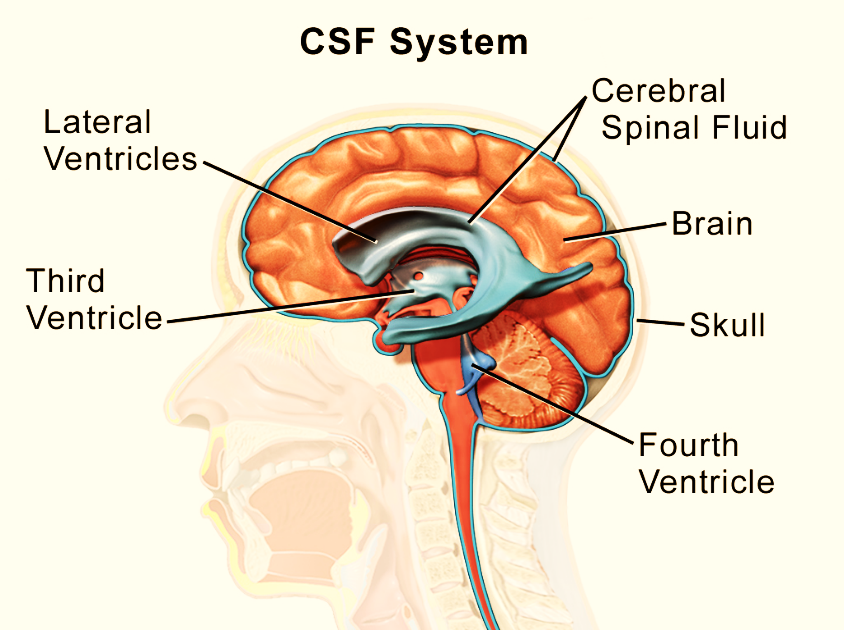
Additional Information: Cerebral aqueduct comes from a Latin word called ‘aqueductus’ which was used to describe pipes that transported water. The aqueduct of the brain is so named maybe because it serves as a canal or duct within which the Cerebrospinal Fluid or CSF flows from the third ventricle to the fourth ventricle. Thus, the cerebral aqueduct forms an integral part of the ventricular system of the brain. The components of the ventricular system comprise ciliated columnar to cuboidal epithelial cells called ependymal cells. These cells form a specialized cellular structure called the Choroid plexus which produces the cerebrospinal fluid. The CSF circulates within the ventricles and permits the brain to float in it, acting as a shock absorber. The CSF is known to help maintain chemical balance of the brain and provide nutrients to it.
Note: The brain comprises cavities called ventricles. There are four such ventricles in the brain – two lateral ventricles, a third and a fourth ventricle. The cerebral aqueduct forms a part of the ventricular system of the brain. It connects the third and fourth brain ventricles and serves as a canal through which cerebrospinal fluid or CSF flows. The CSF is present in the brain ventricles and in the spinal cord. The CSF protects the brain and spinal, provides buoyancy against gravity, provides nutrients to the brain and helps maintain the chemical balance of the brain.
Complete step by step answer: The cerebral aqueduct is also known as Aqueductus mesencephali or Aqueduct of Sylvius. It was first described by Franciscus Sylvius. It lies within the midbrain.
The brain contains cavities called ventricles. There are four such cavities – two on the sides called Lateral ventricles, a third ventricle in the lower part of the brain and a fourth ventricle, along the brain stem. The ventricles are connected with each other and with the spinal cord.
The cerebral aqueduct functions to connect the third ventricle of the brain with the fourth one. Therefore, it lies in between the third and fourth ventricles.
Hence, option (c) is correct.
Fig: Ventricular System of human brain
Additional Information: Cerebral aqueduct comes from a Latin word called ‘aqueductus’ which was used to describe pipes that transported water. The aqueduct of the brain is so named maybe because it serves as a canal or duct within which the Cerebrospinal Fluid or CSF flows from the third ventricle to the fourth ventricle. Thus, the cerebral aqueduct forms an integral part of the ventricular system of the brain. The components of the ventricular system comprise ciliated columnar to cuboidal epithelial cells called ependymal cells. These cells form a specialized cellular structure called the Choroid plexus which produces the cerebrospinal fluid. The CSF circulates within the ventricles and permits the brain to float in it, acting as a shock absorber. The CSF is known to help maintain chemical balance of the brain and provide nutrients to it.
Note: The brain comprises cavities called ventricles. There are four such ventricles in the brain – two lateral ventricles, a third and a fourth ventricle. The cerebral aqueduct forms a part of the ventricular system of the brain. It connects the third and fourth brain ventricles and serves as a canal through which cerebrospinal fluid or CSF flows. The CSF is present in the brain ventricles and in the spinal cord. The CSF protects the brain and spinal, provides buoyancy against gravity, provides nutrients to the brain and helps maintain the chemical balance of the brain.
Recently Updated Pages
Master Class 11 Social Science: Engaging Questions & Answers for Success

Master Class 11 English: Engaging Questions & Answers for Success
Master Class 11 Accountancy: Engaging Questions & Answers for Success
Master Class 11 Physics: Engaging Questions & Answers for Success
Master Class 11 Computer Science: Engaging Questions & Answers for Success
Master Class 11 Business Studies: Engaging Questions & Answers for Success
Trending doubts
One Metric ton is equal to kg A 10000 B 1000 C 100 class 11 physics CBSE
Find the value of the expression given below sin 30circ class 11 maths CBSE
Draw a diagram of nephron and explain its structur class 11 biology CBSE
10 examples of friction in our daily life
Proton was discovered by A Thomson B Rutherford C Chadwick class 11 chemistry CBSE
How many kilometers are there in 100 meters class 11 maths CBSE