




The centroid divides each median of a triangle in the ratio……………………………
Answer
 Verified
622.5k+ views
Hint: First draw the medians of a triangle, medians are the line segments, which joins the midpoint of a side to its opposite vertex. All three medians intersect at common point. Then extend a median at some different point and form a parallelogram, then use in a parallelogram the diagonals bisect each other to find out the required ratio.
Complete step by step answer:
Let us, draw a triangle with all three medians first,
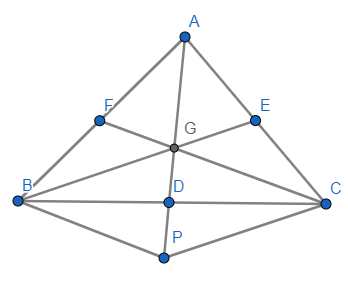
Here AD, BE, CF are the medians and G is the centroid of the $\Delta ABC$ .
This means
$\begin{align}
& AC=2AE=2EC \\
& AB=2AF=2BF \\
& BC=2BD=2DC \\
\end{align}$
Let's produce AD to P such that AG = GP and join BP and CP.
Now in $\Delta ABC$ we have \[GF||BP\] and F and G are the mid points on AB and AP.
Therefore, from the midpoint theorem we can write, $GC\parallel BP$
Similarly, in $\Delta ACP$ we have $GE\parallel CP$ and E and G are the mid points on AC and AP.
Therefore, from the midpoint theorem we can write, $BG\parallel CP$.
This means BGCP is a parallelogram because, $GC\parallel BP$ and $BG\parallel CP$.
Now as we know in a parallelogram the diagonals bisect each other, therefore,
$GD=DP$
But, $AG=GP$
This means,
$\begin{align}
& AG=GD+DP \\
& \Rightarrow AG=2GD \\
& \Rightarrow \dfrac{AG}{GD}=\dfrac{2}{1} \\
\end{align}$
So, that means the median AD is divided in a 2:1 ratio by the centroid G. A similar case procedure can be repeated on all the medians and the ratio will be the same i.e., 2:1 .
Hence, the centroid divides each median of a triangle in the ratio 2:1 .
Note: The caution must be taken when making the lines parallel to each other and applying the mid-point theorem. There should be a valid reason for each substitution.
Another approach is by using concurrency of triangles.
Complete step by step answer:
Let us, draw a triangle with all three medians first,
Here AD, BE, CF are the medians and G is the centroid of the $\Delta ABC$ .
This means
$\begin{align}
& AC=2AE=2EC \\
& AB=2AF=2BF \\
& BC=2BD=2DC \\
\end{align}$
Let's produce AD to P such that AG = GP and join BP and CP.
Now in $\Delta ABC$ we have \[GF||BP\] and F and G are the mid points on AB and AP.
Therefore, from the midpoint theorem we can write, $GC\parallel BP$
Similarly, in $\Delta ACP$ we have $GE\parallel CP$ and E and G are the mid points on AC and AP.
Therefore, from the midpoint theorem we can write, $BG\parallel CP$.
This means BGCP is a parallelogram because, $GC\parallel BP$ and $BG\parallel CP$.
Now as we know in a parallelogram the diagonals bisect each other, therefore,
$GD=DP$
But, $AG=GP$
This means,
$\begin{align}
& AG=GD+DP \\
& \Rightarrow AG=2GD \\
& \Rightarrow \dfrac{AG}{GD}=\dfrac{2}{1} \\
\end{align}$
So, that means the median AD is divided in a 2:1 ratio by the centroid G. A similar case procedure can be repeated on all the medians and the ratio will be the same i.e., 2:1 .
Hence, the centroid divides each median of a triangle in the ratio 2:1 .
Note: The caution must be taken when making the lines parallel to each other and applying the mid-point theorem. There should be a valid reason for each substitution.
Another approach is by using concurrency of triangles.
Recently Updated Pages
Master Class 10 Social Science: Engaging Questions & Answers for Success

Master Class 10 Science: Engaging Questions & Answers for Success
Master Class 10 Maths: Engaging Questions & Answers for Success
Master Class 10 General Knowledge: Engaging Questions & Answers for Success
Master Class 10 Computer Science: Engaging Questions & Answers for Success
Class 10 Question and Answer - Your Ultimate Solutions Guide
Trending doubts
What is the full form of PNG A Petrol Natural Gas B class 10 chemistry CBSE
Explain the Treaty of Vienna of 1815 class 10 social science CBSE
In cricket, how many legal balls are there in a standard over?
Why is there a time difference of about 5 hours between class 10 social science CBSE
Who Won 36 Oscar Awards? Record Holder Revealed
What is the median of the first 10 natural numbers class 10 maths CBSE