




The centroid and the orthocentre are coincident for which one of the following triangles?
(a) Scalene triangle
(b) Isosceles triangle
(c) Equilateral triangle
(d) Right-angled triangle
Answer
 Verified
649.5k+ views
Hint: To solve the above question, we will first draw a triangle ABC and then we will make use of the fact that if the centroid and the orthocentre are coincident then the corresponding medians will coincide with the corresponding altitudes of the triangle ABC. Thus, we will start by drawing a median from A which will be perpendicular to the opposite side. Now, the triangle will be divided into two triangles. Now, we will prove these two triangles as congruent and by CPCT, we will consider the corresponding angles and sides as equal. We will do the same for the median through B. Then finally, we will look at the obtained results and determine what kind of the triangle will it be.
Complete step by step answer:
Before we solve the question, we must know what is a centroid and an orthocentre. The centroid is a point where all three medians intersect. The orthocentre is the point of intersection of altitudes of a triangle. Now, if the centroid and the orthocentre of a triangle coincide, then the corresponding medians will coincide with the corresponding attitudes of the triangle. Thus, if a median is drawn from one point to the opposite side, then it will be perpendicular to that opposite side. Now, we will consider a triangle ABC and we will draw a median from A which is perpendicular to BC. The rough sketch is given as,
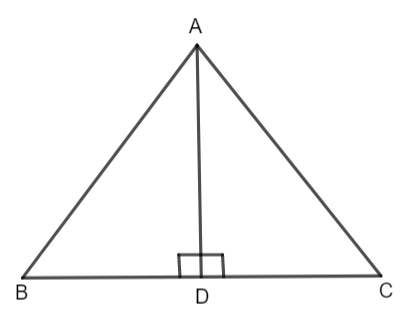
Now, AD is perpendicular to BC, i.e. \[\angle ADB=\angle ADC={{90}^{o}}.\] Also, BD = DC because AD is a median. Now, we will consider triangle ABD and triangle ACD. Thus, we have,
In triangle ABD and triangle ACD,
AD = AD (common side)
\[\angle ADB=\angle ADC={{90}^{o}}\]
BD = DC ( median bisects opposite side)
So, triangle ABD and triangle ACD are congruent to each other by SAS rule. So, by CPCT,
\[\angle ABD=\angle ACD......\left( i \right)\]
\[AB=AC......\left( ii \right)\]
Now, if a median is drawn from B, then it will be perpendicular to AC. The rough sketch is shown.
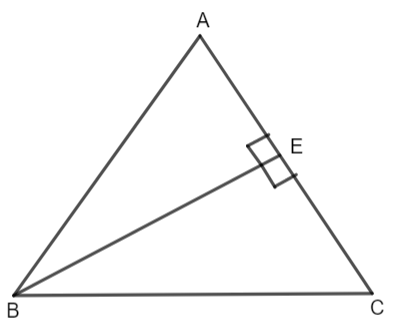
Now, BE is perpendicular to AC and AE = EC because the median bisects the opposite side. Now, we will consider triangle AEB and triangle CEB.
In triangle AEB and triangle CEB,
BE = BE (common side)
\[\angle AEB=\angle CEB={{90}^{o}}\]
AE = EC (median bisects opposite side)
So, triangle AEB and triangle CEB are congruent to each other by SAS rule. So, by CPCT,
\[\angle BAE=\angle BCE.....\left( iii \right)\]
\[AB=BC.....\left( iv \right)\]
From (i), we can say that,
\[\angle ABD=\angle ACD\]
\[\Rightarrow \angle B=\angle C.....\left( v \right)\]
From (iii), we can say that,
\[\angle BAE=\angle BCE\]
\[\Rightarrow \angle A=\angle C.....\left( vi \right)\]
From (v) and (vi), we have,
\[\angle A=\angle B=\angle C.....\left( vii \right)\]
From (ii) and (iv), we have,
\[AB=BC=AC....\left( viii \right)\]
From (vii) and (viii), we can say that the triangle given has all the sides equal, and all the angles equal. The triangle in which all the sides are equal and all the angles are equal is equilateral. So, we can say that triangle ABC is equilateral.
Hence, the option (c) is the right answer.
Note: The above question can also be solved in an alternate way which is shown below.
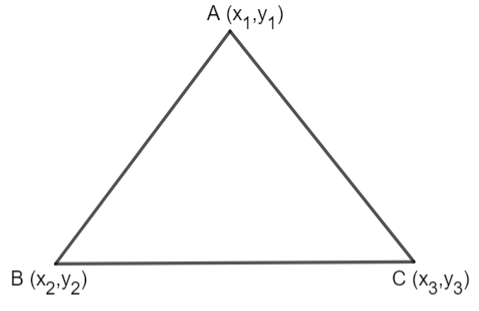
The coordinates of the centroid G(A, B) is given by,
\[G\left( A,B \right)=\left[ \dfrac{{{x}_{1}}+{{x}_{2}}+{{x}_{3}}}{3},\dfrac{{{y}_{1}}+{{y}_{2}}+{{y}_{3}}}{3} \right]\]
The coordinates of the orthocentre O(C, D) are given by,
\[O\left( C,D \right)=\left[ \dfrac{{{x}_{1}}\tan A+{{x}_{2}}\tan B+{{x}_{3}}\tan C}{\tan A+\tan B+\tan C},\dfrac{{{y}_{1}}\tan A+{{y}_{2}}\tan B+{{y}_{3}}\tan C}{\tan A+\tan B+\tan C} \right]\]
Now, G(A, B) and O(C, D) will coincide when \[A=B=C={{60}^{o}}.\] Thus, each of the triangles will be \[{{60}^{o}}.\] In equilateral triangle each angle is \[{{60}^{o}}.\] Thus, triangle ABC is an equilateral triangle.
Complete step by step answer:
Before we solve the question, we must know what is a centroid and an orthocentre. The centroid is a point where all three medians intersect. The orthocentre is the point of intersection of altitudes of a triangle. Now, if the centroid and the orthocentre of a triangle coincide, then the corresponding medians will coincide with the corresponding attitudes of the triangle. Thus, if a median is drawn from one point to the opposite side, then it will be perpendicular to that opposite side. Now, we will consider a triangle ABC and we will draw a median from A which is perpendicular to BC. The rough sketch is given as,
Now, AD is perpendicular to BC, i.e. \[\angle ADB=\angle ADC={{90}^{o}}.\] Also, BD = DC because AD is a median. Now, we will consider triangle ABD and triangle ACD. Thus, we have,
In triangle ABD and triangle ACD,
AD = AD (common side)
\[\angle ADB=\angle ADC={{90}^{o}}\]
BD = DC ( median bisects opposite side)
So, triangle ABD and triangle ACD are congruent to each other by SAS rule. So, by CPCT,
\[\angle ABD=\angle ACD......\left( i \right)\]
\[AB=AC......\left( ii \right)\]
Now, if a median is drawn from B, then it will be perpendicular to AC. The rough sketch is shown.
Now, BE is perpendicular to AC and AE = EC because the median bisects the opposite side. Now, we will consider triangle AEB and triangle CEB.
In triangle AEB and triangle CEB,
BE = BE (common side)
\[\angle AEB=\angle CEB={{90}^{o}}\]
AE = EC (median bisects opposite side)
So, triangle AEB and triangle CEB are congruent to each other by SAS rule. So, by CPCT,
\[\angle BAE=\angle BCE.....\left( iii \right)\]
\[AB=BC.....\left( iv \right)\]
From (i), we can say that,
\[\angle ABD=\angle ACD\]
\[\Rightarrow \angle B=\angle C.....\left( v \right)\]
From (iii), we can say that,
\[\angle BAE=\angle BCE\]
\[\Rightarrow \angle A=\angle C.....\left( vi \right)\]
From (v) and (vi), we have,
\[\angle A=\angle B=\angle C.....\left( vii \right)\]
From (ii) and (iv), we have,
\[AB=BC=AC....\left( viii \right)\]
From (vii) and (viii), we can say that the triangle given has all the sides equal, and all the angles equal. The triangle in which all the sides are equal and all the angles are equal is equilateral. So, we can say that triangle ABC is equilateral.
Hence, the option (c) is the right answer.
Note: The above question can also be solved in an alternate way which is shown below.
The coordinates of the centroid G(A, B) is given by,
\[G\left( A,B \right)=\left[ \dfrac{{{x}_{1}}+{{x}_{2}}+{{x}_{3}}}{3},\dfrac{{{y}_{1}}+{{y}_{2}}+{{y}_{3}}}{3} \right]\]
The coordinates of the orthocentre O(C, D) are given by,
\[O\left( C,D \right)=\left[ \dfrac{{{x}_{1}}\tan A+{{x}_{2}}\tan B+{{x}_{3}}\tan C}{\tan A+\tan B+\tan C},\dfrac{{{y}_{1}}\tan A+{{y}_{2}}\tan B+{{y}_{3}}\tan C}{\tan A+\tan B+\tan C} \right]\]
Now, G(A, B) and O(C, D) will coincide when \[A=B=C={{60}^{o}}.\] Thus, each of the triangles will be \[{{60}^{o}}.\] In equilateral triangle each angle is \[{{60}^{o}}.\] Thus, triangle ABC is an equilateral triangle.
Recently Updated Pages
Basicity of sulphurous acid and sulphuric acid are

Master Class 10 Computer Science: Engaging Questions & Answers for Success
Master Class 10 Social Science: Engaging Questions & Answers for Success
Master Class 10 Science: Engaging Questions & Answers for Success
Class 10 Question and Answer - Your Ultimate Solutions Guide
Master Class 10 Maths: Engaging Questions & Answers for Success
Trending doubts
What is the Total Duration of Football Match?
Explain the Treaty of Vienna of 1815 class 10 social science CBSE
In football, which nation is called "La Roja"?
Why is there a time difference of about 5 hours between class 10 social science CBSE
10 examples of evaporation in daily life with explanations
What is the full form of POSCO class 10 social science CBSE