




The cells observed in matchstick are:
A. Dead cell
B. Living cell
C. Dividing cell
D. All of the above
Answer
 Verified
591.6k+ views
Hint: The cells in matchstick lack protoplasm and protoplasm refers to the living parts of a cell. The protoplasm is composed of the nucleus and cytoplasm. The protoplasm is the main area where the cellular living process takes place.
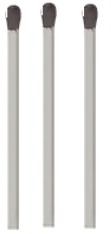
Step by step answer:Robert Hooke first discovered the cell in 1665. He had found empty rooms “cellula” under a microscope in a cork. It was because he had seen the dead cell wall of cork cells. He also performed an experiment using a matchstick where he observed it under the microscope. The cells of the matchstick were rectangular in shape. These were devoid of the nucleus; no cytoplasm and deposition were found inside these cells. Hence, the cells lacked protoplasm and were referred to as the dead cells which were similar to the cork cells. Living cells are usually cells having nucleus, cytoplasm, and cell organelles. They have immense potential to divide and carry out various metabolic functions. Dividing cells look entirely different and they have the potential to duplicate by the process of cell division. In dividing cells various stages of cell division can be observed, usually, the nuclear envelope is invisible during division. Moreover, the dividing cells often show thread-like chromosomes/ chromatids; sometimes arranged in a line (metaphase), sometimes appear as threads (prophase), and sometimes seen moving towards the poles (anaphase).
So, the correct option is A. dead cell.
Note: Robert Hooke observed, discovered, and named the cells. His experiments were based on the crock and matchstick cells. Robert Brown discovered the nucleus of a cell. In the nucleus, all genetic information is stored in the nucleic acid(DNA).
Step by step answer:Robert Hooke first discovered the cell in 1665. He had found empty rooms “cellula” under a microscope in a cork. It was because he had seen the dead cell wall of cork cells. He also performed an experiment using a matchstick where he observed it under the microscope. The cells of the matchstick were rectangular in shape. These were devoid of the nucleus; no cytoplasm and deposition were found inside these cells. Hence, the cells lacked protoplasm and were referred to as the dead cells which were similar to the cork cells. Living cells are usually cells having nucleus, cytoplasm, and cell organelles. They have immense potential to divide and carry out various metabolic functions. Dividing cells look entirely different and they have the potential to duplicate by the process of cell division. In dividing cells various stages of cell division can be observed, usually, the nuclear envelope is invisible during division. Moreover, the dividing cells often show thread-like chromosomes/ chromatids; sometimes arranged in a line (metaphase), sometimes appear as threads (prophase), and sometimes seen moving towards the poles (anaphase).
So, the correct option is A. dead cell.
Note: Robert Hooke observed, discovered, and named the cells. His experiments were based on the crock and matchstick cells. Robert Brown discovered the nucleus of a cell. In the nucleus, all genetic information is stored in the nucleic acid(DNA).
Recently Updated Pages
Master Class 11 Social Science: Engaging Questions & Answers for Success

Master Class 11 Physics: Engaging Questions & Answers for Success
Master Class 11 Maths: Engaging Questions & Answers for Success
Master Class 11 Economics: Engaging Questions & Answers for Success
Master Class 11 Computer Science: Engaging Questions & Answers for Success
Master Class 11 Chemistry: Engaging Questions & Answers for Success
Trending doubts
One Metric ton is equal to kg A 10000 B 1000 C 100 class 11 physics CBSE
There are 720 permutations of the digits 1 2 3 4 5 class 11 maths CBSE
1 Quintal is equal to a 110 kg b 10 kg c 100kg d 1000 class 11 physics CBSE
State and prove Bernoullis theorem class 11 physics CBSE
Difference Between Prokaryotic Cells and Eukaryotic Cells
Discuss the various forms of bacteria class 11 biology CBSE