




The capitulum type of inflorescence is found in
A. Marigold, Sunflower
B. Salvia, Ocimum
C. Euphorbia, Ficus
D. Ocimum, Ficus
Answer
 Verified
602.1k+ views
Hint: An inflorescence is an assortment or cluster of flowers assembled on a stem that is accumulated of a major branch or a complex pact of branches. Morphologically, it is the modified part of the shoot of seed plants where flowers are produced. Inflorescences are described by many diverse characteristics including how the flowers are assembled on the peduncle, the blooming order of the flowers.
Complete answer: Verticillaster consists of biparous cymes ending in uniparous scorpioid cymes on either side. Examples are salvia and Ocimum.
Hypanthodium - In this type of inflorescence the receptacle becomes globular with a cavity within. It opens to the outside with a little opening. Numerous small sessile flowers are created from the internal surface of the receptacle. e.g., Ficus.
Cyathium type of inflorescence is found in the family Euphorbiaceae. In this inflorescence there is a cup-shaped involucre, often provided with nectar liberating glands.
In capitulum inflorescence, the peduncle is flat and the florets are assembled in a centripetal way. The entire cluster of florets is surrounded by a whorl of bracts known as an involucre. The receptacle is flat. Florets are bracketed in Marigold. Examples are marigold, sunflower.
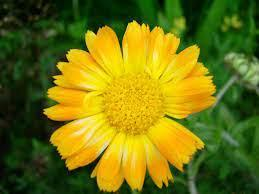
So, the correct answer is “Option A”.
Note:
Certainly, the most remarkable plants to present their flowers in a capitulum are those in the aster family, Asteraceae. Also known as the Compositae because their capitulum often includes two types of flowers in a specially mixed cluster, these capitulos often look like large individual blossoms. The flowers are independently tiny; aggregation in a capitulum assists assembly-line pollination. A single floral visitor can carry pollen to and remove it from many flowers in one foraging.
Complete answer: Verticillaster consists of biparous cymes ending in uniparous scorpioid cymes on either side. Examples are salvia and Ocimum.
Hypanthodium - In this type of inflorescence the receptacle becomes globular with a cavity within. It opens to the outside with a little opening. Numerous small sessile flowers are created from the internal surface of the receptacle. e.g., Ficus.
Cyathium type of inflorescence is found in the family Euphorbiaceae. In this inflorescence there is a cup-shaped involucre, often provided with nectar liberating glands.
In capitulum inflorescence, the peduncle is flat and the florets are assembled in a centripetal way. The entire cluster of florets is surrounded by a whorl of bracts known as an involucre. The receptacle is flat. Florets are bracketed in Marigold. Examples are marigold, sunflower.
So, the correct answer is “Option A”.
Note:
Certainly, the most remarkable plants to present their flowers in a capitulum are those in the aster family, Asteraceae. Also known as the Compositae because their capitulum often includes two types of flowers in a specially mixed cluster, these capitulos often look like large individual blossoms. The flowers are independently tiny; aggregation in a capitulum assists assembly-line pollination. A single floral visitor can carry pollen to and remove it from many flowers in one foraging.
Recently Updated Pages
Master Class 9 General Knowledge: Engaging Questions & Answers for Success

Master Class 9 Maths: Engaging Questions & Answers for Success
Master Class 9 Science: Engaging Questions & Answers for Success
Master Class 9 English: Engaging Questions & Answers for Success
Master Class 9 Social Science: Engaging Questions & Answers for Success
Class 9 Question and Answer - Your Ultimate Solutions Guide
Trending doubts
One Metric ton is equal to kg A 10000 B 1000 C 100 class 11 physics CBSE
Difference Between Prokaryotic Cells and Eukaryotic Cells
Two of the body parts which do not appear in MRI are class 11 biology CBSE
1 ton equals to A 100 kg B 1000 kg C 10 kg D 10000 class 11 physics CBSE
10 examples of friction in our daily life
Name the Largest and the Smallest Cell in the Human Body ?