




The Calvin-Benson cycle starts when-
A. Light is available.
B. Light is not available.
C. Carbon dioxide is attached to RuBP.
D. Electrons leave a photosystem.
Answer
 Verified
608.7k+ views
Hint: The Calvin cycle is referred to as the light-independent reactions occurring in photosynthesis that basically takes place in three main steps i.e. fixation, reduction and regeneration. It is also known as TCA cycle.
Complete answer:
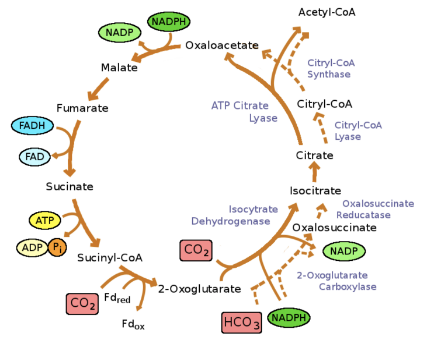
RuBisCO (ribulose bisphosphate carboxylase) is a plant enzyme which catalyzes the fixation of atmospheric carbon dioxide during the process of photosynthesis in plants by catalyzing the reaction between carbon dioxide and RuBP.
However, the Calvin Cycle or the TCA cycle is not directly dependent on light, it depends indirectly on light as the energy carriers (ATP and NADPH) which are necessary for this are the products of light-dependent reactions.
Talking about the fixation, the first stage is of the Calvin cycle, where light-independent reactions are initiated; CO2 is fixed from an inorganic molecule to an organic molecule.
In the second stage, ATP and NADPH are further used to reduce 3-PGA into G3P(Glucose-3-Phosphate); then the ATP and NADPH are converted to ADP and NADP+.
And In the last stage i.e. Regeneration in the Calvin Cycle, RuBP is again regenerated, which allows the system to prepare for more CO2 to be fixed.
Hence the correct option is option C i.e. carbon dioxide is attached to RuBP.
Note: In plants, the carbon dioxide (CO2) enters the leaves through the stomata(responsible for gaseous exchange), where it further diffuses over short distances through the intercellular spaces until it reaches the mesophyll cells present in the leaves.. Once it reaches the mesophyll cells, CO2 diffuses into the stroma of the chloroplast, the site of light-independent reactions of photosynthesis.
Complete answer:
RuBisCO (ribulose bisphosphate carboxylase) is a plant enzyme which catalyzes the fixation of atmospheric carbon dioxide during the process of photosynthesis in plants by catalyzing the reaction between carbon dioxide and RuBP.
However, the Calvin Cycle or the TCA cycle is not directly dependent on light, it depends indirectly on light as the energy carriers (ATP and NADPH) which are necessary for this are the products of light-dependent reactions.
Talking about the fixation, the first stage is of the Calvin cycle, where light-independent reactions are initiated; CO2 is fixed from an inorganic molecule to an organic molecule.
In the second stage, ATP and NADPH are further used to reduce 3-PGA into G3P(Glucose-3-Phosphate); then the ATP and NADPH are converted to ADP and NADP+.
And In the last stage i.e. Regeneration in the Calvin Cycle, RuBP is again regenerated, which allows the system to prepare for more CO2 to be fixed.
Hence the correct option is option C i.e. carbon dioxide is attached to RuBP.
Note: In plants, the carbon dioxide (CO2) enters the leaves through the stomata(responsible for gaseous exchange), where it further diffuses over short distances through the intercellular spaces until it reaches the mesophyll cells present in the leaves.. Once it reaches the mesophyll cells, CO2 diffuses into the stroma of the chloroplast, the site of light-independent reactions of photosynthesis.
Recently Updated Pages
Master Class 12 Economics: Engaging Questions & Answers for Success

Master Class 12 English: Engaging Questions & Answers for Success
Master Class 12 Social Science: Engaging Questions & Answers for Success
Master Class 12 Maths: Engaging Questions & Answers for Success
Master Class 12 Physics: Engaging Questions & Answers for Success
Master Class 9 General Knowledge: Engaging Questions & Answers for Success
Trending doubts
One Metric ton is equal to kg A 10000 B 1000 C 100 class 11 physics CBSE
Difference Between Prokaryotic Cells and Eukaryotic Cells
Two of the body parts which do not appear in MRI are class 11 biology CBSE
Find the value of the expression given below sin 30circ class 11 maths CBSE
1 ton equals to A 100 kg B 1000 kg C 10 kg D 10000 class 11 physics CBSE
Draw a diagram of nephron and explain its structur class 11 biology CBSE