




The body of Tongue Worm Balanoglossus is differentiated into
(A) Head, trunk, and tail
(B) Trunk and tail
(C) Proboscis, collar, and trunk
(D) Proboscis and collar
Answer
 Verified
615.6k+ views
Hint: Hemichordata is a phylum that consists of deuterostome animals that lack head and body. The main body of hemichordate is usually divided into three distinct parts. Deuterostomes are the animals that have the first opening as an anus.
Complete step by step answer:
The Tongue Worm Balanoglossus comes under the phylum Hemichordata. The body of Balanoglossus is divided into three distinct parts that are respectively, proboscis, collar, and trunk. Being a Hemichordate, it's an "evolutionary link" between invertebrates and vertebrates. It is a deuterostome animal, and it has a similar resemblance with the sea squirts which possess branchial openings, or "gill slits". It has a notochord within the upper part of the body and has no nerve chord. It does have a gut chord which is also known as a stomochord within the collar.
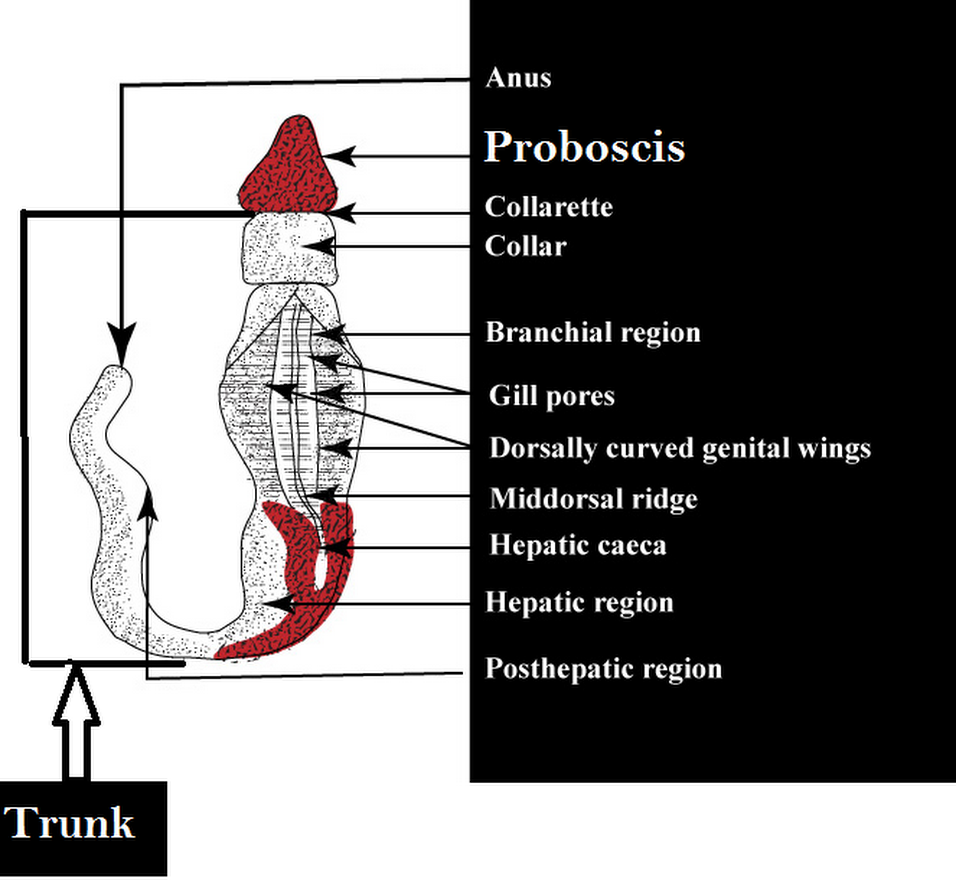
Balanoglossus is defined as a burrowing and exclusively marine creature. It's found in shallow waters between tide marks along the coast of warm and temperate oceans.
Proboscis- It is the anterior-most part of the organism and consists of muscles mostly.
Collar- It is something rectangular in outline and has a buccal cavity in the center.
Trunk- The trunk region consists mostly of the branchio-genital region.
So, the correct answer is ‘(c) Proboscis, collar, and trunk’.
Note: Balanoglossus was discovered in 1825 in Mashail Island by J.F. Eschscholtz who described it as a worm-like sea cucumber or holothurians. The animals in which the mouth is developed first are known as Protostomes. They are totally different from Deuterostome. Earlier they were thought to be similar to various other organisms belonging to different phyla but later were placed in a separate phylum.
Complete step by step answer:
The Tongue Worm Balanoglossus comes under the phylum Hemichordata. The body of Balanoglossus is divided into three distinct parts that are respectively, proboscis, collar, and trunk. Being a Hemichordate, it's an "evolutionary link" between invertebrates and vertebrates. It is a deuterostome animal, and it has a similar resemblance with the sea squirts which possess branchial openings, or "gill slits". It has a notochord within the upper part of the body and has no nerve chord. It does have a gut chord which is also known as a stomochord within the collar.
Balanoglossus is defined as a burrowing and exclusively marine creature. It's found in shallow waters between tide marks along the coast of warm and temperate oceans.
Proboscis- It is the anterior-most part of the organism and consists of muscles mostly.
Collar- It is something rectangular in outline and has a buccal cavity in the center.
Trunk- The trunk region consists mostly of the branchio-genital region.
So, the correct answer is ‘(c) Proboscis, collar, and trunk’.
Note: Balanoglossus was discovered in 1825 in Mashail Island by J.F. Eschscholtz who described it as a worm-like sea cucumber or holothurians. The animals in which the mouth is developed first are known as Protostomes. They are totally different from Deuterostome. Earlier they were thought to be similar to various other organisms belonging to different phyla but later were placed in a separate phylum.
Recently Updated Pages
Master Class 11 Social Science: Engaging Questions & Answers for Success

Master Class 11 Chemistry: Engaging Questions & Answers for Success
Master Class 9 General Knowledge: Engaging Questions & Answers for Success
Master Class 9 Maths: Engaging Questions & Answers for Success
Master Class 9 Science: Engaging Questions & Answers for Success
Master Class 9 English: Engaging Questions & Answers for Success
Trending doubts
One Metric ton is equal to kg A 10000 B 1000 C 100 class 11 physics CBSE
Difference Between Prokaryotic Cells and Eukaryotic Cells
Two of the body parts which do not appear in MRI are class 11 biology CBSE
1 ton equals to A 100 kg B 1000 kg C 10 kg D 10000 class 11 physics CBSE
10 examples of friction in our daily life
Name the Largest and the Smallest Cell in the Human Body ?