




The base of a prism is triangular in shape with sides 3 cm., 4 cm. and 5 cm. Find the volume of the prism if its height is 10 cm.
Answer
 Verified
617.1k+ views
Hint: We first find the area $B$ of the triangle at the base by taking the given data taking $a=3$cm, $b=4$cm, $c=5$cm with the formula $\sqrt{s\left( s-a \right)\left( s-b \right)\left( s-c \right)}$ where $s$ is the semi- perimeter of the triangle. We find he volume $V$ of the prism using the formula $V=B\times h$ where $h$ is the given height of the prism.
Complete step-by-step solution:
We know that a prism is a three-dimensional object polyhedron with $n-$sided polygonal base at the bottom and the same $n-$sided polygonal base translated without rotation at the top with $n$ other parallelogram-shaped faces joining corresponding faces. The volume of the prism is given by the formula volume denoted as $V$, the area of the base denoted as $B$, and the height of the prism as$h$,
\[V=B\times h\]
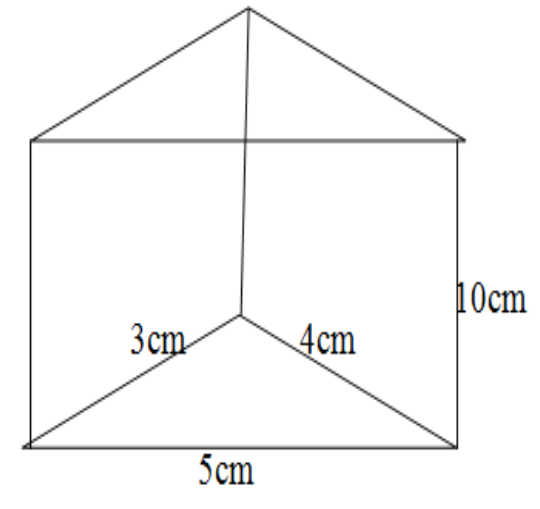
If the base of the prism is a triangle then it is a polyhedron with the base as at the bottom and the top as a 3-sided triangle and 3 parallelogram-shaped faces joining both the bases. We are given in the question that the base is triangular and the sides of the triangle at the base are of length 3cm, 4c, 5cm. The height is given as $h=10$cm. We only need to find the area of the base $B$.
We know that the area of any triangle with length of the sides $a,b,c$ is $\sqrt{s\left( s-a \right)\left( s-b \right)\left( s-c \right)}$ where $s$ is the semi- perimeter of the triangle. The semi-perimeter of the given triangle at the base taking $a=3$cm, $b=4$cm, $c=5$cm is $s=\dfrac{3+4+5}{2}=\dfrac{12}{2}=6$cm. So the area of the base in square cm is
\[B=\sqrt{6\left( 6-3 \right)\left( 6-4 \right)\left( 6-5 \right)}=\sqrt{6\times 3\times 2\times 1}=\sqrt{36}=6\]
Now we can find the volume of the prism as
\[V=B\times h=6\times 10=60\]
So the volume of the triangle is obtained as 60 cubic cm.
Note: We can alternatively calculate the area of the triangle at the base by observing the triangle is right-angled. The triplet length of sides $a=3$cm, $b=4$cm, $c=5$cm satisfy Pythagoras theorem ${{c}^{2}}={{a}^{2}}+{{b}^{2}}$ and hence the $c$ is the hypotenuse. So the triangle is half of the product of base and perpendicular. So we have area as$\dfrac{1}{2}\times b\times c=\dfrac{1}{2}\times 3\times 4=6$ square cm. We also note that the surface area of any prism is $A=2B+Ph$ where $P$ is the base perimeter.
Complete step-by-step solution:
We know that a prism is a three-dimensional object polyhedron with $n-$sided polygonal base at the bottom and the same $n-$sided polygonal base translated without rotation at the top with $n$ other parallelogram-shaped faces joining corresponding faces. The volume of the prism is given by the formula volume denoted as $V$, the area of the base denoted as $B$, and the height of the prism as$h$,
\[V=B\times h\]
If the base of the prism is a triangle then it is a polyhedron with the base as at the bottom and the top as a 3-sided triangle and 3 parallelogram-shaped faces joining both the bases. We are given in the question that the base is triangular and the sides of the triangle at the base are of length 3cm, 4c, 5cm. The height is given as $h=10$cm. We only need to find the area of the base $B$.
We know that the area of any triangle with length of the sides $a,b,c$ is $\sqrt{s\left( s-a \right)\left( s-b \right)\left( s-c \right)}$ where $s$ is the semi- perimeter of the triangle. The semi-perimeter of the given triangle at the base taking $a=3$cm, $b=4$cm, $c=5$cm is $s=\dfrac{3+4+5}{2}=\dfrac{12}{2}=6$cm. So the area of the base in square cm is
\[B=\sqrt{6\left( 6-3 \right)\left( 6-4 \right)\left( 6-5 \right)}=\sqrt{6\times 3\times 2\times 1}=\sqrt{36}=6\]
Now we can find the volume of the prism as
\[V=B\times h=6\times 10=60\]
So the volume of the triangle is obtained as 60 cubic cm.
Note: We can alternatively calculate the area of the triangle at the base by observing the triangle is right-angled. The triplet length of sides $a=3$cm, $b=4$cm, $c=5$cm satisfy Pythagoras theorem ${{c}^{2}}={{a}^{2}}+{{b}^{2}}$ and hence the $c$ is the hypotenuse. So the triangle is half of the product of base and perpendicular. So we have area as$\dfrac{1}{2}\times b\times c=\dfrac{1}{2}\times 3\times 4=6$ square cm. We also note that the surface area of any prism is $A=2B+Ph$ where $P$ is the base perimeter.
Recently Updated Pages
Master Class 12 Economics: Engaging Questions & Answers for Success

Master Class 12 English: Engaging Questions & Answers for Success
Master Class 12 Social Science: Engaging Questions & Answers for Success
Master Class 12 Maths: Engaging Questions & Answers for Success
Master Class 12 Physics: Engaging Questions & Answers for Success
Master Class 9 General Knowledge: Engaging Questions & Answers for Success
Trending doubts
Explain the Treaty of Vienna of 1815 class 10 social science CBSE
Who Won 36 Oscar Awards? Record Holder Revealed
What is the median of the first 10 natural numbers class 10 maths CBSE
Why is it 530 pm in india when it is 1200 afternoon class 10 social science CBSE
Make a sketch of the human nerve cell What function class 10 biology CBSE
What is the full form of POSCO class 10 social science CBSE