




The atomic number of fluorine is 9. Explain the formation of the fluoride ion.
Answer
 Verified
627.3k+ views
Hint: Consider the atomic number of fluorine and then formulate the possible electronic configuration of the atom. From this we can deduce how the fluoride ion will be formed.
Complete step by step answer:
The chemical representation of the fluoride ion is ${{F}^{-}}$. It has 1 electron extra as compared to the number of protons present in its nucleus.
We know that the atomic number of fluorine is 9 and the overall electronic configuration is 2, 7. The first orbital contains 2 electrons and the second orbital contains 7 electrons. 8 electrons are required in the second orbital to form a stable octet. The location of fluorine in the periodic table is:
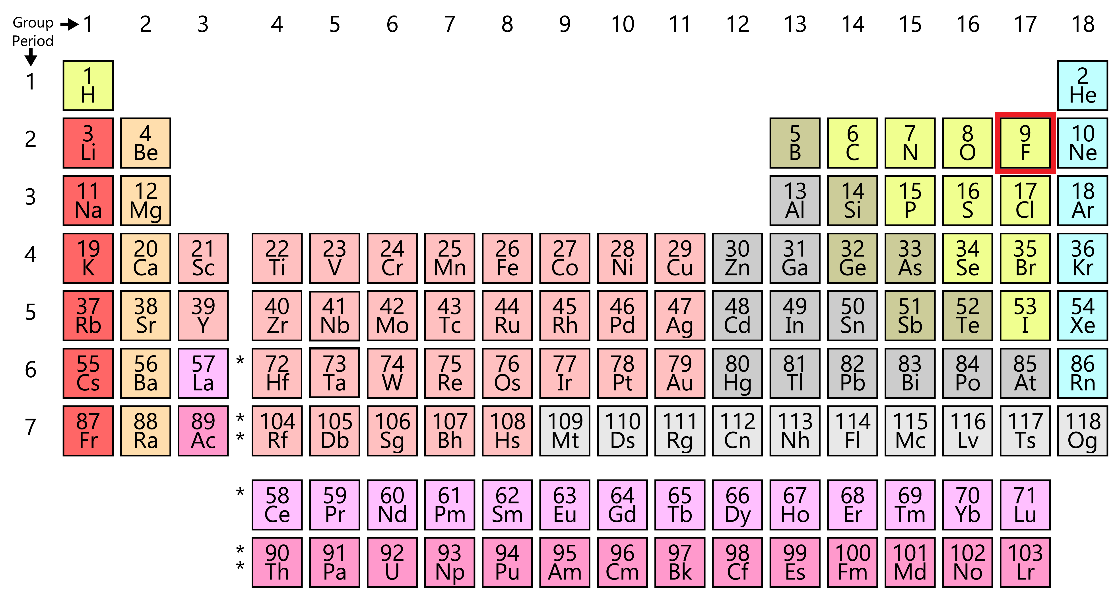
Here, we can see that fluorine is present in the seventeenth group of the periodic table. We have already seen that fluorine requires one electron to form a stable octet. So, it takes one electron from any surrounding atom and completes its octet. The general reaction for the formation of the fluoride ion is:
\[{{F}_{2}}+2{{e}^{-}}\to 2{{F}^{-}}\]
Since, the fluoride ion is far more stable than the fluorine atom, energy is released while the formation of the fluoride ion. And the reaction that takes place is usually exothermic.
Note: Remember that fluorine is the most electronegative element and has an electronegativity of 4.0 on Pauling’s Scale of electronegativity. Thus, the phenomenon of the formation of a ${{F}^{+}}$ ion will never happen since none of the elements are electronegative enough to take an electron from fluorine.
Complete step by step answer:
The chemical representation of the fluoride ion is ${{F}^{-}}$. It has 1 electron extra as compared to the number of protons present in its nucleus.
We know that the atomic number of fluorine is 9 and the overall electronic configuration is 2, 7. The first orbital contains 2 electrons and the second orbital contains 7 electrons. 8 electrons are required in the second orbital to form a stable octet. The location of fluorine in the periodic table is:
Here, we can see that fluorine is present in the seventeenth group of the periodic table. We have already seen that fluorine requires one electron to form a stable octet. So, it takes one electron from any surrounding atom and completes its octet. The general reaction for the formation of the fluoride ion is:
\[{{F}_{2}}+2{{e}^{-}}\to 2{{F}^{-}}\]
Since, the fluoride ion is far more stable than the fluorine atom, energy is released while the formation of the fluoride ion. And the reaction that takes place is usually exothermic.
Note: Remember that fluorine is the most electronegative element and has an electronegativity of 4.0 on Pauling’s Scale of electronegativity. Thus, the phenomenon of the formation of a ${{F}^{+}}$ ion will never happen since none of the elements are electronegative enough to take an electron from fluorine.
Recently Updated Pages
Master Class 11 English: Engaging Questions & Answers for Success

Master Class 11 Social Science: Engaging Questions & Answers for Success
Master Class 11 Maths: Engaging Questions & Answers for Success
Master Class 11 Biology: Engaging Questions & Answers for Success
Master Class 11 Physics: Engaging Questions & Answers for Success
Master Class 11 Chemistry: Engaging Questions & Answers for Success
Trending doubts
One Metric ton is equal to kg A 10000 B 1000 C 100 class 11 physics CBSE
Difference Between Prokaryotic Cells and Eukaryotic Cells
Difference between physical and chemical change class 11 chemistry CBSE
Find the value of the expression given below sin 30circ class 11 maths CBSE
Two of the body parts which do not appear in MRI are class 11 biology CBSE
Draw a diagram of a plant cell and label at least eight class 11 biology CBSE