




The area under acceleration – time graph gives
A. Change in acceleration.
B. Change in velocity.
C. Change in displacement.
D. Change in deceleration.
Answer
 Verified
625.5k+ views
Hint: Acceleration is defined as change in velocity (\[\vec v\]) per unit time. To find out instantaneous acceleration ( \[\vec a\] ) we differentiate the velocity (\[\vec v\]) with respect to time (\[t\]). In graphs in order to find the change in velocity we find the area under acceleration – time graph.
Formulae Used:
\[\vec a = \dfrac{{d\vec v}}{{dt}}\]
Where \[\vec a\]= acceleration of the particle
\[d\vec v\]= infinitesimal change in velocity.
\[dt\]= time take for making that infinitesimal change in velocity
Complete step-by-step solution:
Since instantaneous acceleration is given by
\[\vec a = \dfrac{{d\vec v}}{{dt}}\]
Rearranging the terms
\[d\vec v = \vec a.dt\]
Integrating both sides , we get
\[\int {d\vec v = \int {\vec a.dt} } \] we know that the term \[\int\limits_{{t_1}}^{{t_2}} {\vec a.dt} \]gives the area between the acceleration – time graph between time \[{t_1}\]to \[{t_2}\] and the term \[\int {d\vec v} \], represents the total change in velocity between the same interval of time.
Since, the area of the curve between acceleration – time graph shows the change in velocity of the moving object.
Hence, option ( B ) is the correct answer.
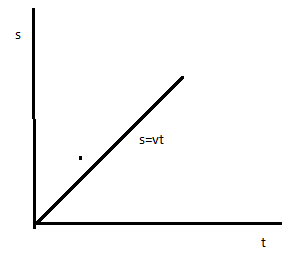
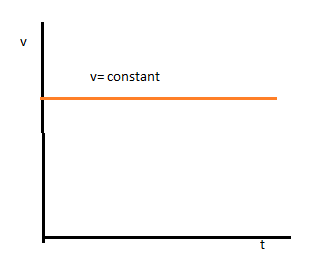
In case of uniform motion velocity remains constant , and displacement is the linear function of velocity as \[s = vt\], where \[s\] is the displacement of any object and \[v\] is the constant velocity with which the particle is moving & \[t\] is the time taken to cover the displacement or the time for which the particle is moving with constant velocity \[v\].
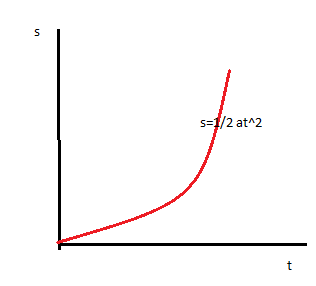
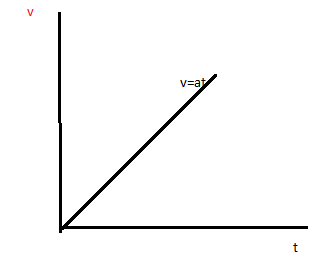
In case of uniformly accelerated motion the velocity is increasing with respect to time. The velocity is increasing with respect to time and the displacement is also increasing with respect to time.
Note:- Here is a diagram that shows the relation between displacement, velocity & acceleration.
Slope of velocity - time curve gives the value of instantaneous acceleration & the slope of displacement - time curve gives the value of instantaneous velocity.
Formulae Used:
\[\vec a = \dfrac{{d\vec v}}{{dt}}\]
Where \[\vec a\]= acceleration of the particle
\[d\vec v\]= infinitesimal change in velocity.
\[dt\]= time take for making that infinitesimal change in velocity
Complete step-by-step solution:
Since instantaneous acceleration is given by
\[\vec a = \dfrac{{d\vec v}}{{dt}}\]
Rearranging the terms
\[d\vec v = \vec a.dt\]
Integrating both sides , we get
\[\int {d\vec v = \int {\vec a.dt} } \] we know that the term \[\int\limits_{{t_1}}^{{t_2}} {\vec a.dt} \]gives the area between the acceleration – time graph between time \[{t_1}\]to \[{t_2}\] and the term \[\int {d\vec v} \], represents the total change in velocity between the same interval of time.
Since, the area of the curve between acceleration – time graph shows the change in velocity of the moving object.
Hence, option ( B ) is the correct answer.
In case of uniform motion velocity remains constant , and displacement is the linear function of velocity as \[s = vt\], where \[s\] is the displacement of any object and \[v\] is the constant velocity with which the particle is moving & \[t\] is the time taken to cover the displacement or the time for which the particle is moving with constant velocity \[v\].
In case of uniformly accelerated motion the velocity is increasing with respect to time. The velocity is increasing with respect to time and the displacement is also increasing with respect to time.
Note:- Here is a diagram that shows the relation between displacement, velocity & acceleration.
Slope of velocity - time curve gives the value of instantaneous acceleration & the slope of displacement - time curve gives the value of instantaneous velocity.
Recently Updated Pages
Master Class 12 Business Studies: Engaging Questions & Answers for Success

Master Class 12 Chemistry: Engaging Questions & Answers for Success
Master Class 12 Biology: Engaging Questions & Answers for Success
Class 12 Question and Answer - Your Ultimate Solutions Guide
Master Class 11 English: Engaging Questions & Answers for Success
Master Class 11 Social Science: Engaging Questions & Answers for Success
Trending doubts
Which are the Top 10 Largest Countries of the World?
Draw a labelled sketch of the human eye class 12 physics CBSE
Differentiate between homogeneous and heterogeneous class 12 chemistry CBSE
Differentiate between Pyramid of energy and pyramid class 12 biology CBSE
Why is the cell called the structural and functional class 12 biology CBSE
Draw the diagram of the pyramid of energy Explain In class 12 biology CBSE