




The area of the square built upon the hypotenuse of a right triangle is equal to the sum of the areas of the squares upon the remaining sides
Answer
 Verified
608.7k+ views
Hint: Here we will use the relation inside the right-angled triangle, that relation is known as Pythagoras theorem.
If a, b, c are the sides of a right-angled triangle then \[{a^2} + {b^2} = {c^2}\] where c is the longest side know as hypotenuse
We will also use the concept that the area of the square with side is \[{a^2}\]
Complete step by step answer:
A right-angled triangle is given with sides a, b, c where c is the hypotenuse.
Our solution will be based on the below figure:
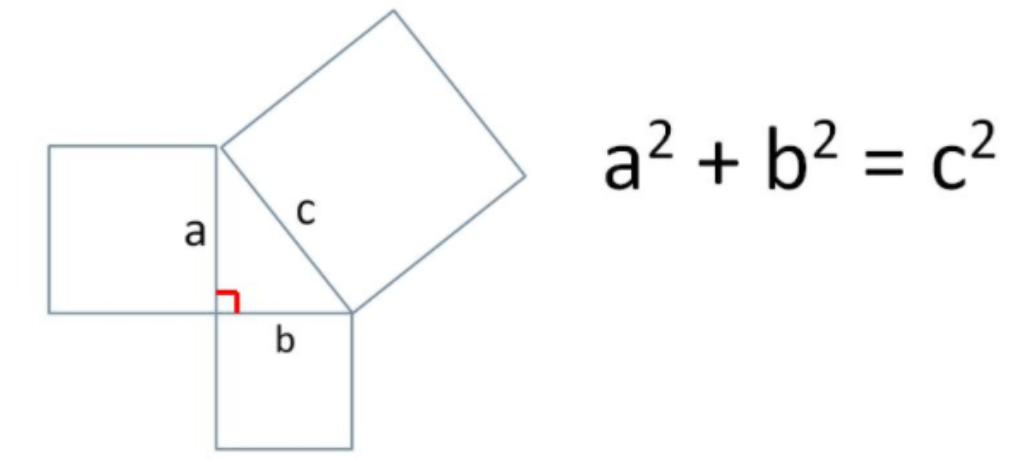
In the above figure the angle between side a and b is right and 90 degrees.
Squares are made on every side of the triangle
Here we can easily observe that area of the square whose side is a is equal to \[{a^2}\]
And we can also easily observe that area of the square whose side is b is equal to \[{b^2}\]
And we can also easily observe that area of the square whose side is c is equal to \[{c^2}\]
By Pythagoras theorem
\[{a^2} + {b^2} = {c^2}\]
(area of square with side a) + (area of square with side b) = (area of square with side c)
Hence, we can state that the given statement is True.
Note: In this type of questions we need to focus on the basic concept of geometry. We need to know the area of the square when the side of the square is given. Pythagora's theorem is need to be learnt.
If a, b, c are the sides of a right-angled triangle then \[{a^2} + {b^2} = {c^2}\] where c is the longest side know as hypotenuse
We will also use the concept that the area of the square with side is \[{a^2}\]
Complete step by step answer:
A right-angled triangle is given with sides a, b, c where c is the hypotenuse.
Our solution will be based on the below figure:
In the above figure the angle between side a and b is right and 90 degrees.
Squares are made on every side of the triangle
Here we can easily observe that area of the square whose side is a is equal to \[{a^2}\]
And we can also easily observe that area of the square whose side is b is equal to \[{b^2}\]
And we can also easily observe that area of the square whose side is c is equal to \[{c^2}\]
By Pythagoras theorem
\[{a^2} + {b^2} = {c^2}\]
(area of square with side a) + (area of square with side b) = (area of square with side c)
Hence, we can state that the given statement is True.
Note: In this type of questions we need to focus on the basic concept of geometry. We need to know the area of the square when the side of the square is given. Pythagora's theorem is need to be learnt.
Recently Updated Pages
The branch of science which deals with nature and natural class 10 physics CBSE

Where is the Centre for Environmental Education Located?
Which country won UEFA Euro 2020 tournament (played in 2021)?
Understanding the Sun's Density: Exploring the Mass Density of a Hot Plasma - FAQs and Data Analysis
How is Abiogenesis Theory Disproved Experimentally?
In a plane electromagnetic wave the electric field class 12 physics CBSE
Trending doubts
What is the full form of PNG A Petrol Natural Gas B class 10 chemistry CBSE
Explain the Treaty of Vienna of 1815 class 10 social science CBSE
Why is there a time difference of about 5 hours between class 10 social science CBSE
What is the median of the first 10 natural numbers class 10 maths CBSE
Write a letter to the newspaper editor highlighting class 10 english CBSE
What is the "grid" in Formula 1 racing?