




The area of region bounded by the parabola ${{y}^{2}}=16{{x}^{2}}$ & its latus rectum is
A. $\dfrac{64}{3}sq\text{ unit}$
B. $\dfrac{128}{3}sq\text{ unit}$
C. $\dfrac{32}{3}sq\text{ unit}$
D. $\dfrac{16}{3}sq\text{ unit}$
Answer
 Verified
559.8k+ views
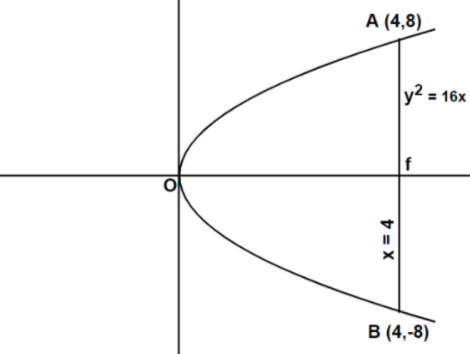
Hint: Plot the parabola & draw the line of latus. Find the point of intersection and integrate the curve i.e. ${{y}^{2}}=16x$ i.e.$y=4\sqrt{x}$ .Limit values will be the values of x and since it's symmetric so we can double the area.
Complete step by step solution:
Compare the given parabola ${{y}^{2}}=16{{x}^{2}}$
with${{y}^{2}}=4ax$
we get
$4a=16$
$\begin{align}
& a=\dfrac{16}{4} \\
& a=4 \\
\end{align}$
$\therefore $ Focus is F$\left( a,0 \right)$ i.e. F$\left( 4,0 \right)$
Equation of latus rectum
For $x=a$
That is, $x=4$
For $x=4$,${{y}^{2}}=16x$
$\begin{align}
& \Rightarrow {{y}^{2}}=16\times 4=64 \\
& \Rightarrow y=\pm 8 \\
& \Rightarrow {{y}^{2}}=16x \\
& \Rightarrow y=\sqrt{16x}=4\sqrt{4x} \\
\end{align}$
Now Area of OAFB$=2$Area of OAF
\[\begin{align}
& =2\int\limits_{0}^{4}{ydx=2\int\limits_{0}^{4}{4\sqrt{x}}dx} \\
& =8\int\limits_{0}^{4}{{{x}^{1/2}}dx} \\
& =8\dfrac{{{x}^{3/2}}}{3/2}\underset{0}{\overset{4}{\mathop{|}}}\, \\
& =8\times \dfrac{2}{3}{{x}^{3/2}}\underset{0}{\overset{4}{\mathop{|}}}\, \\
& =16\left[ {{\left( 4 \right)}^{3/2}}-{{0}^{3/2}} \right] \\
& =\dfrac{16}{3}\times 8=\dfrac{128}{3}sq\text{ units} \\
\end{align}\]
Additional information:
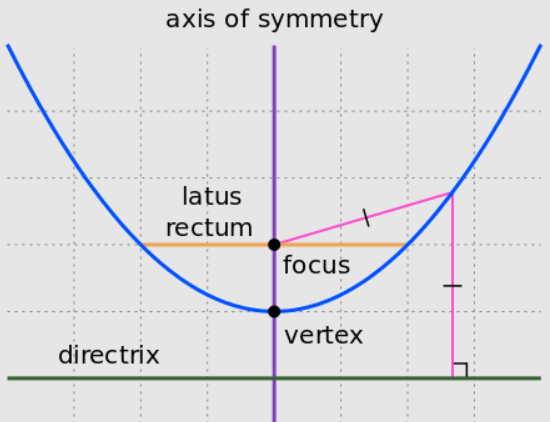
In mathematics, a parabola is a plane curve which is mirror-symmetrical and is approximately U-shaped.
A parabola can also be defined geometrically as a set of points (locus of points) in the
A parabola is a set of points, such that for any point P of the set the distance |PF| to a fixed point F, the focus, is equal to the distance |Pl| to a fixed line l, the directrix $\{P:|PF|=|Pl|\}$
For a parabola, the semi-latus rectum, p, is the distance of the focus from the directrix. Using the parameter p, the equation of the parabola can be rewritten as
${{x}^{2}}=2py$
In the case of f<0 the parabola has a downward opening.
The presumption that the axis is parallel to the y axis allows one to consider a parabola as the graph of a polynomial of degree 2, and conversely: the graph of an arbitrary polynomial of degree 2 is a parabola (see next section).
If one exchanges x and y, one obtains equations of the form${{y}^{2}}=2px$ . These parabolas open to the left (if p<0) or to the right (if p>0).
We can find the area of the region along the y-axis rather than x-axis. In that case function should be in terms of y & limits also for variable y.
Note: In symmetrical diagram or function if it is even function then the answer will be zero so to avoid that we must double the area. The knowledge about the parabola that is the equation of parabola which is ${{x}^{2}}=2py$, required to answer such questions. Whenever we are required to find the area under the given curve we always use integration.
Complete step by step solution:
Compare the given parabola ${{y}^{2}}=16{{x}^{2}}$
with${{y}^{2}}=4ax$
we get
$4a=16$
$\begin{align}
& a=\dfrac{16}{4} \\
& a=4 \\
\end{align}$
$\therefore $ Focus is F$\left( a,0 \right)$ i.e. F$\left( 4,0 \right)$
Equation of latus rectum
For $x=a$
That is, $x=4$
For $x=4$,${{y}^{2}}=16x$
$\begin{align}
& \Rightarrow {{y}^{2}}=16\times 4=64 \\
& \Rightarrow y=\pm 8 \\
& \Rightarrow {{y}^{2}}=16x \\
& \Rightarrow y=\sqrt{16x}=4\sqrt{4x} \\
\end{align}$
Now Area of OAFB$=2$Area of OAF
\[\begin{align}
& =2\int\limits_{0}^{4}{ydx=2\int\limits_{0}^{4}{4\sqrt{x}}dx} \\
& =8\int\limits_{0}^{4}{{{x}^{1/2}}dx} \\
& =8\dfrac{{{x}^{3/2}}}{3/2}\underset{0}{\overset{4}{\mathop{|}}}\, \\
& =8\times \dfrac{2}{3}{{x}^{3/2}}\underset{0}{\overset{4}{\mathop{|}}}\, \\
& =16\left[ {{\left( 4 \right)}^{3/2}}-{{0}^{3/2}} \right] \\
& =\dfrac{16}{3}\times 8=\dfrac{128}{3}sq\text{ units} \\
\end{align}\]
Additional information:
In mathematics, a parabola is a plane curve which is mirror-symmetrical and is approximately U-shaped.
A parabola can also be defined geometrically as a set of points (locus of points) in the
A parabola is a set of points, such that for any point P of the set the distance |PF| to a fixed point F, the focus, is equal to the distance |Pl| to a fixed line l, the directrix $\{P:|PF|=|Pl|\}$
For a parabola, the semi-latus rectum, p, is the distance of the focus from the directrix. Using the parameter p, the equation of the parabola can be rewritten as
${{x}^{2}}=2py$
In the case of f<0 the parabola has a downward opening.
The presumption that the axis is parallel to the y axis allows one to consider a parabola as the graph of a polynomial of degree 2, and conversely: the graph of an arbitrary polynomial of degree 2 is a parabola (see next section).
If one exchanges x and y, one obtains equations of the form${{y}^{2}}=2px$ . These parabolas open to the left (if p<0) or to the right (if p>0).
We can find the area of the region along the y-axis rather than x-axis. In that case function should be in terms of y & limits also for variable y.
Note: In symmetrical diagram or function if it is even function then the answer will be zero so to avoid that we must double the area. The knowledge about the parabola that is the equation of parabola which is ${{x}^{2}}=2py$, required to answer such questions. Whenever we are required to find the area under the given curve we always use integration.
Recently Updated Pages
Master Class 11 Social Science: Engaging Questions & Answers for Success

Master Class 11 Chemistry: Engaging Questions & Answers for Success
Master Class 12 Business Studies: Engaging Questions & Answers for Success
Master Class 12 Chemistry: Engaging Questions & Answers for Success
Master Class 12 Biology: Engaging Questions & Answers for Success
Class 12 Question and Answer - Your Ultimate Solutions Guide
Trending doubts
One Metric ton is equal to kg A 10000 B 1000 C 100 class 11 physics CBSE
Difference Between Prokaryotic Cells and Eukaryotic Cells
Two of the body parts which do not appear in MRI are class 11 biology CBSE
Explain zero factorial class 11 maths CBSE
10 examples of friction in our daily life
Name the Largest and the Smallest Cell in the Human Body ?