




The area \[\left( \Delta \right)\] and angle $\theta $ of a triangle are given, when the side opposite to the given angle is minimum, then the length of remaining two sides are
A) $\sqrt {\dfrac{{2\Delta }}{{\sin \theta }}} \,,\sqrt {\dfrac{{3\Delta }}{{\sin \theta }}} $
B) $\sqrt {\dfrac{{2\Delta }}{{\sin \theta }}} \,,\sqrt {\dfrac{{2\Delta }}{{\sin \theta }}} $
C) $\sqrt {\dfrac{{4\Delta }}{{\sin \theta }}} \,,\sqrt {\dfrac{{2\Delta }}{{\sin \theta }}} $
D) $\sqrt {\dfrac{{6\Delta }}{{\sin \theta }}} \,,\sqrt {\dfrac{{6\Delta }}{{\sin \theta }}} $
Answer
 Verified
589.2k+ views
Hint:
We can draw a diagram to represent the triangle and write the area of the triangle as half times the product of the two sides and the sine of the included angle. Then we can write the 3rd side in terms of the other two sides and the included angle. Then we can minimize the function. Then we can find the value of a and b when the other side is minimum. Then we can obtain the answer by comparing it with the options.
Complete step by step solution:
We can draw a triangle representing the sides and angles.
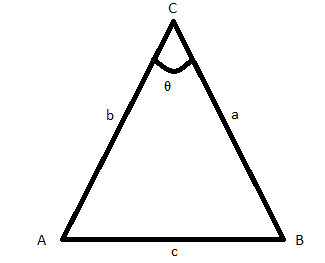
We know that the area of a triangle from any 2 sides and the angle between them is given by, half times the product of the two sides and the sine of the included angle. So, we can write the area in terms of the given angle.
$ \Rightarrow \Delta = \dfrac{1}{2} \times a \times b \times \sin \theta $
On rearranging, we get,
$ \Rightarrow 2\Delta = a \times b \times \sin \theta $
Now we can write a in terms of b.
$ \Rightarrow a = \dfrac{{2\Delta }}{{b \times \sin \theta }}$ … (1)
Similarly, we can write b in terms of a
$ \Rightarrow b = \dfrac{{2\Delta }}{{a \times \sin \theta }}$ … (2)
Now we can represent the third side using the cosine rule.
$ \Rightarrow c = {a^2} + {b^2} - 2ab\cos \theta $
Now we can substitute equation (2).
$ \Rightarrow c = {a^2} + {\left( {\dfrac{{2\Delta }}{{a \times \sin \theta }}} \right)^2} - 2a\dfrac{{2\Delta }}{{a \times \sin \theta }}\cos \theta $
On simplification, we get,
$ \Rightarrow c = {a^2} + \dfrac{{4{\Delta ^2}}}{{{a^2}{{\sin }^2}\theta }} - \dfrac{{4\Delta \cos \theta }}{{\sin \theta }}$
The last term is constant so the value of c is minimum when the other 2 terms are minimum. Now we can take the inequality of AM and GM of the other 2 terms.
\[ \Rightarrow \dfrac{{x + y}}{2} \geqslant \sqrt {xy} \]
On multiplying both sides with 2, we get,
\[ \Rightarrow x + y \geqslant 2\sqrt {xy} \]
On substituting the values, we get,
\[ \Rightarrow {a^2} + \dfrac{{4{\Delta ^2}}}{{{a^2}{{\sin }^2}\theta }} \geqslant 2\sqrt {{a^2} \times \dfrac{{4{\Delta ^2}}}{{{a^2}{{\sin }^2}\theta }}} \]
On cancelling the common terms, we get,
\[ \Rightarrow {a^2} + \dfrac{{4{\Delta ^2}}}{{{a^2}{{\sin }^2}\theta }} \geqslant 2\sqrt {\dfrac{{4{\Delta ^2}}}{{{{\sin }^2}\theta }}} \]
On taking the root in the RHS, we get,
\[ \Rightarrow {a^2} + \dfrac{{4{\Delta ^2}}}{{{a^2}{{\sin }^2}\theta }} \geqslant 2\dfrac{{2\Delta }}{{\sin \theta }}\]
On further simplification, we get,
\[ \Rightarrow {a^2} + \dfrac{{4{\Delta ^2}}}{{{a^2}{{\sin }^2}\theta }} \geqslant \dfrac{{4\Delta }}{{\sin \theta }}\]
On substituting $2\Delta = a \times b \times \sin \theta $
\[ \Rightarrow {a^2} + \dfrac{{{a^2}{b^2}{{\sin }^2}\theta }}{{{a^2}{{\sin }^2}\theta }} \geqslant \dfrac{{2ab\sin \theta }}{{\sin \theta }}\]
On cancelling the common terms, we get,
\[ \Rightarrow {a^2} + {b^2} \geqslant 2ab\]
So, the minimum value occurs when ${a^2} + {b^2} = 2ab$ .
Now using this condition, we can find a relation between a and b
\[ \Rightarrow {a^2} + {b^2} = 2ab\]
On rearranging we get,
\[ \Rightarrow {a^2} + {b^2} - 2ab = 0\]
On applying the identity, we get,
\[ \Rightarrow {\left( {a - b} \right)^2} = 0\]
On taking square root on both sides, we get,
\[ \Rightarrow \left( {a - b} \right) = 0\]
On rearranging we get,
\[ \Rightarrow a = b\]
On substituting in equation (1), we get,
$ \Rightarrow a = \dfrac{{2\Delta }}{{a \times \sin \theta }}$
On multiplying throughout with a, we get,
$ \Rightarrow {a^2} = \dfrac{{2\Delta }}{{\sin \theta }}$
On taking the square root, we get,
$ \Rightarrow a = \sqrt {\dfrac{{2\Delta }}{{\sin \theta }}} $
As \[a = b\] , we can write,
$ \Rightarrow b = \sqrt {\dfrac{{2\Delta }}{{\sin \theta }}} $
So, we get the other sides as $\sqrt {\dfrac{{2\Delta }}{{\sin \theta }}} \,,\sqrt {\dfrac{{2\Delta }}{{\sin \theta }}} $ which is option B.
So, the correct answer is option B.
Note:
We must draw a triangle and label its angles and sides. We must take the side opposite to the vertex A as a and so on. While writing the area in terms of one angle and 2 sides, we must make sure that we take the angle in between them. Inequality of AM and GM is that the Arithmetic mean of any numbers will be greater than or equal to their geometric mean. While taking the square root we take only the positive root as the length of the side cannot be negative. After proving both sides are equal, we must find their value. We cannot compare with the option to get the solution as there are 2 such options where both sides are equal.
We can draw a diagram to represent the triangle and write the area of the triangle as half times the product of the two sides and the sine of the included angle. Then we can write the 3rd side in terms of the other two sides and the included angle. Then we can minimize the function. Then we can find the value of a and b when the other side is minimum. Then we can obtain the answer by comparing it with the options.
Complete step by step solution:
We can draw a triangle representing the sides and angles.
We know that the area of a triangle from any 2 sides and the angle between them is given by, half times the product of the two sides and the sine of the included angle. So, we can write the area in terms of the given angle.
$ \Rightarrow \Delta = \dfrac{1}{2} \times a \times b \times \sin \theta $
On rearranging, we get,
$ \Rightarrow 2\Delta = a \times b \times \sin \theta $
Now we can write a in terms of b.
$ \Rightarrow a = \dfrac{{2\Delta }}{{b \times \sin \theta }}$ … (1)
Similarly, we can write b in terms of a
$ \Rightarrow b = \dfrac{{2\Delta }}{{a \times \sin \theta }}$ … (2)
Now we can represent the third side using the cosine rule.
$ \Rightarrow c = {a^2} + {b^2} - 2ab\cos \theta $
Now we can substitute equation (2).
$ \Rightarrow c = {a^2} + {\left( {\dfrac{{2\Delta }}{{a \times \sin \theta }}} \right)^2} - 2a\dfrac{{2\Delta }}{{a \times \sin \theta }}\cos \theta $
On simplification, we get,
$ \Rightarrow c = {a^2} + \dfrac{{4{\Delta ^2}}}{{{a^2}{{\sin }^2}\theta }} - \dfrac{{4\Delta \cos \theta }}{{\sin \theta }}$
The last term is constant so the value of c is minimum when the other 2 terms are minimum. Now we can take the inequality of AM and GM of the other 2 terms.
\[ \Rightarrow \dfrac{{x + y}}{2} \geqslant \sqrt {xy} \]
On multiplying both sides with 2, we get,
\[ \Rightarrow x + y \geqslant 2\sqrt {xy} \]
On substituting the values, we get,
\[ \Rightarrow {a^2} + \dfrac{{4{\Delta ^2}}}{{{a^2}{{\sin }^2}\theta }} \geqslant 2\sqrt {{a^2} \times \dfrac{{4{\Delta ^2}}}{{{a^2}{{\sin }^2}\theta }}} \]
On cancelling the common terms, we get,
\[ \Rightarrow {a^2} + \dfrac{{4{\Delta ^2}}}{{{a^2}{{\sin }^2}\theta }} \geqslant 2\sqrt {\dfrac{{4{\Delta ^2}}}{{{{\sin }^2}\theta }}} \]
On taking the root in the RHS, we get,
\[ \Rightarrow {a^2} + \dfrac{{4{\Delta ^2}}}{{{a^2}{{\sin }^2}\theta }} \geqslant 2\dfrac{{2\Delta }}{{\sin \theta }}\]
On further simplification, we get,
\[ \Rightarrow {a^2} + \dfrac{{4{\Delta ^2}}}{{{a^2}{{\sin }^2}\theta }} \geqslant \dfrac{{4\Delta }}{{\sin \theta }}\]
On substituting $2\Delta = a \times b \times \sin \theta $
\[ \Rightarrow {a^2} + \dfrac{{{a^2}{b^2}{{\sin }^2}\theta }}{{{a^2}{{\sin }^2}\theta }} \geqslant \dfrac{{2ab\sin \theta }}{{\sin \theta }}\]
On cancelling the common terms, we get,
\[ \Rightarrow {a^2} + {b^2} \geqslant 2ab\]
So, the minimum value occurs when ${a^2} + {b^2} = 2ab$ .
Now using this condition, we can find a relation between a and b
\[ \Rightarrow {a^2} + {b^2} = 2ab\]
On rearranging we get,
\[ \Rightarrow {a^2} + {b^2} - 2ab = 0\]
On applying the identity, we get,
\[ \Rightarrow {\left( {a - b} \right)^2} = 0\]
On taking square root on both sides, we get,
\[ \Rightarrow \left( {a - b} \right) = 0\]
On rearranging we get,
\[ \Rightarrow a = b\]
On substituting in equation (1), we get,
$ \Rightarrow a = \dfrac{{2\Delta }}{{a \times \sin \theta }}$
On multiplying throughout with a, we get,
$ \Rightarrow {a^2} = \dfrac{{2\Delta }}{{\sin \theta }}$
On taking the square root, we get,
$ \Rightarrow a = \sqrt {\dfrac{{2\Delta }}{{\sin \theta }}} $
As \[a = b\] , we can write,
$ \Rightarrow b = \sqrt {\dfrac{{2\Delta }}{{\sin \theta }}} $
So, we get the other sides as $\sqrt {\dfrac{{2\Delta }}{{\sin \theta }}} \,,\sqrt {\dfrac{{2\Delta }}{{\sin \theta }}} $ which is option B.
So, the correct answer is option B.
Note:
We must draw a triangle and label its angles and sides. We must take the side opposite to the vertex A as a and so on. While writing the area in terms of one angle and 2 sides, we must make sure that we take the angle in between them. Inequality of AM and GM is that the Arithmetic mean of any numbers will be greater than or equal to their geometric mean. While taking the square root we take only the positive root as the length of the side cannot be negative. After proving both sides are equal, we must find their value. We cannot compare with the option to get the solution as there are 2 such options where both sides are equal.
Recently Updated Pages
Master Class 11 Business Studies: Engaging Questions & Answers for Success

Master Class 11 Computer Science: Engaging Questions & Answers for Success
Master Class 11 Economics: Engaging Questions & Answers for Success
Master Class 11 Social Science: Engaging Questions & Answers for Success
Master Class 11 English: Engaging Questions & Answers for Success
Master Class 11 Chemistry: Engaging Questions & Answers for Success
Trending doubts
Draw a diagram of nephron and explain its structur class 11 biology CBSE
Explain zero factorial class 11 maths CBSE
Chemical formula of Bleaching powder is A Ca2OCl2 B class 11 chemistry CBSE
Name the part of the brain responsible for the precision class 11 biology CBSE
The growth of tendril in pea plants is due to AEffect class 11 biology CBSE
One Metric ton is equal to kg A 10000 B 1000 C 100 class 11 physics CBSE