




The apparent weight of a body is
This question has multiple correct options
A. may be positive.
B. may be negative.
C. may be zero.
D. is always positive.
Answer
 Verified
603.7k+ views
Hint: To solve this question, we must remember that an object's apparent weight will differ from an object's weight whenever the force of gravity acting on the object is not balanced by an equal, but opposite, normal force.
Complete step-by-step solution -
Apparent weight is a property of objects that corresponds to how heavy an object is. The apparent weight of an object will differ from the weight of an object whenever the force of gravity acting on the object is not balanced by an equal but opposite normal force.
We know the apparent weight is a property of objects relating to the heaviness of an object.
Imagine a mass m man standing on a weighing machine mounted in a lift. The Man's real weight is mg. It acts downward vertically through the man's center of gravity G, it acts on the weighing machine which offers resistance R. The weighing machine reads the R reaction, and which is the man's power. So, R is the man's apparent weight.
Now we are going to be making cases.
Case 1: If the lift is going up with acceleration a.
The net force on the man is upward, R - mg = ma
\[\therefore \] Apparent weight, R = m(g + a)
So the man's apparent weight inside it increases when the lift accelerates upwards. That means it can be good to weigh apparently.
Case 2: If the lift is going down with acceleration a.
The net downward power on the man is, mg – R = ma
\[\therefore \] Apparent weight, R = m( g – a ).
And as the lift accelerates downwards, the man's apparent weight within it diminishes if a value increases and is more than g then the man's apparent weight inside the lift is negative.
Case 3: When lift falls freely.
When the lift free falls below due to gravity. Then a =g.
On the man the net downward force is,
\[\therefore \] R = m( g - g ) =.0
And the man's apparent weight gets zero.
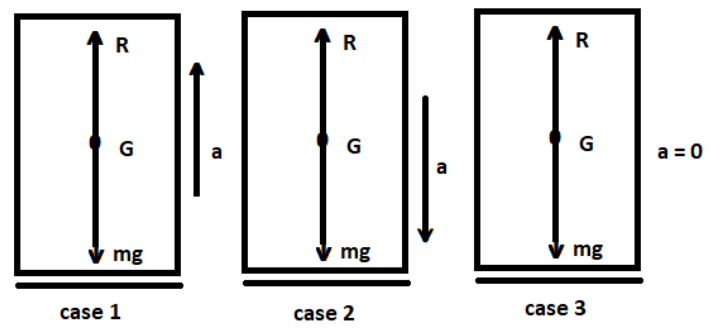
And now we can see in all three situations that a body 's apparent weight can be positive, can be negative, and can be null.
So choices (A), (B ) and ( C) are the correct responses.
Note: Whenever we ask questions of this type, we need to know the concept of force and apparent weight first. Then we are going to consider a situation and we're going to make some cases to prove that statement. Before that, we can define the importance of the apparent weight by using those examples. Through that, we can get the response we need.
Complete step-by-step solution -
Apparent weight is a property of objects that corresponds to how heavy an object is. The apparent weight of an object will differ from the weight of an object whenever the force of gravity acting on the object is not balanced by an equal but opposite normal force.
We know the apparent weight is a property of objects relating to the heaviness of an object.
Imagine a mass m man standing on a weighing machine mounted in a lift. The Man's real weight is mg. It acts downward vertically through the man's center of gravity G, it acts on the weighing machine which offers resistance R. The weighing machine reads the R reaction, and which is the man's power. So, R is the man's apparent weight.
Now we are going to be making cases.
Case 1: If the lift is going up with acceleration a.
The net force on the man is upward, R - mg = ma
\[\therefore \] Apparent weight, R = m(g + a)
So the man's apparent weight inside it increases when the lift accelerates upwards. That means it can be good to weigh apparently.
Case 2: If the lift is going down with acceleration a.
The net downward power on the man is, mg – R = ma
\[\therefore \] Apparent weight, R = m( g – a ).
And as the lift accelerates downwards, the man's apparent weight within it diminishes if a value increases and is more than g then the man's apparent weight inside the lift is negative.
Case 3: When lift falls freely.
When the lift free falls below due to gravity. Then a =g.
On the man the net downward force is,
\[\therefore \] R = m( g - g ) =.0
And the man's apparent weight gets zero.
And now we can see in all three situations that a body 's apparent weight can be positive, can be negative, and can be null.
So choices (A), (B ) and ( C) are the correct responses.
Note: Whenever we ask questions of this type, we need to know the concept of force and apparent weight first. Then we are going to consider a situation and we're going to make some cases to prove that statement. Before that, we can define the importance of the apparent weight by using those examples. Through that, we can get the response we need.
Recently Updated Pages
Which will be the least stable resonating structure class 11 chemistry CBSE

How many 5 digit telephone numbers can be construc-class-11-maths-CBSE
How do you find the angle of the resultant vector class 11 physics CBSE
Draw labelled diagram of the following i Gram seed class 11 biology CBSE
1 Quintal is equal to a 110 kg b 10 kg c 100kg d 1000 class 11 physics CBSE
What is the need and importance of classification class 11 biology CBSE
Trending doubts
Find the value of the expression given below sin 30circ class 11 maths CBSE
One Metric ton is equal to kg A 10000 B 1000 C 100 class 11 physics CBSE
10 examples of friction in our daily life
Draw a diagram of a plant cell and label at least eight class 11 biology CBSE
Difference between physical and chemical change class 11 chemistry CBSE
Proton was discovered by A Thomson B Rutherford C Chadwick class 11 chemistry CBSE